Showing posts with label liquid. Show all posts

Saturday, February 8, 2014

A 2-Tablespoon Freshwater Tap every 12 feet!

Seeing IS Believing except when the subject is freshwater. We usually conclude that there is no water when we cannot spot any where we are looking.
Water in Air Is nearly all in Vapor Form
The moisture in the air is essentially in vapor form and our naked eyes cannot see any gas or vapor.
Clouds are visible to us because of the liquid water droplets that are dispersed in the air that makes up the cloud.
Fog is another example of us being able to see the moisture in air because some of this water exists in liquid form.
An Air-Moisture Map
Water Vapor in the Air Around Us
Source - wateronline.com
NOAA/ESPL have mapped the moisture in the air we breathe i.e. in the air at sea level.
The average water content of this air - the air all around us and the air we breathe - varies from a low of approx 2.4 grams per cubic meter to a high of approx. 24 grams per cubic meter. The maximum amount can even exceed 26 grams per cubic meter but this concentration exists in only a very few places.
Water Amounts in Air
Tablespoon of water
Source - theguardian.com
Using the conversion (1 cubic centimeter (cc) of water weighs 1 gram) the moisture in 1 cubic meter of air varies from approx one-sixth of a tablespoon to over One-and-a-half tablespoons.
Thus, approx. 16 cubic meters (565 cubic feet) of air contain a cup (16 teaspoons) of water. Or, the air in an average sized room 8.5 feet high, 12 feet wide and 12 feet long contains a bit more than 2 tablespoons of safe water! 

All that remains to be accomplished is to capture this water for local use. Isn't this a challenge worth overcoming?

Saturday, November 30, 2013

Why is Steam White?

Ever wonder why you cannot see the water vapor in the air around us?
Water in Vapor form
Source - scienceprojectideasforkind.com
Water molecules when in vapor form are transparent.
That's one reason why we cannot see the moisture in the air.
Another, of course, is the tiny size of water molecules, so tiny that our eyes cannot make them out or the loose chains that they form.
Yet another, is that the vapor molecules are randomly arranged and so present no discernible shape to the human eye.
Water Molecules in Liquid Form
Source - crazykitcheninventions.co.uk
Steam is essentially a lot of liquid water molecules suspended in a mixture of air and water vapor molecules.
As light rays that hit these randomly arranged liquid water molecules is a mixture of all colors (i.e. white light), the light exiting from the many liquid molecules appears as white - the color we attribute to steam.
If a different color light, say, red were to be falling on steam, the steam would appear to be red in color.

Saturday, September 7, 2013

Freeze Sea-Water to Convert it into Freshwater?

As sea water freezes, dissolved salt is excluded, and the resulting ice has much less salt in it compared to sea water. Repeated recycling between solid and liquid can eliminate virtually all the salt in sea water.
Salt content of different waters
No water is totally free of salt. Sea water has a typical salinity of 3.5%.
Water salinity based on dissolved salts
Fresh waterBrackish waterSaline waterBrine
< 0.05%0.05% – 3%3% – 5%> 5%
Crystal Structures
Ice and salt crystals have very different structures in solid form:
Crystalline Structure of Ice
Source - ps.uci.edu
Crystalline structure of  Salt
Source - webelements.com
Ice has a hexagonal (six-sided) structure while salt has a cubic (four-sided) structure. It is primarily due to this structural differences that salt and water separate during the freezing process.
The Freezing Process
As pockets of sea water start freezing, the crystalline structure of frozen water begins to appear which pushes salt molecules away to produce water pockets rich in salt (aka brine solution). As the salt-free water freezes, the brine solution resists freezing because its high salt content has lowered its freezing temperature.
As ice freezing continues, this brine solution, essentially, leeches out from the water crystals leaving behind water whose salt content is much lower than that of sea water.
Freezing speed, if fast enough, can trap some salt molecules inside ice crystals but these are gradually released as ice crystals reach for their steady state.

Saturday, April 27, 2013

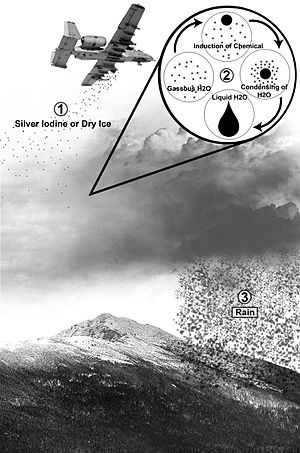
Rain and Snow from Cloud Seeding

Cloud seeding is done to increase precipitation in areas where extreme drought or long-term scarcity conditions exist.
Typical inorganic seeding nuclei
Cloud Seeding
Source - en.wikipedia.org
Most seeding procedures use inorganic particles or artificially produced organic particles.
AgI Molecule
Source- axcessbio.com 
Silver Iodide (AgI) is a commonly used inorganic condensation nuclei.
Dry Ice (solid Carbon dioxide) is another inorganic nuclei commonly used.
Artificial Precipitation Process
Precipitation Process
Source - en.wikipedia.org
For rain to fall upon demand i.e. for artificial cloud seeding to work, the air needs to contain super-cooled water. Super-cooled water is liquid water colder than zero degrees Celsius.
Silver Iodide has a crystalline structure very similar to that of ice and it is assumed that existence of this structure induces freezing temperatures that convert water vapor into super-cooled liquid water.
Dry ice achieves the super-cooling effect by its expansion that in turn super-cools water vapor.
Rainmaking using silver iodide or solid carbon dioxide both require existence of liquid droplets in super-cooled air.
These initially miniscule liquid droplets serve as the base for liquid and ice droplets to grow to a size large enough that they end up falling to the ground.
Cloud Seeding Goal
Lots and lots of rain is the goal of cloud seeding. Humanity cannot, however, capture much, if any, of this rain and, typically must wait for hydrological processes that add this artificially produced rainwater to existing reservoirs of liquid water that are water is being drawn water from.
Obviously, cloud seeding is an option for supplying multiple acre-feet of water rather than the few liters each individual requires.  

Saturday, April 6, 2013

Cotton Fabric That Absorbs Water From Air?

We know that moisture in the air is 2% in liquid form and 98% in vapor form. This ratio improves a bit - by another 1% or so - in favor of liquid water when a mist or fog rolls around.
For some reason, humanity has continued to focus on capturing the liquid water in air while there is no research on capturing the water that exists as vapor.
Now word comes of a new polymer that does just that.
What's a polymer?
A Polymer (multiple copies of the same unit
Source - ec.europa.eu
Covalent Bond
Source - en.wikipedia.org
A polymer is a compound whose structure is characterized by copies of the same units connected by covalent chemical bonds. A polymer, thus, is a collection of a number of copies of the same unit. 
The covalent bond is the sharing of two electrons between a carbon and a hydrogen atom that each contribute one electron to the coupling.
The New Polymer PNIPAAm
PNIAAm cotton fabric
Left (closed structure at high temperatures)
Right (open structure at low temperatures)
Source - Endoven University
Researchers at Netherland's Endoven University of Technology and at Hong Kong Polytechnic University have together created a new polymer they call PNIPAAm.
When this polymer is applied to cotton fabric, like a cotton shirt, the resulting combination is much more absorbent of liquid water from the air, than is the cotton alone.
The combination can absorb as much as 340% of the cotton weight of water. Cotton alone absorbs about 18% of its weight of water.
Key area of continuing research is the temperature at which the combination starts absorbing and releasing water and building actual clothing to check how the results from the test-beds pan out.

Saturday, March 2, 2013

Lots and Lots of Water in the Atmosphere!


Total moisture in the atmosphere
In total there exists, at any one moment, 12,900 cubic kilometers of water in the atmosphere. 
Liquid water in air
98% of this moisture exists as vapor while 2% exists as liquid i.e. there are:
~ 258 cubic kilometers of water in liquid form in the atmosphere, and
~ 12,642 cubic kilometers of water in vapor form in the atmosphere
Using 1 cubic kilometer = 2.64172052 × 10¹¹ US gallons, there are:
~ 681.56 x 1011 US gallons of water in liquid form in the atmosphere, and
~ 33,396.63 x 1011 US gallons of water in vapor form in the atmosphere
Moisture in air replenishment rate
All the moisture in the atmosphere is, however, replaced every 9 days i.e. 12,900 cubic kilometers of water is delivered to the surface of the Earth from the atmosphere every 9 days i.e.
~ 681.56 x 1011 US gallons of liquid water falls on Earth every 9 days, and
~ 33,396.63 x 1011 US gallons of vapor water falls on Earth every 9 days
Water deposited on Earth from the atmosphere every day
~ 3,787 x 1011 US gallons every day
For a 10 billion human population, this is ~ 37,870 US gallons/person/day
What's behind global water scarcity?
Recognizing that ~ 37,870 US gallons/person/day is just NEW water and does not include water from rivers, lakes, underground aquifers and other sources, the question arises:
Why do we have a water scarcity issue in most places around the globe, today?
Granted, we cannot capture every, or even most, drops for humanity's use, water scarcity remains a challenge for human ingenuity in two ways: How do we capture precipitation in locations that nature chooses and how do we transport the collected water to where we want or desperately needs to have it?

Saturday, February 2, 2013

Lightening Requires Liquid Water!

Without water in the atmosphere, there would be no lightening
Positive and Negative Electrical Charges
A Positive Charge
(A lack of Electrons)
Source - Wikipedia.org
A Negative Charge
(An excess of Electrons)
Source - Wikipedia.org
Excess or shortage in electrons determine the charge of an object.
An excess of electrons makes an object a negatively charged object.
A shortage of electrons makes an object a positively charged object.
Location of charged Water in air
Water droplets (liquid) with positive charges stay higher up in the atmosphere. Water droplets with negative charge stays lower in the atmosphere.
Separation of Charges Causes Charge Movement
Lightning is a transfer of electrostatic charges between oppositely charged regions of the sky in an attempt to equalize charges in these regions or the transfer of electrostatic charges between a cloud and the surface of the Earth.
Lightening locations
Lightning frequency map
Source - wikipedia.org
Lightening does not occur everywhere on Earth.
Most lightning occurs over land and in areas where convention currents in the air are the greatest as these currents promote separation of areas that contain oppositely charged droplets of liquid water.
The caution to stay away from water when there is atmospheric movement in charges, thus, makes excellent sense!

Saturday, November 17, 2012

How does Water exist in Air?

Water molecules in the air exist like sand, salt and sugar molecules exist in a salt-sand-sugar mixture. The compound H2O is free and stands alone like a component in a physical mixture not as a component in a chemical mixture
A mechanical Mixture
Each component stands apart
Source - tojojoling.blogspot.com
Each piece stands apart
Source - cookteen.com
In a mechanical mixture, each component exists separately from every other component.
In a mechanical mixture, each component can be separated from all other components through a process akin to separating all the pasta or the red candy.
Air is a mechanical mixture of elements and compounds
Elements in the air include:
Gas
Ratio compared to Dry Air (%)
Chemical Symbol
By volume
By weight
Oxygen
20.95
23.20
O2
Nitrogen
78.09
75.47
N2
Hydrogen
0.00005
~ 0
H2
Argon
0.933
1.28
Ar
Neon
0.0018
0.0012
Ne
Helium
0.0005
0.00007
He
Krypton
0.0001
0.0003
Kr
Xenon
9 10-6
0.00004
Xe
Source - http://www.engineeringtoolbox.com/air-composition-d_212.html
Compounds in the air include:
Water, Carbon Dioxide, Sulfur dioxide, Methane, Nitrous oxide, Ozone, Nitrogen dioxide, Iodine, Carbon monoxide and Ammonia
Water exists in the air in 2 forms
The water in air exists in two states: about 2% exists in liquid form while the remaining approx 98% exists in liquid form.
The task of extracting water from the air is mostly a task of extracting the vapor form of water from the air.

Saturday, February 18, 2012

Can Motion Assist in Changing Water Vapor Into Liquid Water?

Water differs from every other resource (except, maybe, air) in that water is the only resource that needs motion to maintain its authenticity. Water's need to be in motion is so great that water seems self-driven to move - movement is ingrained in water; talking about water implies talking about something that is always moving.
Still Waters Run Deep
Rocks revealed in a flowing river
Source - alaska-in-pictures.com
Still Water
Source - me.ncrs.usda.org
This proverb commonly means that a person showing a calm exterior should be handled with caution because the calmness does not reveal anything (positive or negative; good or bad; liked or disliked) about that person. This proverb's origin is the observation that moving water reveals a lot about what's in the water while stagnant water does not reveal any information and, thus, anything dangerous will not be known.
Stagnant water
Source - warrencountymosquito.org
Stagnant water holds a severe risk to health of humans. Living hazards (to humans) breed profusely in water that is not in motion.
We seem to be programmed to avoid stagnant water through its impact on our senses: stagnant water is cloudy and we cannot see what's in it; stagnant water has a foul smell; We can also usually see dirt and debris on the surface of a body of stagnant water
Whirlpools
Water never moves in a straight line especially when flowing through narrow paths. Water molecules seem to fight each other to move into the space that a molecule in front of them vacates as it moves forward. 
A top view of a Whirlpool
Source - dailymail.co.uk
This "fight" between water molecules, to move into the vacant space before them, somehow initiates the spinning motion unique to a whirlpool. Whirlpools occur in lakes, in rivers, in virtually every body of water. All that is required is for the water to be moving. This movement most commonly occurs under the influence of gravity.
A Whirlpool as it appears from below
Source - spiralwishingwells.com
And doesn't the underside of a whirlpool look too much like a tornado?
Moving between States
Motion Changes Water between solid,liquid and vapor
Source - rmbel.info
Earth's Water Cycle uses motion to transform water between its three states: solid, liquid and vapor. 


Can we utilize movement to change water vapor in the air we breathe into liquid form whenever and wherever we choose to do so?

Saturday, January 28, 2012

Freshwater - A Singular Resource

Singular, according to the American Heritage Dictionary, means "Being only one; individual, Deviating strongly from the norm." Yes, water, and in particular, freshwater is unlike any other resource.


Water is MORE than just another Commodity
Commodities
Source - tradecommodity.com.au
Water is a commodity in the sense that it is a material that can be bought and sold. 
Being basic to all life is what makes water a commodity with a difference.
Not only was water the medium for incubating life, water is also continuously required for sustaining and maintaining life.
We cannot, therefore, just think of buying and selling water - we must also factor in how humans, all other living species and nature's ecosystems are impacted by us moving water around.


Water is Distributed WORLDWIDE
Freshwater Distribution
Source - rusrev.org
Water is the most widely distributed substance on Earth. It is available everywhere. While the specific amount of water differs in different locations, there is no place on Earth with, literally, no water.
All other natural resources are also widely distributed, but each and everyone is not available everywhere even in the smallest of amounts. Some amount of freshwater is available everywhere on Earth.


Water has NO Substitute
There is no other substance, natural or synthetic, that can replace water. It is hoped that the world will migrate away from fossil fuels to renewable energy. No such transition is possible with water.


Water exists simultaneously in multiple forms: Vapor, liquid and solid
3 forms of water
Source - fcwa.org
No other resource exists in more than one form in the same location. Huge amounts of water are also bound into soil and other materials in every location.
Every other resource exists in a single form, usually as a liquid, in the same location.


We cannot MAKE new water
Periodic Table of Elements
Source - elementsdatabase.com
We humans cannot make any element of the periodic table or the basic compounds that combinations of these elements form in nature.
Water formation Equation
Source - scienceforums.net
Making water is a particularly tough proposition because of the amount of energy released. We simply have no way of containing this energy release.


We cannot DESTROY water
When we burn oil, no more oil remains, as the oil disintegrates into different chemical compounds.
Water, on the other hand, does not ever disintegrate into its components. Water gets polluted, changes color, acquires an odor or simply evaporates into the atmosphere or disappears into the ground.


Water is in Constant MOTION
Water Cycle
Source - kidzone.ws
Unlike every other natural resource, water is in constant motion. It is constantly moving between its three forms - from liquid to vapor, from vapor to liquid, from solid to liquid and every other possible transformation. Water is always moving in rivers and churning in lakes and oceans.
NO other natural resource exhibits this perpetual motion behavior. 


Water's Singularity
Water's perpetual motion, it's simultaneous existence in multiple forms, it's availability everywhere and its role as the basis for all life make it singularly unique.


We seem to want to treat water in ways similar to how we think and act with other resources. This may be our greatest error in dealing with water, and especially, finding ways to alleviate water scarcity everywhere on Earth.


We should, instead be looking at harnessing the unique characteristics of water to end water scarcity everywhere on Earth.