Showing posts with label ice. Show all posts

Saturday, May 4, 2013

The Darker a Cloud the Stronger the Rain!

We all know from experience that the darker a cloud the stronger the rainstorm it will produce. 
Cloud Color and Rain Amount
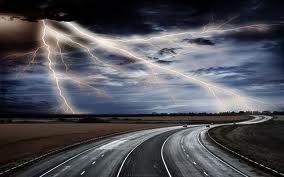
Dark Clouds
Source - wallpapersget.com
From experience we know that there is a very strong correlation between the color of a cloud and the amount of rain it produces:
- the darker a cloud, the more rain we expect to get
or,
- the lighter (with the lightest being the whitest) a cloud the less rain likely.
Particulate Density
All clouds contain particles.
Light Scattered by Particles
Source - http://www.cas.manchester.ac.uk
When sunlight passes through a cloud it gets scattered by these particles.
The more light scattered the less light emerges from the bottom of the cloud - the bottom is what we see and use to describe the cloud as a dark one or a light one.
Light scattered by a cloud
Source - tutorvista.com
Water Droplets and/or Ice Crystals
In addition to particles, clouds contain water droplets and/or ice crystals. These droplets and crystals also disperse the sunlight that falls on the cloud from above. As the density of these droplets and crystals increases, less and less sunlight is able to penetrate the cloud. This lack of penetrations darkens the color of the cloud.
So what we know from experience is true: The darker a cloud, the stronger the rain falling from it because it contains more water droplets and ice crystals

Saturday, April 27, 2013

Rain and Snow from Cloud Seeding

Cloud seeding is done to increase precipitation in areas where extreme drought or long-term scarcity conditions exist.
Typical inorganic seeding nuclei
Cloud Seeding
Source - en.wikipedia.org
Most seeding procedures use inorganic particles or artificially produced organic particles.
AgI Molecule
Source- axcessbio.com 
Silver Iodide (AgI) is a commonly used inorganic condensation nuclei.
Dry Ice (solid Carbon dioxide) is another inorganic nuclei commonly used.
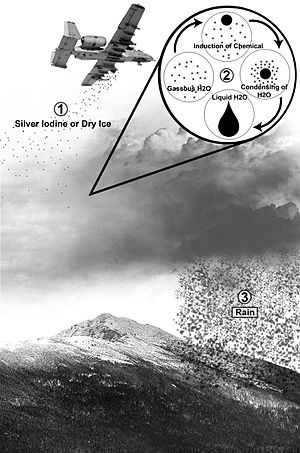
Artificial Precipitation Process
Precipitation Process
Source - en.wikipedia.org
For rain to fall upon demand i.e. for artificial cloud seeding to work, the air needs to contain super-cooled water. Super-cooled water is liquid water colder than zero degrees Celsius.
Silver Iodide has a crystalline structure very similar to that of ice and it is assumed that existence of this structure induces freezing temperatures that convert water vapor into super-cooled liquid water.
Dry ice achieves the super-cooling effect by its expansion that in turn super-cools water vapor.
Rainmaking using silver iodide or solid carbon dioxide both require existence of liquid droplets in super-cooled air.
These initially miniscule liquid droplets serve as the base for liquid and ice droplets to grow to a size large enough that they end up falling to the ground.
Cloud Seeding Goal
Lots and lots of rain is the goal of cloud seeding. Humanity cannot, however, capture much, if any, of this rain and, typically must wait for hydrological processes that add this artificially produced rainwater to existing reservoirs of liquid water that are water is being drawn water from.
Obviously, cloud seeding is an option for supplying multiple acre-feet of water rather than the few liters each individual requires.  

Saturday, April 28, 2012

Lot's of Freshwater, But NOT WHERE It's Needed

Precipitation, commonly called rain, the predominant source of freshwater, is more than enough for a 10+ billion human population plus the other species and nature's ecosystems that must have freshwater.
Rainfall
Source - countryofsb.org
From the very beginning, rain has supplied the freshwater needs of human, other species and nature's ecosystems in two ways: 
- Either, by dropping manna-from-the-heavens directly onto crops and where the freshwater was needed and/or 
- Replenishing lakes and other bodies tapped by humans, other freshwater species and nature's freshwater ecosystems.
Total Rainfall on land
Source - sciencemag.org
A total of 98,500 cubic kilometers of rain is estimated to fall on land every year.
This liquid precipitation is in addition to the 12,500 cubic kilometers that fall as ice and snow on land.
Ignoring for a minute that this rainfall in not geographically uniform and that it has extreme spacial and temporal variations, the 98,500 cubic kilometers/year
= 270 cubic kilometers/day
As 1 cubic kilometer = 264 billion US gallons,
the average rainfall of 270 cubic kilometers/day
= 71,280 billion US gallons/day
For a 10 billion human population (the projected human population in 2050), this rainfall
= 7,128 US gallons per day.
Why Freshwater Scarcity?
Ignoring freshwater accessed over long distances from surface bodies (lakes, rivers, etc) and underground aquifers, with so much rainfall available per person per day, why do we have scarcity anywhere in the world?
The answer: Scarcity is the result of rainfall not being uniform all over Earth's land mass and the unpredictable spacial and temporal variations of rainfall.