Showing posts with label rainfall. Show all posts

Saturday, May 25, 2013

The Problem of Safe Water - The Lernaean Hydra?

Could Greek mythology's water serpent, the Lernaean Hydra, be is an excellent model to define our problem of Safe water aka freshwater?
The Lernaean Hydra
Lernaean Hydra
Source - eaudrey.com
The Hydra was the guardian of the Underworld and lived beneath the waters of a lake, the Lake of Lerna. It was shaped like a serpent with its heads its unique feature: It had multiple heads and would grow two heads for every one head that was cut off. One of the Hydra's heads was called the Immortal Head because it could not be cut off.

Heraces
(silver sculpture from the 1530s)
Source - wikipedia.org
Heracles (Hercules, to us) was charged with the task to kill the Hydra. He initially tried cutting off individual heads but saw two new heads replace those he chopped off.
Eventually he did figure out a way to kill the Hydra. Maybe, Heracles' solution shows us the way to solve the problem of safe water - more on this in the next blog post.
Constant Amount of Freshwater Precipitation 
Precipitation in rain, snow and other forms is the only act of nature that makes safe drinking water (aka freshwater) a renewable resource.
Annual Precipitation
Source - http://hypertextbook.com/facts/2008/VernonWu.shtml
The aggregate global annual freshwater precipitation has stayed more-or-less constant over time - it has never changed in an amount that might give us reason to classify freshwater as a nonrenewable resource! 
Variability in annual amount is not significant by any measure.
Whatever action humanity may take, this cycle of aggregate precipitation continues unabated. So there would conceivably not be a water problem at all unless we are missing something
India precipitation change
Source - delayedoccilater.wordpress.com
Changing precipitation patterns
Change in US precipitation
Source - meted.ucar.edu
Change in Africa precipitation
Source - scrippsblogs.ucsd.edu
This missing something is variability in local rainfall, snowfall and other deposits of freshwater i.e. the variability in aggregate precipitation at any single location. 
The problem of safe water is, thus, characterized in the changes that surface when we examine local changes in precipitation patterns.
How is the Problem of Freshwater a Hydra?
Our global precipitation amount is the body of the Hydra that doesn't change while the heads are the local problems that are as many as places where people live and work - a new factory needs additional safe water but may end up polluting a local stream from where we used to get freshwater; a city grows in population that requires the city fathers to build a new aqueduct to transport safe water from hundreds of miles away; simply look at any local community for its future vulnerabilities to its existing safe water supplies!
Like the Hydra of Heracles, our Hydra of freshwater supply grows a new head - usually too many multiple new heads - whenever local precipitation levels change beyond humanity's ability to counter that change with a compensating change in demand.
The Challenge of Safe Water
Humanity's ability to cope at the local level with the variability of nature's continuously renewed safe water supply is our primary challenge that can rip apart the foundations of our societies everywhere in the world, once again, in the 21st century.

Saturday, February 16, 2013

Rainfall Predictions Possible With Cell Phone Technology

Knowing how much rain falls on a location is key to determining if any unfilled thirst remains unfilled at that particular location. Unfortunately, however, knowing actual rainfall amounts has always been a very difficult task.
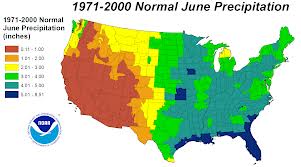
Typical Precipitation Map
Source - climatecentral.org
Resolution of data that makeup such a map is, at best, around 50 miles and is possibly as high as 100-200 miles. This data is gathered from rain gauges installed every 50, 100 or larger distances apart.
We are, however, very well aware that rainfall amounts are not usually similar or identical over a 50 mile or a 100 mile or a 200 mile square of area.
Using rainfall data from this map can lead to incorrect conclusions: thirst experienced by some farms can be overlooked, or, some farms that don't experience thirst can be targeted for additional water supply. In either case, resources expended to deliver water (safe for irrigation) will end up being misspent.
Radar Maps
Source - weathercentral.com
Doppler radar have better resolution that do rainfall data maps.
However, the installed base of Doppler radar sites are predominantly around major cities and population centers. Doppler radar, thus, provides us with high resolution rainfall maps in and around cities.
Farms or other remote agricultural locations have few of these radars and thus assessing their thirst is a problematic task
Towers (for mobile phones) may hold the answer!
For cell phones to work, microwave transmissions are relayed between individual towers. 
These microwave signals, between towers, are transmitted at a known constant strength that allows for signal decay over distance and for known weather conditions that might reasonably be anticipated. For a particular weather condition, the rate at which this signal falls off (or deteriorates) can be predicted for any set of towers.
When liquid water is in the air (i.e. it is raining), however, the signal between towers drops (is weaker) because a part of the signal is reflected off raindrops and does not make it to the next tower.
Depending upon terrain, towers can be just 1-2 miles apart.
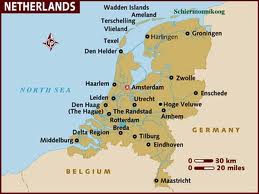
The Netherlands Experiment
Source - lonelyplanet.com
Netherlands, the country, has just 32 rain gauges, but about 8,000 mobile phone towers.
An algorithm has been developed that measures differences between normal (no rain) signal strength and signal strength when it rains.
An experiment was run, in September 2011, to see how well signal monitoring could measure actual rainfall amounts.
This test, conducted with data from just 2400 cell towers, mapped rainfall amounts very close to the measurements from a combination of radar and rain gauges.
Thirst in the Developing and Underdeveloped worlds As cell phones, and the towers that enable them, have become commonplace all over the developing and underdeveloped world, its a simpler step to use cell phone signals to measure and predict rainfall amounts in real time. The traditional alternative, involving radar and rain gauges, may not be necessary any more.

This post was inspired by an article in The New Scientist magazine

Saturday, September 1, 2012

Freshwater's Supply Chain is Unlike that of Any Other Resource!

Freshwater is a resource like no other. While differences between freshwater and other renewable and non-renewable resources are many, freshwater's supply chain makes freshwater a most unique natural and renewable resource. Nature delivers freshwater in ways it doesn't do for any other resource. 
Freshwater's Current 3-Source Supply Chain
Source - willoughby.nsw.gov.au
3 sources of freshwater exist for most human settlements. These are:
1. Rainwater that naturally falls on the settlement
2. Freshwater transported from near and far locations  to the settlement, and
3. Locally obtained water, usually from a combination of sources located at ground level (e.g. rivers and lakes) and below ground (e.g. wells that tap the local water table).
Some locations do not, of course, have all 3 sources available to them -  but most do, because this 3-source approach was seen as the most prudent and dependable one.
Threat's to the 3-Source Supply
All three sources can be threatened today in a variety of ways for human settlements in different locations:
1. Climate change has impacted the frequency, amount and location of rainfall.
2. The ability to bring water from remote locations is threatened by both dwindling resources at the remote location and the assertion of communities along the transportation route to the freshwater being transported.
3. Continued extraction of groundwater has lowered water table levels, in some cases to depths that are difficult to access.
Rainfall - Resource delivery on a near-regular schedule
Source - diswaterdrams.com
Other than freshwater, nature delivers no other natural resource on a fairly regular schedule to locations where the resource may also be ingeniously available in bulk. 
Delivery of freshwater as rain was probably of little value while humans were migrating all over the globe. Rainfall's value only became evident about 10,000 years ago, when humans chose to settle down in one place (and grow the food they needed) instead of moving around in search of food. Humans, in a sense, became dependent on rainfall at the start of the agricultural age.
Rainfall Dependency
Once reliant on rain to grow their food, humans became subject to the impacts of any change in rainfall delivery frequency, amount or location. And it is, in large part, this dependency that is shaping a crisis in freshwater supply - supply of rain is simply too undependable.
The one unique feature that defines freshwater delivery is today the one unique force behind freshwater scarcity and water security.


Saturday, July 14, 2012

Where On Earth Is the Water?

Ocean-water dependent species and ecosystems have two luxuries that freshwater-dependent species and ecosystems lack:
- Ocean-water exists in one BIG connected mass distributed all over the world. Freshwater exists in multiple locations all over the world
- Ocean-water exists mostly in just one form: as a liquid; Freshwater, however, exists in vapor (e.g. as a gas), liquid and solid (e.g. as ice) form
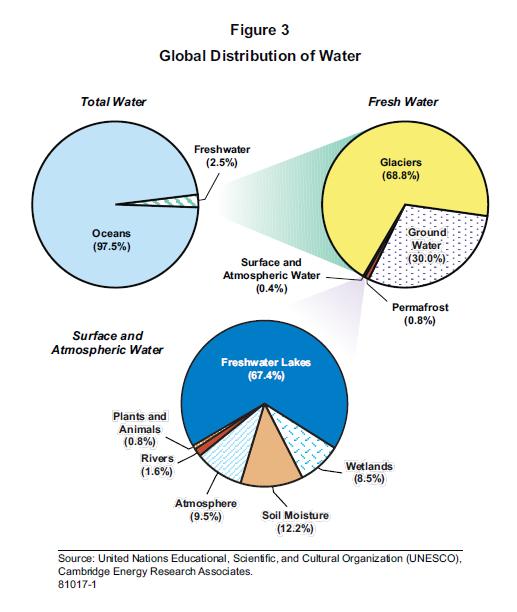
Global Distribution of Water
Water covers much of the Earth's surface:
- Ocean-water is the predominant (97.5% of the total) variety.
- Just 2.5% of the total water on Earth is freshwater. 
Freshwater Locations
Ignoring movement of freshwater between various deposits of freshwater on Earth, Freshwater exists in 8 locations:
- In glaciers as ice and in liquid form
- As groundwater in underground aquifers
- In Freshwater lakes
- In wetlands
- Dissolved in soil
- Suspended in the atmosphere
- In flowing rivers, and
- In plants and animals
Historical Sources of Freshwater
There are two types of sources that humankind has tapped for its freshwater needs:
A. Freshwater Bodies
Freshwater lakes, wetlands and rivers were humankind's earliest sources of water. These sources are still major sources of freshwater because they are continuously replenished. We may choose to extract freshwater at rates greater than the replenishment rate, but that is another subject.
Plants were probably a major source of freshwater for humanity, because all food contains freshwater. With the harnessing of agriculture (about 10,000 years ago) and the resulting improvement in diet, humans get a lot of their required freshwater from the food they eat and digest.
B. Water moving between bodies of freshwater
While all water is always in continuous motion, Evaporation and condensation are the primary ways freshwater moves between different freshwater bodies. 
Tapping New Sources of Freshwater
Of the 8 freshwater bodies, the single ocean-water body and the ways water moves between these bodies, there are only 6 possible new sources of freshwater:
1. The freshwater in the atmosphere is nearly 5 times MORE than the freshwater in all the rivers on Earth.
2. The freshwater in soil is nearly 6.6 times MORE than the freshwater in all the rivers
3. The freshwater in plants and animals
4. Artificially converting seawater into freshwater i.e. desalination.
5. Making freshwater from scratch - our bodies make between 300 and 400 ml of freshwater per day through the biological process of metabolism - hence our name for this water is "metabolic water"
6. Catching freshwater as it moves from one source to another - Rainfall is the predominant such source.
Increasing Freshwater Supplies
In addition to the above 6 choices, there exists, of course, the option to use less water by recycling used water, increasing water use efficiency and reducing the amount of water that is wasted.
The Task Before Us
Which of the above 6 "new sources" of freshwater and using less water should we focus on and why?

Saturday, April 28, 2012

Lot's of Freshwater, But NOT WHERE It's Needed

Precipitation, commonly called rain, the predominant source of freshwater, is more than enough for a 10+ billion human population plus the other species and nature's ecosystems that must have freshwater.
Rainfall
Source - countryofsb.org
From the very beginning, rain has supplied the freshwater needs of human, other species and nature's ecosystems in two ways: 
- Either, by dropping manna-from-the-heavens directly onto crops and where the freshwater was needed and/or 
- Replenishing lakes and other bodies tapped by humans, other freshwater species and nature's freshwater ecosystems.
Total Rainfall on land
Source - sciencemag.org
A total of 98,500 cubic kilometers of rain is estimated to fall on land every year.
This liquid precipitation is in addition to the 12,500 cubic kilometers that fall as ice and snow on land.
Ignoring for a minute that this rainfall in not geographically uniform and that it has extreme spacial and temporal variations, the 98,500 cubic kilometers/year
= 270 cubic kilometers/day
As 1 cubic kilometer = 264 billion US gallons,
the average rainfall of 270 cubic kilometers/day
= 71,280 billion US gallons/day
For a 10 billion human population (the projected human population in 2050), this rainfall
= 7,128 US gallons per day.
Why Freshwater Scarcity?
Ignoring freshwater accessed over long distances from surface bodies (lakes, rivers, etc) and underground aquifers, with so much rainfall available per person per day, why do we have scarcity anywhere in the world?
The answer: Scarcity is the result of rainfall not being uniform all over Earth's land mass and the unpredictable spacial and temporal variations of rainfall.

Saturday, April 7, 2012

Every Water Is Not The Same!

We all are quite familiar with the salty taste of ocean water compared to water deposited by rain and water streaming out of a faucet. Another difference may help us tap on-demand, the oldest freshwater source on Earth.
The Ocean in the Atmosphere
The hydrologic cycle maintains and continuously replenishes a vast ocean of freshwater in the air closest to the ground. This ocean is the source of all rain and snow, the dew we find deposited on our cars, dew deposited on the ground early in the morning and the moisture that appears on the outside of a cold glass. 
Isotope Hydrology
Change in isotope content during the hydrologic cycle
Source - ANTSO.gov.au
It is an established fact that water from different sources contains different number and types of isotopes.(see post dated Oct 15, 2011).
Isotope Hydrology is the new science that uses existence of isotopes to estimate age and origin of water in each stage of the hydrologic cycle.
What makes Isotope Hydrology most interesting is that it can map a "local" hydrologic condition to include an identification of the the origin and content of water in the local atmosphere.
Predicting & Catalyzing Precipitation
The primary cause of freshwater scarcity is continued lack of rain where and when we humans want and need it. Precipitation (mostly rain) directly waters our food crops, adds runoff to increase river flows and lake levels, and replenishes ground water reservoirs.
We could soon produce rain on-demand using Isotope Hydrology that can accurately measure the isotopic content of local air, compare it to conditions that produce rain and identify what changes are necessary to produce rain on demand anywhere on Earth!