Showing posts with label scarcity. Show all posts

Saturday, February 22, 2014

The Many Images Of Water Scarcity

Collecting Water
A primary face of scarcity is that of manually collecting water.
Source - thewaterproject.org
Source - peakwater.org
Source - rainharvest.co.za
Source - meerkat21.wordpress.com
Implicit in these images is the scare of water being unclean i.e. contaminated in some horrible way - the implication being sickness, illness and disease that will hit the people drinking this water.
Water Collection Takes Effort
Source - watertanksystem.blogspot.com
Another set of images mainly show
Source - mx.noticias.yahoo.com
the effort being required and being spent in the collection of water
Source - geographyblog.eu
which, hopefully, is safe for drinking 
e.g. walking long distances; a community-intensive task, a one-man unbelievable option, etc. 

Too Many People At The Same Source
Source - australianrain.blogspot.com
Scource - worldpulse.com
Source - newindianexpress.com
Images that show very large number of people involved in gathering water for a singe source imply scarcity e.g. a multitude of people encircling a single source (a well or tanker) of water, or a long line of people, each waiting for her/his turn to fill up a container with water.
Empty Water Sources
Source - balramranasingh.blogspot.com
Source - rttc.org
Low levels of water in water reservoirs or empty containers imply scarcity.


Parched Landscapes
Source - worldwildlife.org
Source - insideclimatenews.org
Land that shows the signs of having dried up and becoming cracked.


Saturday, November 2, 2013

Definitions Matter for Water Scarcity to be Seen as a REAL Issue?

Everyone sees every problem from their own perspective - a perspective built from mostly their understanding, experience and interests. And when many definitions exist, the probability of getting a consensus decreases. Maybe, this lack of a common definition is the cause of lackluster progress against water insecurity!
Different Ways to define Water Scarcity
Which Regions are Under Stress" has many answers!
Source: globalwaterforum.org
Why a consensus is necessary and matters is clearly seen in the result of applying differing (the following of many others) indexes to West Africa and Europe!
As the different colors clearly indicate, different approaches - to describe water insecurity- do lead to different conclusions and, thus, different actions will be deemed necessary to alleviate this insecurity.
Water security: for Who?
Source - oxforddictionaries.com
Whose insecurity is to be eradicated is complicated by the following kinds of competing interests:

  • Do the needs of people override the needs of the environment? Or must both go hand-in-hand?
  • Does the need of industry override the needs of agriculture?
  • When must human migration be the preferred option over staying put?
  • How do the needs of different human settlements sharing water resource sources get balanced?
  • ... ... ... 
  • ... ... ...
Water Stress Index
The regional adequacy of natural sources of water for the "population residing in the region" is measured for each person:

  • > 1700 cubic meters per person per year signifies NO Stress
  • < 1700 cubic meters per person per year signifies a population experiencing stress from inadequate water supplies
  • <1000 cubic meters per person per year signifies a population experiencing water scarcity
  • < 500 cubic meters per person per year signifies a population under dire scarcity
These Water Stress definitions lead to some interesting conclusions depending upon the geographical definition of "Region", e.g.:

  • If the "region" is the Whole Planet, then there is NO Stress
  • If the "region" is a Continent, there is NO Stress
  • If the "region" is a country, there may or may not exist enough stress worthy of remediation
  • ... ...
Virtually every scenario we can dream up can be identified through the application of the numerical criteria underlying the definition of Water Stress!
Water Demand-vs.-Supply Index
In recognition of the fact that different people use different quantities of water, this index looks at regional water insecurity as defined through unmet need e.g.:
  • If water demand is <20% of the supply, the region has NO scarcity
  • If water demand is 20-40% of supply, the region is deemed water scarce
  • If water demand is >40% of supply, the region is deemed to be under severe scarcity
Usually applied at the country level, this index can be adapted to anyone's interests by including man-made water sources, by emphasizing recycling and a number of other actions.
Water Infrastructure Index
Having water resources but not being able to get our hands on the water is the perspective behind this index. 
Water Poverty Index
This approach factors in prosperity of the population in a selected region. As the definition of prosperity varies widely, this index is extremely complex and thus easily manipulated to support the interests of individuals preferring to use this Index.

Saturday, March 2, 2013

Lots and Lots of Water in the Atmosphere!


Total moisture in the atmosphere
In total there exists, at any one moment, 12,900 cubic kilometers of water in the atmosphere. 
Liquid water in air
98% of this moisture exists as vapor while 2% exists as liquid i.e. there are:
~ 258 cubic kilometers of water in liquid form in the atmosphere, and
~ 12,642 cubic kilometers of water in vapor form in the atmosphere
Using 1 cubic kilometer = 2.64172052 × 10¹¹ US gallons, there are:
~ 681.56 x 1011 US gallons of water in liquid form in the atmosphere, and
~ 33,396.63 x 1011 US gallons of water in vapor form in the atmosphere
Moisture in air replenishment rate
All the moisture in the atmosphere is, however, replaced every 9 days i.e. 12,900 cubic kilometers of water is delivered to the surface of the Earth from the atmosphere every 9 days i.e.
~ 681.56 x 1011 US gallons of liquid water falls on Earth every 9 days, and
~ 33,396.63 x 1011 US gallons of vapor water falls on Earth every 9 days
Water deposited on Earth from the atmosphere every day
~ 3,787 x 1011 US gallons every day
For a 10 billion human population, this is ~ 37,870 US gallons/person/day
What's behind global water scarcity?
Recognizing that ~ 37,870 US gallons/person/day is just NEW water and does not include water from rivers, lakes, underground aquifers and other sources, the question arises:
Why do we have a water scarcity issue in most places around the globe, today?
Granted, we cannot capture every, or even most, drops for humanity's use, water scarcity remains a challenge for human ingenuity in two ways: How do we capture precipitation in locations that nature chooses and how do we transport the collected water to where we want or desperately needs to have it?

Saturday, September 8, 2012

Perspective & Predictability Define Scarcity!

Source - cartoonstock.com
"One person's junk is another person's fortune" goes the old adage.
The difference between "junk" and "antique" is predominantly one of perspective.
Perspective is, of course, itself influenced by many factors that vary widely because these factors are very individual and extremely personal in nature.
It's much the same condition with safe drinking water:
- Those that have enough cannot see how they could ever do with less 
- Those that don't have enough seem to find a way to survive with what they can get
Of course those that can only get less than the necessary minimum suffer ill heath and other debilitating impacts.
Is piped water available 365/24/7 the definition of no scarcity?
Bathroom plumbing
Source - avivimprovements.wordpress.com
In the middle of the twentieth century, piped water was the norm not the exception for most of humanity.
Now, at the beginning of the twenty-first century, a large part of humanity does not get piped water 365/24/7 although all permanent houses have the necessary plumbing in place - for these house dwellers, supply of water may be intermittent or only available for a few hours a week on a unpredictable schedule.
Using the definition of 365/24/7 piped water supply, a large part of humanity already is experiencing scarcity with more people joining this group daily.
Perspective is ruled by Existing Circumstances
Esher's Waterfall
Source - en.wikipedia.org
Esher's depiction of a waterfall is a great example of perspective. Only people who happen to be in the left tower and in the big house on the left, are the ones who experience the waterfall.
The former see water dropping from where they are, while the latter see water falling to where they are.
For everyone else, water is simply moving at the same level as, of course, water cannot rise against gravity.
When asked if receiving freshwater 365/24/7 is necessary, most people who don't have 365/24/7 water supply do not label regular continuous unavailability a problem. From their perspective, they can live with much less than 365/24/7 piped water supply. 
The opposite is true for those that are used to having water run out of a tap when they turn the tap on. For them scarcity has arrived, if there is no water, even for a few seconds, running out of any tap.
Unpredictability creates scarcity
Women fetching water
Source - artwolfe.photoshelter.com
Those with and without continuously piped water agree on one thing: water availability must be predictable.
Once predictability is assured, scarcity disappears for most every individual wherever they may live and under whatever circumstances.
Take the case of people, mostly all of whom are women and girls, who make daily long difficult treks for drinking water.
In their minds, fetching necessary drinking water is just a necessary chore they must perform daily. That's just part of their life.
They don't even consider fetching water a burdensome chore. It is those with piped water that call fetching water an unnecessary and unfortunate chore.
What is the Absolute Minimum amount of freshwater for Humans?
Water Meter
Source - caes.uga.edu
Humans loose water when they breathe and when they perform virtually any movement. Even the process of being alive (not counting breathing, uses up water.
At a United Nations conference in 1977, it was decided that an average human being requires 3 liters (3.2 quarts) of water under average conditions i.e. an person living in an average climate and doing the things that people do on an average.
But, of course, there is no average human being or average climate or average life condition. And, the 3 liters do not include water needed for cooking and sanitation and human hygiene.
Adding up these numbers in a practical way, the minimum required freshwater per capita is 50 liters (13.2 gallons) per day, it was agreed, for maintaining a person's body water balance and ensuring acceptable healthiness.
Is 50 liters/day/person truly enough?
Yes, if we ask those 2+ billion who live on less than 50 liters per day!
No, if we ask those that live on more than ten times the 50 liters per day!

So what's should be the freshwater supply target per head per day?

Saturday, August 11, 2012

Small Numbers and Water Sufficiency!

Small numbers, like everything else, when looked at without a framing context have no meaning at all and usually lead to the wrong conclusion. The oft-repeated statement "Only 2.5% of the water on Earth is freshwater" is factually correct considering the measurements and assumptions behind its quantification. But is it correct in implying that because 2.5% is a small number, it only represents a problem?
Lumps of Sugar
Source - blog.cytalk.com
If the question is: Are 2 lumps of sugar more than enough to feed all the ants in the world or would 600 lumps of sugar be adequate?
Source - twobitbard.weebly.com
The likely answer usually is: 600 lumps.
The primary reasoning behind this answer is the assumption that as 600 is more than 2, then 600 is likely to NOT be the wrong answer. And, as the convoluted logic goes, if it is less likely to be the wrong answer, then, of course, it is more likely to be right answer.
Source - clker.com
The other bits of assumption are what we know about how much sugar an ant requires and the actual size of each lump of sugar! And as we do not precisely know these bits of information, we go with the larger number i.e. 600 lumps while assuming the size of each sugar lump based on how large we think the spoon is. This spoon size is based on the spoons we usually use.
But what if each lump was 1kilometer long on each edge? And there were 150 Trillion ants in the world? Then too the larger number would be the answer, because the number is simply larger. Going with the larger number of 600 lumps is just safer because it is less likely to be wrong.
This logic applies also to freshwater supplies
Only 2.5% of the Earth's Water is Freshwater
Source - go.water.usgs.gov
What is the conclusion when we see the world's water (larger blue sphere) and freshwater in liquid form (smaller blue sphere), displayed relative to the size of the Earth? 
The 1st conclusion: We have very little water and even less liquid freshwater! (relative to the size of the Earth, of course)
The 2nd conclusion: We could quickly run out of freshwater! ... because see how little of it exists in comparison with the size of the Earth.
But what's our conclusion when we know the following:
The total amount of water on Earth is: 
- About 332,500,000 cubic miles (mi3) = 1,386,000,000 cubic kilometers (km3)
- The larger sphere is about 860 miles (about 1,385 kilometers) in diameter
The amount of Freshwater
If 2.5% of the total water is Freshwater, then the amount of freshwater is: 8,312,500 cubic miles (mi3) = 3,465,000 cubic kilometers (km3)
The size of these numbers makes it very difficult to reach a conclusion one way or another! Even conceptualizing how large (or small) a cubic mile is, is difficult for most of us.
The Takeaway
Small percentages do not necessarily imply insufficiency or sufficiency.
Much more analysis is required before we can judge if we are facing freshwater insufficiency or insecurity anytime in the near or far future.

Saturday, July 7, 2012

How Long is the Future? - When Water Is the Topic!

We each have a different idea of the time period we are looking at when we talk about the future! So how do we get the global community of people and nations to work together on freshwater scarcity from which only a few are immune?
How Long is the Future?
Source - blog.enerdynamics.com
An interesting description of the question comes from Eric Schmidt, Executive Chairman of Google: "Based on their professions, people have different answers to the question “How long is the future?” If you are a political leader it is 2 years, 4 tears or 6 years. If you are a government worker it is 2 weeks or even 1 week because the budget has not even been approved. If you are in a company where your bonus is paid out at the end of the year and that is a majority of your compensation, then that's your future. If you are a long term owner who is largely prevented from selling any of your shares, the owner has a very different definition of the future? Politicians, for example, see the future in increments of a few years, while those who have long-term equity in a company see the future differently."
Freshwater's Role
Source - en.wikipedia.org
Freshwater is at the HEART of everything artificial and many many natural creations on Earth.
Included in the artificial creations are not only physical things and what we call 'stuff' but also political, economic and social stability, each of which also depends upon how long a freshwater-secure future we seek or envision.
The "Future" in Development: NGOs, GOs and others
Unfortunately, each organization's definition of "Future" differs in the development community. Some may be looking till the end of their latest funded project; others may be working within the funding cycles of their benefactors; still others may simply be waiting for their funding to run out; other's still may be run out of a location by factors they simply cannot influence. The "future" is different for each entity. So how do we reconcile these different definitions of the future when we talk about safe drinking water?
Is how we define Innovation, the key?
Source - fotolia.com
Any discussion of innovation is also never independent of time. Are we innovating to get through this winter? Are we innovating till the benefiting community moves to a new physical location? Are we seeking a better future for our children? 
All the questions include a presumption of a set time period in them.
The huge objects we have created (like dams, aqueducts, levees etc) were supposed to last for a very very long time and they have done so, sometimes to our regret because of unforeseen negative impacts on nature's creations and balance.
Our Freshwater Future: 10 years or less?
Source - vimeo.com
The earliest forecast date when we encounter dire water scarcity for many is the one that says: By 2025, as many as one-third of the human population (2.8 billion people) could be experiencing severe water shortages! And the vast majority of these people will be in the underdeveloped and developing world!
The period from the start of 2013 till the end of of 2024 consists of just 12 years. So, 
1. We have 12 years to make a lasting difference for 2.8 billion people.
2. The difference we make should last at least their lifetime i.e. our innovation should prevail over water shortages through a lifetime of 65 years (a fair global measure of life expectancy) at a minimum.
How many of our current efforts are good for at least 65 years?
But we have a decade to get it done!
Are we in the water development community working the plan to prevail throughout the 21st century and everywhere in the world , rather than enduring safe drinking water scarcity or severe water stress ?

Saturday, May 26, 2012

How Successful Are We At FreshWater Management?

A study was completed in early 2010 that mapped threats, like scarcity and pollution, to freshwater supplies at the regional level. This study shows that humankind has, so far, a good record at combating threats to freshwater security is many parts of the world.
Conclusions of the Study
1. About 80% of the world's population exists in areas where freshwater supplies are NOT secure
2. The most severe threat is to 3.4 billion people
Natural Areas of Freshwater Scarcity
Natural areas of Scarcity
Source - nature.com
Looking at the global map:
- Much of North America (especially the population centers of Canada, US and Mexico) and Western Europe is under high stress. Many areas experience extreme natural stress
- Much of Middle Africa should be fairly unstressed
- Most of India and Western China are under high natural stress.
- There are wide areas with NO natural water flows like, much of Australia, northern and Southern Africa and Inner Asia.
Impact of Human Intervention
Freshwater Managed by Humankind
Source - nature.com
Looking at this global map, some startling results are visible:
- Much of North America (except Mexico) is being managed to virtually eliminate natural unavailability of freshwater
- Middle Africa, despite being under few natural forces of water stress, is experiencing extreme freshwater scarcity
- India's water management is somewhat successful at alleviating natural water stresses but has a long way to go to be freshwater secure
- China's water management is somewhat successful at alleviating natural water stresses but has a long way to go to be freshwater secure
Assumptions underlying the Study
Undoubtedly, we need to better understand and agree with all the assumptions, subjective factors, weighing of individual threats, combining of threats, etc before people all over the world will accept how well or how poor a job they have done on freshwater security.
However, there are three conclusions that we should all be able to agree on:
A. The threat of freshwater scarcity is a common threat virtually everywhere around the globe.
B. There are two options to resolve this common threat: We can
EITHER work together, addressing the BIG scale of the threat, to find a universal solution, 
OR we leave it to individual nations and regions to work out their individual custom solutions.
C. The problem of freshwater insecurity is so large in scale that time is of the essence i.e. we must eradicate freshwater security quickly before the increasing freshwater demand overwhelms us. This increasing demand is coming in the next decade from the 500+ million people who are expected to dramatically improve their Standard of Living and the 700 million additions to the human population

Saturday, May 5, 2012

Why Seek Freshwater Abundance? To Better Lives of More Others!

A reason why we talk so much about a crisis in freshwater is our desire to better the lives of our fellow human beings whose life revolves around the collection and transportation of freshwater to the extent that they have little time in a day to accomplish anything else
The 60+ billion hour annual investment
Women Carrying Water in Tanzania
Source - news.bbc.co.uk
A major impediment to success for many women and children around the globe is the time they spend on freshwater collection - a time they could be spending in school or working at a job or earning additional income or spending quality time with their families.
In Africa alone, it is estimated that over 40 billion hours are spent to transport freshwater from where it is available to where it is needed.
The 6+ miles of walk to and from where the freshwater is available not only take valuable time away from these women, but it also makes them vulnerable to physical attacks and the risk of harassment and sexual attacks while they are travelling through desolate places.
Children Transporting Water
Source - unep.org
For children too, getting the water where it is needed is a trek that makes them miss school and an education that might rescue them from poverty.
The age of many of these children is 10 or 11, when they start to take on the task of procuring water for their families.
The work is so treacherous for young children that they sometimes loose their footing while drawing water from a well and fall into the well.
The delivery of freshwater is a never-ending chore for may of the women and children e.g.in Niger, as 80% of the people have no running water connections, the task of collecting and bringing freshwater is a constant never-ending task.
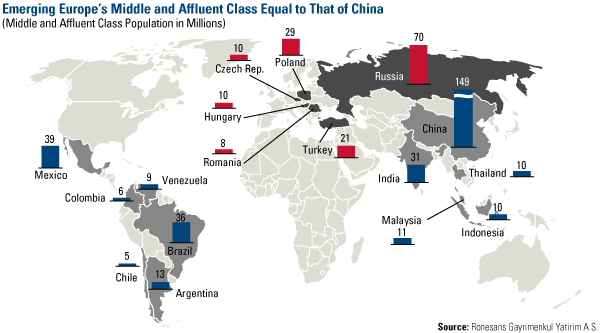
Raising Living Standards for 500 million people
Source - advisorperspectives.com
An estimated 500 million people in the developing world are expected to join the affluent in the developed world. 
The more affluent a person or community is, the more freshwater she and the community will consume.
China is by far the leader in adding people to its Middle Class, followed by Russia, Brazil, Mexico and India.
Why Seek Freshwater Abundance?
With more freshwater available we are confident that unavailability will no longer hold people back from their potential.  This is one reason why any freshwater scarcity is a concern. 

Saturday, April 28, 2012

Lot's of Freshwater, But NOT WHERE It's Needed

Precipitation, commonly called rain, the predominant source of freshwater, is more than enough for a 10+ billion human population plus the other species and nature's ecosystems that must have freshwater.
Rainfall
Source - countryofsb.org
From the very beginning, rain has supplied the freshwater needs of human, other species and nature's ecosystems in two ways: 
- Either, by dropping manna-from-the-heavens directly onto crops and where the freshwater was needed and/or 
- Replenishing lakes and other bodies tapped by humans, other freshwater species and nature's freshwater ecosystems.
Total Rainfall on land
Source - sciencemag.org
A total of 98,500 cubic kilometers of rain is estimated to fall on land every year.
This liquid precipitation is in addition to the 12,500 cubic kilometers that fall as ice and snow on land.
Ignoring for a minute that this rainfall in not geographically uniform and that it has extreme spacial and temporal variations, the 98,500 cubic kilometers/year
= 270 cubic kilometers/day
As 1 cubic kilometer = 264 billion US gallons,
the average rainfall of 270 cubic kilometers/day
= 71,280 billion US gallons/day
For a 10 billion human population (the projected human population in 2050), this rainfall
= 7,128 US gallons per day.
Why Freshwater Scarcity?
Ignoring freshwater accessed over long distances from surface bodies (lakes, rivers, etc) and underground aquifers, with so much rainfall available per person per day, why do we have scarcity anywhere in the world?
The answer: Scarcity is the result of rainfall not being uniform all over Earth's land mass and the unpredictable spacial and temporal variations of rainfall.

Saturday, February 25, 2012

Am I Immune From Water Shortage?

Investing in real estate has always been about location, location, location. Water shortage too has a similar qualifier (all water problems and their solutions are local, local, local) that is compounded by the fact that no location is immune from water shortage.


A world rich in water - for some!
When currently used and  accessible water supplies are studied at a macro level, the conclusions might be:
- Approximately 50% of the world (the blue and grey areas in the map) does not have a water problem,
- If I reside in one of these water-adequate areas, I should not have to worry about water shortages, and
- If I live in the red, orange and green areas, I could experience water scarcity e.g.if I live in the southwest region of the US, then I could experience water shortages unless I have a way to transport water from outside to where I live or I choose to live in the vicinity of the right water transportation infrastructure.


The devil is in the details
Source - NRDC
A county-by-county map of the United states supports the macro-level conclusion that the southwest region of the of the US is prone to water shortages. However, assuming that predictions of Climate Change turn out to be accurate, the map says a lot more:
- 412 counties (marked in red) spread all over the US will experience water supply shortages and some of them are in water rich areas like Florida.
- Only 30% (929 out of 3141) counties would be immune from water shortages in the future i.e. the vast majority of the US population will need to deal with water scarcity by 2050. 


The water-immune are few in number!
Source - 


A map on global distribution of human population identifies that a very large percent of the global population will experience water shortage because of where they live.
In these areas, every city dweller knows that 24/7 supply of fresh water is unheard of today. Every city dweller also knows to plan their day around their need to stock up with water whenever it becomes available.

5.5 Billion people have experience with Water Shortage
80% have experience with water shortages
Image Source - atlas1. wikispaces.com
When the global population is tallied by where they live, nearly 80% of the people on Earth live on a near-daily basis with not having enough safe freshwater when they need or want it.
Faced with freshwater shortage, their options range between:
- Adopting the resigned attitude that justifies using unsafe readily-available water, and
- Arranging their daily schedule around the gathering of necessary amounts of safe freshwater.
For these 5.5 billion, water is a personal local challenge.
- The remaining 20%, nearly 1.5 billion people, mostly have water for the taking whenever they so desire. 


Saturday, January 14, 2012

We have Never Run Out of Any Natural Resource! (1 of 2)

I cannot think of any resource we have ever completely run out of! But the possibility that we may run out of a vital resource scares us to no end. Running out of freshwater is only the latest in a series of scares. Like we have done so many times before, we can rely on human ingenuity to find a way to forever alleviate a perceived or locally-experienced scarcity. One alternate way is to replace what's running out with something totally different.

Whale Oil to Kerosene
Whale Oil
Source - Wikipedia.org
In the mid-19th century, whale oil was the primary fuel for lighting. This "oil" was obtained from the blubber of whales and from the head cavities (not blubber) of the sperm whale. As much as 3 tons of sperm oil could be extracted from large sperm whales.
Whale Oil Lamp
Source - ioffer.com
The typical oil lamp we use today was the oil lamp used to burn whale oil.
As demand grew for whale oil, whale population reduced and whale oil price increased from $200 a barrel in 1983 to nearly $1,500 in 1885. This steep price increase encouraged many individuals to seek an alternative to whale oil. 
Kerosene Drums
Source - hiwtc.com
Canadian geologist Abraham Gesner is credited with developing the way to produce an alternative to whale oil in 1885. He developed the process to distill from bituminous tar, a widely abundant and cheap resource available more commonly than whales, a different kind of oil called Kerosene.
This is the same kerosene we use today to fuel or jet planes.
Scarcity had motivated an individual to innovate a way out of an earlier resource shortage!

Charcoal to Coal
Charcoal
Source - gallerytunsten.com
Charcoal is a fuel produced by heating wood (and other substances) in the absence of oxygen.
Charcoal became scarce in the 17th century when wood use jumped in Europe to meet shipbuilding needs and when forests began to be cleared to produce land for agriculture.
Charcoal prices increased till it was replaced by coal as a primary fuel for heating for a variety of domestic and industrial uses.
Coal is today, the most widely used fossil fuel.
Charcoal continues to be the fuel choice in underdeveloped countries where forests have been decimated by human demand for charcoal for domestic use.
Charcoal's replacement by coal is yet another example of how human ingenuity eradicated a shortage.

Replacement for Water?
Unfortunately, there is no substitute for water and freshwater. So human ingenuity must be applied in a different way. The next post (dated 21 Jan 2012) will address how our reliance on science can help

Wednesday, November 16, 2011

Speed of Remedy Deployment is Key to Reducing Water Scarcity

Any global effort to reduce the ranks of people (and other living things and nature's ecosystems) experiencing water scarcity and shortages must recognize two crucial facts:
  1. As time progresses, the water-deprived group will continue to grow by the addition of more people, especially in the developing parts of the world.
  2. To get a net reduction in the number of water-deprived people, any remedy must, therefore, be deployed at a rate much larger than the rate of addition to the water-deprived ranks.
Addition to the Water-Deprived Ranks
Source - wikipedia.org
The rate of addition to human population has generally declined over the past 30 years. 
At its peak, 88 million people were added in 1989. The recent lowest addition was 73.9 million people added in 2003. In 2009, however, the human population added 75.3 million people. The annual addition is projected to drop to 43 million people in 2050.


Current Estimates of the Water-Deprived
Source - collections.europarchive.org
Water scarcity was quantified as follows, in 2004, by UNICEF and the World Heath Organization:


  • About 1.1 billion people lack access to safe drinking water - This is more than 1 out of every 6 people on Earth
  • About 2.6 billion people lack adequate sanitation - This is 2 out of every 6 people on Earth
It is, thus, an understatement to say that we have at least 2 billion people today whose thirst for safe drinking water still needs to be quenched.


Water Scarcity Elimination Target
Thus, to maintain the water-deprived population at current levels requires deploying water supply-increasing remedies that impact around 100 million people. Such a number might also reduce by just a very tiny bit, the size of the 2 billion water-deprived population.
A significant dent in the 2 billion water-deprived population will be a reduction in the population by 100 million per year. Thus, thus, requires us to provide safe drinking water to at least 200 million people per year i.e. 100 million in addition to the  maintenance number of 100 million.


Providing Safe Water to 200 Million
The goal of providing water to 200 million people in one year is equivalent to providing safe water to:
- nearly 548,000 people/day or
- nearly 22,831 people/hour, or
- nearly 381 people/minute, or
- nearly 6 people/second


Challenge of the MASSIVE SCALE of Water Scarcity
The 200 million goal, at first look, appears impossible to meet or imagine. But there may be clues in how other industries have reached numbers that come close to those required to provide safe water to 200 million more people every year.
The Lesson from the Telephone Industry - Joseph Schumpeter's concept of 'gales of creative destruction' applied to water scarcity implies that the existing water-industry complex has very little incentive to innovate and innovation can only come from outside - like it did in the telephone industry, where mobile phones have transformed the traditional telephone industry by being able to supply a "product" that requires minimal customization in the local environment.


Necessary Characteristics of the Remedy for Water Scarcity
  1. What constitutes the product that requires insignificant local customization and increases supply of safe freshwater to people anywhere on Earth? The answer to this question incorporates humanity's need for speed in supplying safe drinking water to those that are deprived of this life resource today.
  2. Must address the daunting variety of water problems that are found all over the globe, and
  3. Must work anywhere on Earth
The second and third characteristics were identified in the post dated October 1, 2011, titled "Water Needs Thinking on a Massive Scale"