Showing posts with label moisture. Show all posts

Saturday, February 15, 2014

Rivers of Freshwater in the air = The Water Internet for Everyone Everywhere?

Latest research by NOAA is clearly revealing that there are Rivers in the atmosphere in numbers and sizes, much like the rivers on land masses.
Rivers in the sky
River that caused Flooding on 16 Feb, 2004
Source - noaanews.noaa.gov
Rivers, whether in the sky or on a land ground mass, produce the same results:
- they cause floods
- they physically change their location over time
- the flow in them varies
- they contain safe drinking water (aka freshwater)
Differences between these rivers are significant:
- We cannot pollute rivers in the sky
- We don't currently know how to dam the rivers in the sky, but are learning how to extract freshwater from the sky rivers on a piecemeal basis.
River causing flood in UK in 2009
Source - newscientist.com
- Rivers on ground hold, carry and deliver liquid water, while rivers in the atmosphere transport water vapor.
Global Rivers in the Air
Two Major Flows of Water Vapor in the Air
Source - baynature.org
Air currents flow, generally speaking, on very standard and predictable paths.

The questions of our day: How can we extract the water vapor that the rivers in the air carry everywhere and hold in some places while discharging in others? Can we make the water laden atmosphere for our local water needs everywhere, what the wireless Internet has become for global communications?
Now, that's a goal worthy of us, in this 21st century!

Saturday, February 8, 2014

A 2-Tablespoon Freshwater Tap every 12 feet!

Seeing IS Believing except when the subject is freshwater. We usually conclude that there is no water when we cannot spot any where we are looking.
Water in Air Is nearly all in Vapor Form
The moisture in the air is essentially in vapor form and our naked eyes cannot see any gas or vapor.
Clouds are visible to us because of the liquid water droplets that are dispersed in the air that makes up the cloud.
Fog is another example of us being able to see the moisture in air because some of this water exists in liquid form.
An Air-Moisture Map
Water Vapor in the Air Around Us
Source - wateronline.com
NOAA/ESPL have mapped the moisture in the air we breathe i.e. in the air at sea level.
The average water content of this air - the air all around us and the air we breathe - varies from a low of approx 2.4 grams per cubic meter to a high of approx. 24 grams per cubic meter. The maximum amount can even exceed 26 grams per cubic meter but this concentration exists in only a very few places.
Water Amounts in Air
Tablespoon of water
Source - theguardian.com
Using the conversion (1 cubic centimeter (cc) of water weighs 1 gram) the moisture in 1 cubic meter of air varies from approx one-sixth of a tablespoon to over One-and-a-half tablespoons.
Thus, approx. 16 cubic meters (565 cubic feet) of air contain a cup (16 teaspoons) of water. Or, the air in an average sized room 8.5 feet high, 12 feet wide and 12 feet long contains a bit more than 2 tablespoons of safe water! 

All that remains to be accomplished is to capture this water for local use. Isn't this a challenge worth overcoming?

Saturday, January 18, 2014

Safe Water Delivery Using Artificial Porous Materials

We can have an endless, but not infinite, supply of safe drinking water if we could only extract the water in the air we breathe. 
Wiping Air with a Sponge or an Eraser
Source - redbookmag.com
This extraction of water can be visualized as a gizmo that acts like a sponge or a chalkboard eraser when we move it in the air where we need to extract safe water.
This gizmo would "clean" the air around us of water molecules, with the same motion that we use to wipe a blackboard clean of chalk!
Later, once the gizmo fills up with extracted water, we could squeeze out (literally speaking) this water.
Luckily, materials that may be very suitable for just such an action already exist.
MOFs - Metal-Organic Frameworks
Source - ucla.edu
Source - labroots.com
MOFs are structures consisting of organic molecules and metal ions. The organic molecules hold metal ions in a 3-D grid pattern that is porous to another, a third, material.
The structures can have virtually any 3-D configuration - the configuration essentially depends upon the organic molecules and the metal ions that comprise the structure.
As we may also expect, the combination of organic molecules and metal ions define what materials will be absorbed by a specific structure.
Cavity size, number of cavities and absorption rates can also all be controlled.
Water Absorption
Chemistry of organic molecules can, in the presence of moisture and under different ambient temperatures, get compromised but a list of water-stable combinations have been developed. The focus, however, has been on using MOFs for energy applications like hydrogen and other gas absorption, storage and release.
All that remains is to focus this research on water absorption, storage and release! 
A local supply of safe drinking water using a MOF that extracts moisture from the air we breathe can be a reality in our very near future!

Saturday, November 30, 2013

Why is Steam White?

Ever wonder why you cannot see the water vapor in the air around us?
Water in Vapor form
Source - scienceprojectideasforkind.com
Water molecules when in vapor form are transparent.
That's one reason why we cannot see the moisture in the air.
Another, of course, is the tiny size of water molecules, so tiny that our eyes cannot make them out or the loose chains that they form.
Yet another, is that the vapor molecules are randomly arranged and so present no discernible shape to the human eye.
Water Molecules in Liquid Form
Source - crazykitcheninventions.co.uk
Steam is essentially a lot of liquid water molecules suspended in a mixture of air and water vapor molecules.
As light rays that hit these randomly arranged liquid water molecules is a mixture of all colors (i.e. white light), the light exiting from the many liquid molecules appears as white - the color we attribute to steam.
If a different color light, say, red were to be falling on steam, the steam would appear to be red in color.

Saturday, April 6, 2013

Cotton Fabric That Absorbs Water From Air?

We know that moisture in the air is 2% in liquid form and 98% in vapor form. This ratio improves a bit - by another 1% or so - in favor of liquid water when a mist or fog rolls around.
For some reason, humanity has continued to focus on capturing the liquid water in air while there is no research on capturing the water that exists as vapor.
Now word comes of a new polymer that does just that.
What's a polymer?
A Polymer (multiple copies of the same unit
Source - ec.europa.eu
Covalent Bond
Source - en.wikipedia.org
A polymer is a compound whose structure is characterized by copies of the same units connected by covalent chemical bonds. A polymer, thus, is a collection of a number of copies of the same unit. 
The covalent bond is the sharing of two electrons between a carbon and a hydrogen atom that each contribute one electron to the coupling.
The New Polymer PNIPAAm
PNIAAm cotton fabric
Left (closed structure at high temperatures)
Right (open structure at low temperatures)
Source - Endoven University
Researchers at Netherland's Endoven University of Technology and at Hong Kong Polytechnic University have together created a new polymer they call PNIPAAm.
When this polymer is applied to cotton fabric, like a cotton shirt, the resulting combination is much more absorbent of liquid water from the air, than is the cotton alone.
The combination can absorb as much as 340% of the cotton weight of water. Cotton alone absorbs about 18% of its weight of water.
Key area of continuing research is the temperature at which the combination starts absorbing and releasing water and building actual clothing to check how the results from the test-beds pan out.

Saturday, March 2, 2013

Lots and Lots of Water in the Atmosphere!


Total moisture in the atmosphere
In total there exists, at any one moment, 12,900 cubic kilometers of water in the atmosphere. 
Liquid water in air
98% of this moisture exists as vapor while 2% exists as liquid i.e. there are:
~ 258 cubic kilometers of water in liquid form in the atmosphere, and
~ 12,642 cubic kilometers of water in vapor form in the atmosphere
Using 1 cubic kilometer = 2.64172052 × 10¹¹ US gallons, there are:
~ 681.56 x 1011 US gallons of water in liquid form in the atmosphere, and
~ 33,396.63 x 1011 US gallons of water in vapor form in the atmosphere
Moisture in air replenishment rate
All the moisture in the atmosphere is, however, replaced every 9 days i.e. 12,900 cubic kilometers of water is delivered to the surface of the Earth from the atmosphere every 9 days i.e.
~ 681.56 x 1011 US gallons of liquid water falls on Earth every 9 days, and
~ 33,396.63 x 1011 US gallons of vapor water falls on Earth every 9 days
Water deposited on Earth from the atmosphere every day
~ 3,787 x 1011 US gallons every day
For a 10 billion human population, this is ~ 37,870 US gallons/person/day
What's behind global water scarcity?
Recognizing that ~ 37,870 US gallons/person/day is just NEW water and does not include water from rivers, lakes, underground aquifers and other sources, the question arises:
Why do we have a water scarcity issue in most places around the globe, today?
Granted, we cannot capture every, or even most, drops for humanity's use, water scarcity remains a challenge for human ingenuity in two ways: How do we capture precipitation in locations that nature chooses and how do we transport the collected water to where we want or desperately needs to have it?

Saturday, July 21, 2012

Why can't we see Water in the Air?

What we know reflects the questions we formulate which, in turn, limit the scope of the answers we get. These answers then tell us what we can do and, maybe, why.
Asking the right question about air we breathe!
Glass half full of water
Source - en.wikipwedia.org
Puddle
Source - roywater.com
When we look at freshwater we see it as something that exists in bulk, like a glass half full of water, a huge lake that we can jump into, a puddle that can wet our shoes.
From these experiences we jump to the conclusion, and remember it as knowledge, that when we cannot "see" any water it's because there is no water there.
This knowledge, based solely on experience, also makes us typically unaware of the air that surrounds us. Only when we have difficulty breathing, or breathe in something that we choke on, do we realize that the air exists and is bad.
Water we cannot see because it's bulk is so small
Water on a leaf
Source - savethepark.org
Water exists in the air as groups of molecules in gaseous or vapor form.
Liquid water molecules can combine into large enough bodies visible to the human eye, for example, in fog.
 These sets of molecules have body when compared to the molecules of air's other ingredients (Nitrogen, carbon-dioxide and other gases).
But these water molecule groups are so tiny when compared with drops of water that we can clearly see, for example, on plant leaves.
primarily dependent on temperature.

Just because we cannot see the water in the air around us , in the same air we breathe, it does not imply that air is devoid of moisture of any kind!

Saturday, July 14, 2012

Where On Earth Is the Water?

Ocean-water dependent species and ecosystems have two luxuries that freshwater-dependent species and ecosystems lack:
- Ocean-water exists in one BIG connected mass distributed all over the world. Freshwater exists in multiple locations all over the world
- Ocean-water exists mostly in just one form: as a liquid; Freshwater, however, exists in vapor (e.g. as a gas), liquid and solid (e.g. as ice) form
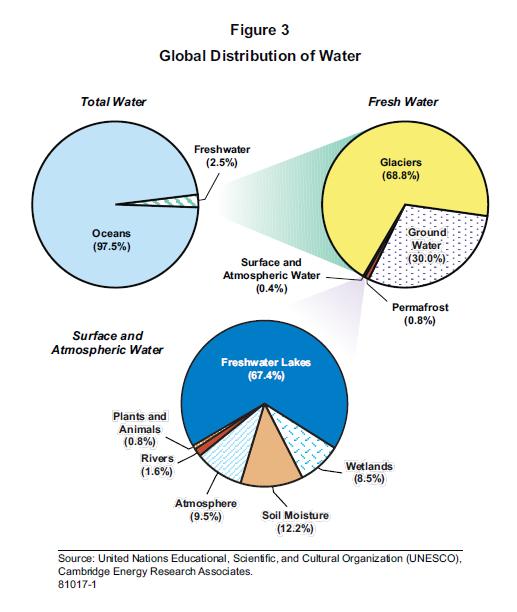
Global Distribution of Water
Water covers much of the Earth's surface:
- Ocean-water is the predominant (97.5% of the total) variety.
- Just 2.5% of the total water on Earth is freshwater. 
Freshwater Locations
Ignoring movement of freshwater between various deposits of freshwater on Earth, Freshwater exists in 8 locations:
- In glaciers as ice and in liquid form
- As groundwater in underground aquifers
- In Freshwater lakes
- In wetlands
- Dissolved in soil
- Suspended in the atmosphere
- In flowing rivers, and
- In plants and animals
Historical Sources of Freshwater
There are two types of sources that humankind has tapped for its freshwater needs:
A. Freshwater Bodies
Freshwater lakes, wetlands and rivers were humankind's earliest sources of water. These sources are still major sources of freshwater because they are continuously replenished. We may choose to extract freshwater at rates greater than the replenishment rate, but that is another subject.
Plants were probably a major source of freshwater for humanity, because all food contains freshwater. With the harnessing of agriculture (about 10,000 years ago) and the resulting improvement in diet, humans get a lot of their required freshwater from the food they eat and digest.
B. Water moving between bodies of freshwater
While all water is always in continuous motion, Evaporation and condensation are the primary ways freshwater moves between different freshwater bodies. 
Tapping New Sources of Freshwater
Of the 8 freshwater bodies, the single ocean-water body and the ways water moves between these bodies, there are only 6 possible new sources of freshwater:
1. The freshwater in the atmosphere is nearly 5 times MORE than the freshwater in all the rivers on Earth.
2. The freshwater in soil is nearly 6.6 times MORE than the freshwater in all the rivers
3. The freshwater in plants and animals
4. Artificially converting seawater into freshwater i.e. desalination.
5. Making freshwater from scratch - our bodies make between 300 and 400 ml of freshwater per day through the biological process of metabolism - hence our name for this water is "metabolic water"
6. Catching freshwater as it moves from one source to another - Rainfall is the predominant such source.
Increasing Freshwater Supplies
In addition to the above 6 choices, there exists, of course, the option to use less water by recycling used water, increasing water use efficiency and reducing the amount of water that is wasted.
The Task Before Us
Which of the above 6 "new sources" of freshwater and using less water should we focus on and why?

Saturday, April 7, 2012

Every Water Is Not The Same!

We all are quite familiar with the salty taste of ocean water compared to water deposited by rain and water streaming out of a faucet. Another difference may help us tap on-demand, the oldest freshwater source on Earth.
The Ocean in the Atmosphere
The hydrologic cycle maintains and continuously replenishes a vast ocean of freshwater in the air closest to the ground. This ocean is the source of all rain and snow, the dew we find deposited on our cars, dew deposited on the ground early in the morning and the moisture that appears on the outside of a cold glass. 
Isotope Hydrology
Change in isotope content during the hydrologic cycle
Source - ANTSO.gov.au
It is an established fact that water from different sources contains different number and types of isotopes.(see post dated Oct 15, 2011).
Isotope Hydrology is the new science that uses existence of isotopes to estimate age and origin of water in each stage of the hydrologic cycle.
What makes Isotope Hydrology most interesting is that it can map a "local" hydrologic condition to include an identification of the the origin and content of water in the local atmosphere.
Predicting & Catalyzing Precipitation
The primary cause of freshwater scarcity is continued lack of rain where and when we humans want and need it. Precipitation (mostly rain) directly waters our food crops, adds runoff to increase river flows and lake levels, and replenishes ground water reservoirs.
We could soon produce rain on-demand using Isotope Hydrology that can accurately measure the isotopic content of local air, compare it to conditions that produce rain and identify what changes are necessary to produce rain on demand anywhere on Earth!

Saturday, February 4, 2012

Water Molecules React to Frequency of Microwaves

A singular property of water molecules is that they get excited (i.e. start moving) when hit with microwaves. Microwave ovens use this knowledge about water to cook food.


Microwaves
Light Waves
Source - chemwiki.ucdavis.edu
Microwaves are light waves with a wavelength of between 1 mm and 1 meter.
They carry a lot less energy than radio waves and are much less lethal than X-rays.
The frequency of microwaves is just right for water molecules, which absorb the energy in microwaves.
This absorption raises the temperature of water. Microwaves can raise water temperature to water's boiling point.
Microwave Ovens
A Microwave Oven
Source - globalmicrowave.org
These ovens raise the temperature of water in the food placed in the oven, and the heated water helps cook the food.
Microwaves are generally not strong enough to raise temperature of food molecules.
Microwave ovens are designed to spread microwaves evenly all over the food so that waves supply energy distributed equally within the volume of an oven.
Unevenly Cooked or Heated food
A common complaint about microwave oven cooking is that the food we heat or cook in it does not heat or cook evenly throughout. 
Water is the cause of uneven heating and cooking.
As microwaves only heat up water molecules, if these water molecules are not evenly dispersed in the food, the food heats up differently in different places, for example:
- Microwaved soup has a hot layer on top and a cold center. The hot layer on top is the result of the uppermost water particles getting heated the most because they absorb much of the microwave energy before the waves can penetrate deeper into the body of the soup.
- Sometimes the middle of food is cooked "first" in a microwave oven because there is a larger concentration of water molecules in the middle of many foods. The moist center heats up first and longer.
- Foods, dry of moisture, like cornflakes rice or pasta are difficult to cook in a microwave because these foods have little moisture that microwaves can heat up.
- Breads get hard in a microwave oven because microwaves evaporates the little moisture contained in bread and, thus, dry the bread into a hard crust.
Invention of the Microwave Oven
Dr Percy Spencer
Source - Gallawa.com
The original name for microwave ovens was Radarange.

An engineer, Dr Percy Spencer, discovered the impact of microwaves while he was developing radar technology that converts electricity into microwaves.
Dr. Spencer's employer, Raytheon, commercialized microwave ovens and sold the first one in 1947.
Today, 90 percent of US homes have a microwave oven.

Saturday, October 29, 2011

TINY Creatures that Absorb Water Vapor from Air

Source - Wikipedia.org
Crabs, lobsters, crayfish and shrimp all share one physical attribute - they all have external skeletons. This skeleton surrounds nearly all their body organs and protects them from predators.
One structure of their body, pleopods, exists outside their skeleton. 


Pleopods of creatures on land
Source - animalcrossing.wikia.com
Source - derelia.com
Land-living brethren of crabs and lobsters, pill bugs, have succeeded in colonizing land by adapting their pleopods to absorb water vapor from air that is not saturated with moisture.
Pill bugs can loose as much as 30% of their body-moisture and still survive by replenishing this loss by absorbing water vapor in unsaturated air.
Their major loss of body-moisture is through evaporation from the body surface. One of the reasons to roll up into a ball is to reduce the body surface susceptible to promoting evaporation.


Other creatures that absorb water vapor
Flea Larvae
Source - en.wikipedia.org
Book lice
Source - asktheexterminator.com
Silverfish
Source - silverfishbugs.net
Other creatures that absorb water vapor from air are flea larvae, book lice, silverfish, meal worms and ticks.


Why are all of nature's creations that can absorb water vapor from the air, so tiny? Is this a dependency on the amount of water vapor in the atmosphere? Is this a dependency on the size of the water vapor absorbing body structure?

Saturday, March 26, 2011

We Use Water's Unusual Properties To Our Advantage

Dry air is heavier (more dense) than wet air, because water vapor is lighter (less dense) than air. We creatively utilize our knowledge of air density, that is also a function of temperature and pressure, to our advantage.


Baseballs Travel Further in Denver
 
The lower the air pressure, the less dense the air and the less the number of molecules in a unit of air. Thus,  a baseball (or any moving object) experiences less resistance (or drag) to its motion and ends up travelling a longer distance in air of less density.
Source - USAtoday.com
The baseball goes further as the reduced molecules in the air reduce the rate at which its speed slows.
This same effect is seen, but somewhat less obviously when the amount of water vapor increases in the air. Baseballs travel further in moist air where increase in the amount of water vapor reduces the number of molecules subjecting the baseball to resistance.


Indy 500 cars are designed with weather in mind
Source - farcaronline.blogspot.com
Dry dense air also slows a race car. But as high speed is a mandatory requirement, race cars are designed to take advantage of the drag produced by different weather conditions.
Simply speaking, the Indy 500 cars are designed to accept the drag to better hug the track i.e. make the drag push the car onto the track. 
While driving skills are of paramount importance, it is these design modifications that allow a race car to take a turn at 115 mph (without sliding off the track) instead of a slow 70 mph to win the Indianapolis 500.
The driver and pit crew cannot, of course, change the amount of water vapor in the air (humidity) or adjust the atmospheric pressure over the race track. 
All they know is the air temperature and how it is forecast to change while the race is being run. The design allows them to make adjustments to their car that will allow the driver to race with the optimum drag and, hopefully, win the race. 


NASCAR reduces drag with Nitrogen
Source - Nascar.com
Nascar races are run with stock cars - cars we all drive on city streets but strengthened a bit to accommodate more lethal accidents than those we expect during our drives. 
Nascar's solution to reduce air resistance, because they cannot make body design changes, is to use Nitrogen instead of air to inflate the tires of their cars. 
Nitrogen eliminates the small amount of water vapor that exists inside a tire filled with air. As the tire heats up, the water vapor increases the internal pressure in a tire and introduces instabilities that have greater impacts at higher speeds, reduces gas mileage, increases tire wear and reduces tire life. Nitrogen does not display any such negative characteristics.


NASCAR's solution is so appealing that many of us city drivers are starting to fill the tires of our cars with Nitrogen.

Saturday, March 5, 2011

Water Helps A Gecko Walk On Ceilings With a Small Human Child On Its Back

In the Simpsons Movie, Homer had to hold up his pig upside down, to realize his dream of owning a pig that could imitate a spider and walk on ceilings. He could have realized this dream and  
Source-thesharkguys.com
Gecko climbing the wall.
(Credit: iStockphoto/Luis Carlos Torres)
watched his pig from his favorite couch, if he had only known about nature's ingenious design of the underside of a Gecko's foot.All he really had to do was modify the underside of his pig's feet (to make them similar to the feet nature gave the common household gecko) and add a little moisture to the air in the room. 

Van Der Walls Forces
At the molecular level, all molecules experience some level of attraction. This 
attraction is electrical in nature and arises from the temporary fluctuating dipoles that are created by electron motion. 
A molecule that typically is symmetrical and has no electrical distortion, can exhibit an electrical charge when either a lot of its electrons happen to be in the same area of the molecule or when influenced by another molecule that is exhibiting an electrical charge. This temporary "sloshing around" of electrons creates fluctuating dipoles even in a 'normally' benign molecule.
Source-Labwater.com


And, as one would expect, in the presence of water that exhibits a permanent dipole charge, the molecular attraction is strong, long-lived and nearly permanent.


The Underside of the Gecko's Foot
Different types of geckos have different 'looking feet' but they all share a common characteristic - they can all interact with all kinds of surfaces at the molecular level and use this molecular attraction to scamper up walls and run around on the ceiling.
Different Gecko Foot Designs
Source-geckolab.lclark.edu 
Gecko Foot Hairs & Strands
Source-Sciencephoto.com
Each toe of a gecko's foot contains hundreds of pad like ridges. On each ridge are millions of hairs that each divide, at their ends, into smaller strands. These strands are so tiny that the molecules at their ends interact with the molecules of the surface the gecko is walking on. The presence of even minuscule amounts of water strengthens these attractive bonds between the gecko's strands and the surface. Maybe, this is why, the Gecko population surges after a monsoon rain when the moisture in the air makes the gecko most mobile on nearly every kind of surface.
In a laboratory environment, the Van Der Walls attraction forces between a single strand and a surface have been measured to support a weight of up to 200 microNewtons - enough to support an ant. With half a million strands on each foot a little gecko walking with 2 million strands can carry a back-pack weighing 90 lbs - the weight of a small child.
Capillary Contribution of water
Liquid bridges formed by water monolayers. between a surface and the strands under a gecko's foot, further increase the attraction bond (due to Van Der Walls forces) that enables the gecko to scamper up walls and walk on ceilings. This increase in adhesion force significantly increases with increase in surface hydrophilicity and increasing levels of humidity.


Capillary forces will be the subject of a future blog.
The task at hand is to use learning from a gecko's foot to use Van Der Walls forces to attract water molecules in the atmosphere using water molecules resident on a hydrophilic surface.