Showing posts with label adsorption. Show all posts

Saturday, November 5, 2011

Overcoming Distance is Humanity's Fundamental Freshwater Challenge

Transportation of water to where people have chosen to live or forcing people to live in close proximity to freshwater supplies are two solutions that mankind has practiced ever since the beginning of civilization. This "transportation" issue is still the heart of our current and future freshwater crises.


Places with Meager Freshwater Supplies
The story and images of women spending their day carting water from sources far, far away from where they live, are well known and publicized as a scourge on the already poor. 
Source - newstimeafrica.com
Source - workworthdoing.com
Innovators have developed devices, like the rolling container that makes water transportation a less physical activity, but does not address the basic issue - the water is far away from where the people who need it are.
Ancient Roman Aqueduct
Source - think2020.tripod.com
In the richer parts of the world the solution to this basic issue is no different, except in scale and institutionalization - the formation of an organization which exists for the sole purpose of supplying needed freshwater.
Source - planetforward.org
Source - spannertech.com


Without such costly and massive creations, most of the population centers in the developed world would also be susceptible to water shortages and supply disruptions.
Covering the distance problem is still the most basic issue behind the supply of freshwater.
Places with Abundant Freshwater Supply
Humanity's Freshwater crisis would disappear in an instant if people lived in locations where there currently exists an abundant natural supply of freshwater and where future freshwater supplies were assured.
Source - worldatlas.com
Unfortunately, however, the two locations with the most freshwater resources (the areas around the North and South Poles) are too inhospitable for long human existence.


And there are no other locations that have necessary freshwater supplies for the existing and future mega-cities that are projected to house nearly 50% of the world's population.


The Distance Eliminating Solutions
The only "local" bodies of freshwater, that can eliminate or, at least, drastically shorten the distance, are the bodies of water located in the "local" air (the atmosphere) and under the ground over which people live. The reality that local underground supplies are already non-existent or under severe stress of becoming extinct, leaves only the option of finding ways to harvest water from the local atmosphere.

Saturday, October 29, 2011

TINY Creatures that Absorb Water Vapor from Air

Source - Wikipedia.org
Crabs, lobsters, crayfish and shrimp all share one physical attribute - they all have external skeletons. This skeleton surrounds nearly all their body organs and protects them from predators.
One structure of their body, pleopods, exists outside their skeleton. 


Pleopods of creatures on land
Source - animalcrossing.wikia.com
Source - derelia.com
Land-living brethren of crabs and lobsters, pill bugs, have succeeded in colonizing land by adapting their pleopods to absorb water vapor from air that is not saturated with moisture.
Pill bugs can loose as much as 30% of their body-moisture and still survive by replenishing this loss by absorbing water vapor in unsaturated air.
Their major loss of body-moisture is through evaporation from the body surface. One of the reasons to roll up into a ball is to reduce the body surface susceptible to promoting evaporation.


Other creatures that absorb water vapor
Flea Larvae
Source - en.wikipedia.org
Book lice
Source - asktheexterminator.com
Silverfish
Source - silverfishbugs.net
Other creatures that absorb water vapor from air are flea larvae, book lice, silverfish, meal worms and ticks.


Why are all of nature's creations that can absorb water vapor from the air, so tiny? Is this a dependency on the amount of water vapor in the atmosphere? Is this a dependency on the size of the water vapor absorbing body structure?

Saturday, March 19, 2011

Trees are Tall Because Water Can Move Against Gravity

Source - USDA Forest Service
The Sequoia Sempervirens (commonly known as The California Redwood) tree species has the tallest tree in the world, reaching a height of 379.1 feet. This height, a bit short of the estimated 430 feet maximum possible height for a tree, is the result of the tree's ability to develop an internal structure that water can use to rise from tree roots to the topmost leaves of the tree.


Water Molecule
Source- H2O_molecule_scheme_of_dipole.png‎
The unique shape of the water molecule, the shape that makes the water molecule a "polar" molecule, is used by the tree to design its internal water supply system that moves water up the tree. Simply speaking, water moves up the tree because it is "attracted" to the sides of the channels that the tree has created in its internal structure.


Capillary Action
Source - davidnelson.md.
Capillary action is the phenomenon that raises water molecules closest to a vertical surface (of the sides of a tube) because the attraction between the water molecules and the surface material molecules is high and the tube is so small that the water in the tube is unable to form a water surface, as shown on the right. 
When there is a very very tiny or no water surface, then the condition exists (called Capillary action) that all the water  molecules on the surface are "pulled up" and water rises against gravity.
Water in a narrow tube continues to rise due to capillary action, till the forces of attraction (between the water molecules and molecules of the wall material) are able to support the column of water that is formed in the tube. Measurement of this attraction force and calculations of water weight have shown that the maximum height that capillary action can transport water, against the force of gravity, is about 430 feet. So no tree can be taller than 430 feet in height. 


Capillary action is also behind the ability of water to move through soil from high humidity locations to low humidity locations.


Tree Leaves & Branches Are Smallest at the top
Source-hollowcreektreefarm.com
In especially tall trees, the number of branches, the length of a branch, the number of leaves and the size of a leaf all reduce as the height increases. 
These differences with height are due to the amount of water that the tree has available at different heights. As less water is available at greater heights, there is less need for longer branches, lots of leaves and leaves of larger sizes, because transpiration needs are less at greater heights. 
This reducing volume of water with height, produces the typical conical shape of trees.

Saturday, February 26, 2011

Water Vapor Absorption and The Surface Law

Many of nature's crucial processes occur at surfaces. Nutrients, water vapor and other material are exchanged by cells at the surface of each cell. Liquid water evaporates into the air (as water vapor) from the surface of a body of water. Sunlight is absorbed at the surface of the leaf. 


Water vapor absorption and adsorption also requires surfaces. Thus, ignoring efficiency considerations for the moment, a larger amount of water vapor will be absorbed if a larger a surface area is available that is capable of absorbing water vapor.


The Surface Law

A cube with sides of length 's'
Source: tutornext.com
The ability to increase surface area is controlled by the Surface Law that states: As volume of a physical object increases, the object's relative surface area decreases. For example, consider the cube on the right:
  • A cube 1 unit in size (s=1), has volume equal to1 and surface area equal to 6. Its ratio of surface area/volume is 6
  • A cube 2 units in size (s=2), has volume equal to 8 and a surface area equal to 24. Its ratio of surface area/volume is 3
  • A cube 4 units in size (s=4), has a volume equal to 64 and surface area equal to 96. Its ratio of surface area/volume is 1.5 
In the above example, the relative surface area reduces as the volume increases. From a biological perspective, this implies that it is relatively more difficult to supply nutrients to the cells at the center of each cube as the volume of cube increases. As expected, Nature has come up with interesting structures that increase surface area without increasing mass


Tracheal System
source: users.rcn.com. 
This is a grouping of tubes, air sacs and various geometries (such as loops or helices) that continuously bring air to tissues so that the tissues can directly exchange nutrients (oxygen, water vapor, carbon dioxide, etc) from the air.


Pores
Nature invented pores to increase surface area. 

source: the poultrysite.com
The typical chicken egg is perforated by about 10,000 pores (approx 1.5 pores per square millimeter of shell surface) that permit passage of respiratory gases and water vapor through the hard shell.


The pore size (17 micro-mm) has been optimized to provide the large amount of oxygen required just prior to hatching.


The Human Respiratory System
Source: Goldiesroom.org


As body size increases, the complexity of providing enough surface area to all the tissues and cells in the body increases.

  • Oxygen is extracted from the air we breathe at the surfaces of miniature air sacs (alveoli) in the lungs
  • This oxygen diffuses from the blood into a cell at the surface of a capillary

The human system to move oxygen into the body and remove carbon dioxide from the human body increases in complexity by creating new surface areas with specialized functionality that feeds nutrients to cells and extracts waste for disposal.


A Gram with Surface Area of 2 Basketball Courts
Source: physorg.com
MOF-74 is a porous crystalline powder developed at the University of California in Los Angeles that resembles a series of tightly packed straws comprised of mostly carbon atoms (white balls) with columns of zinc ions (blue balls) running down the walls.


The green balls are hydrogen molecules that this design is optimized for.


A gram of MOF-74 has the surface area of 2 basketball courts


Many many more examples exist of structures created by nature and mankind for supplying cells with nutrients and removing waste. So what would a structure look like that presents enough surface area to withdraw water vapor from unsaturated air?

Saturday, January 8, 2011

Water From Air using ADSORPTION

The old adage “drops of water make an ocean” also applies to making AIR a universal source of fresh water – all that needs done is extract the first drop of water from air and then just keep adding new drops after they are extracted, onto the first drop.


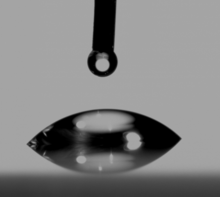
A water drop on a glass surface

The first water drop will look somewhat like the photograph (on the left) of a water droplet placed on a glass surface using a bulb dropper. In this photograph, the water droplet is not adhering in any way to the surface of the glass.


This photograph is, however, representative of a phenomenon that exists in both Chemistry and Biology called Adsorption.


Adsorption is the physical adherence of a material (the adsorbate, in either gas or liquid or solid form) onto a surface of another material (the adsorbent)usually by "bonding"  of ions, atoms, molecules or biomolecules between the two materials. 


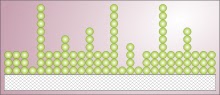
Adsorbate Molecules on Adsorbent Surface 
Adsorption results in increasing the total volume. Atoms on the surface of the adsorbent attract the adsorbate atoms and, thus, a layer of the adsorbate is created on the surface of the adsorbent. In reality the picture is more like the illustration on the right. Water, as adsorbate behaves exactly in a similar manner but its structure is not so well ordered


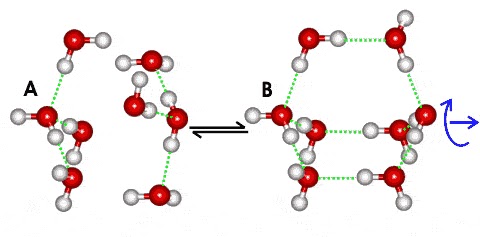
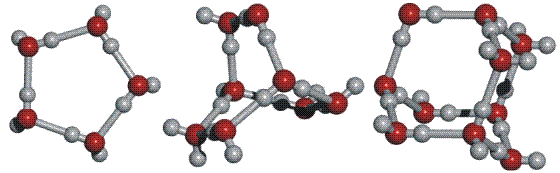
Water Clustering
A unique property of water, due its unique physical molecules, is that water molecules cluster in nearly an infinite number of shapes, two of which are shown in the following illustration:


This ability to cluster and form new chemical forms gives water many of its unique properties. Desiccants (like silica gel) use adsorption to remove water from air.


Adsorption in Biology
In the Science of Virology, the adhesion of a substance to an organic particle, e.g. the adhesion of a virus to a cell, is also known as Adsorption. 


In Chemistry the adhesion is fueled by chemical bonds (e.g. by water's hydrogen bonds) while in Virology, viruses adsorb to their host cell surface via specific anti-receptor molecules, often glycoproteins. One example of glycoproteins found in the human body is mucins, which are secreted in the mucus of the respiratory and digestive tracts, where sugars attach to the mucins and give then considerable water-holding capacity.


It still remains to be seen if glycoproteins, and its brethren,can be used to extract water from the air in considerable volume!


Photo Sources:
http://en.wikipedia.org/wiki/Surface_energy
http://en.wikipedia.org/wiki/Adsorption
http://www.lsbu.ac.uk/water/abstrct.html#min