Showing posts with label aqueduct. Show all posts

Saturday, April 26, 2014

Why Water from Indigenous Sources?

In the very beginning, people lived next to water sources and when the water source could not sustain the number of humans, either the humans moved or something happened to the weak and the old that brought their numbers down.
Migration out of Africa
Human Migration from Africa
Source: phys.org
While no historical record exists of human migration out of Africa, scientists have tracked human migration by studying mtDNA and mutations of mtDNA.
It is thought likely that when water and food shortages occurred, humans learned from animal migrations and may have literally followed heard movements in search of water and food.
As the accompanying map shows, eventually, human migration populated all of the continents, except the inhospitable polar regions.
Migration Today
Growth in City Population
Source - newgeography.com
Each week about a million people move from the country into a city. Today about 50% of human population lives in cities.
By 2050, nearly 70% of the then human population will reside in cities. This will put enormous pressure on the services and supplies infrastructure of every city.
Water Supply to cities
Aqueduct
Source - pbs.org
Water Piping
Source - dreamstim.com
Pipelines, canals, aqueducts are all ways we have perfected to bring water from far distances to a city. But as cities grow, every one of these water transportation choices will need expansion or replacement with cost, time and environmental impact considerations.
This is where the idea of a water refinery comes in
Water Refineries for Cities
Air currents move air (and the water contained in the air) to every place on Earth. Various forms of precipitation (like rain, snow, dew etc) then extract the water from the air and deposit it on land. Nature's invention is known as the Water Cycle.
The man-made facility that extracts moisture from air is a water refinery. With such a refinery available, there will be less dependence on the historical infrastructure that includes pipelines, aqueducts, canals, to name a few. This indigenous water supply, from a virtually limitless source, is the most likely way for cities to meet the water needs of its inhabitants.

Saturday, August 25, 2012

Freshwater Innovations Fuel Population Growth!

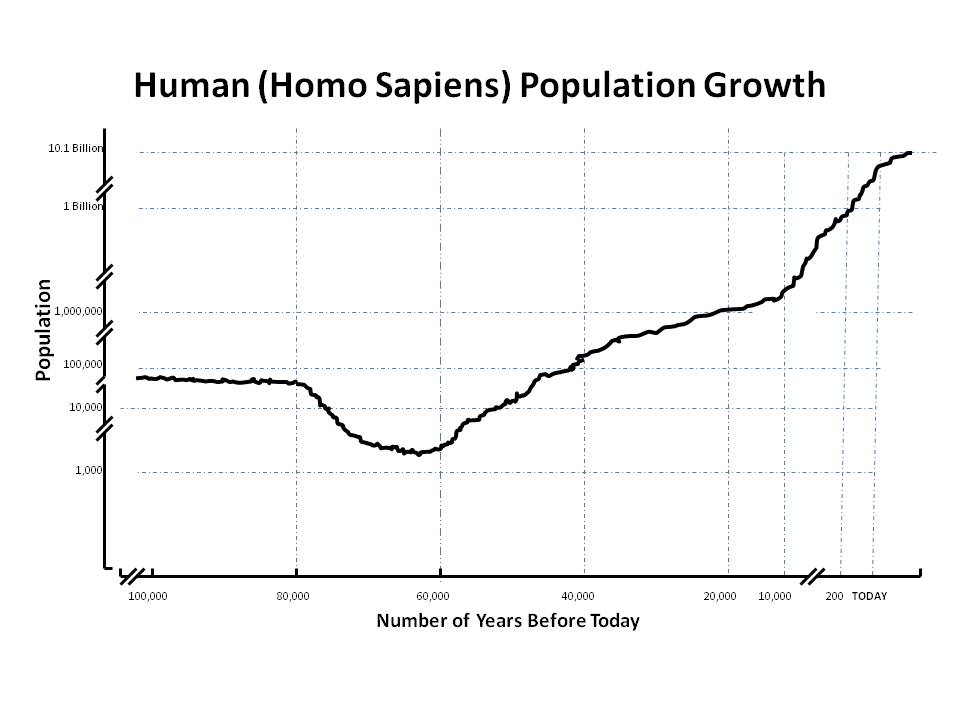
While we may never know with absolute certainty the answer to the question: "Which came first, the chicken or the egg?" we can be reasonably sure that human population grew and thrived because required amounts of freshwater became available necessary to sustain growing numbers of people.
Human Population Growth
Source - Adapted from Page 15, of book titled
"Pandora's Seed" authored by Spencer Wells
Approximately 200,000 years ago, our breed of human (aka Homo Sapiens) originated in Africa. Only 60,000 years ago Homo Sapiens started to grow in number.
Some 10,000 years ago, however, this rate of growth accelerated dramatically - Human population grew thousand-fold, from 1 million people to 1 billion people, in less than 10,000 years. 
Role of Freshwater
Source - Ommato LLC
When key water-related innovations are superimposed on to the population graph, it becomes clear how these innovations influenced growth in numbers of people. Key water-related innovations included:
- About 10,000 years ago, humans dug a well to capture water they saw disappearing into the ground
- Some 7,000 years ago, irrigation was born when humans figured out that water would, on its own accord, move from higher levels to lower levels
- About 5,000 years ago humans made the artificial lake when they built a dam to stop a river from flowing
- Approx 4,000 years ago humans began to raise water from lower levels to higher levels with the invention of a Shaduf. This was quickly followed with the Archimedes Screw and the Waterwheel all increasing the height to which water could be raised.
- Around 300 AD, 1900 years ago, the Romans built their gigantic aqueducts to bring water from many miles away to their cities.
Impact of Innovations
Each innovation had its incremental impact. But as is evident from the chart, the greatest impact on human population numbers came from the inventions that raised water to very high levels and that transported water over long distances.

What innovations lie in the wings or are possible today, that will bring abundance to safe drinking water in the 21st century?

Saturday, November 5, 2011

Overcoming Distance is Humanity's Fundamental Freshwater Challenge

Transportation of water to where people have chosen to live or forcing people to live in close proximity to freshwater supplies are two solutions that mankind has practiced ever since the beginning of civilization. This "transportation" issue is still the heart of our current and future freshwater crises.


Places with Meager Freshwater Supplies
The story and images of women spending their day carting water from sources far, far away from where they live, are well known and publicized as a scourge on the already poor. 
Source - newstimeafrica.com
Source - workworthdoing.com
Innovators have developed devices, like the rolling container that makes water transportation a less physical activity, but does not address the basic issue - the water is far away from where the people who need it are.
Ancient Roman Aqueduct
Source - think2020.tripod.com
In the richer parts of the world the solution to this basic issue is no different, except in scale and institutionalization - the formation of an organization which exists for the sole purpose of supplying needed freshwater.
Source - planetforward.org
Source - spannertech.com


Without such costly and massive creations, most of the population centers in the developed world would also be susceptible to water shortages and supply disruptions.
Covering the distance problem is still the most basic issue behind the supply of freshwater.
Places with Abundant Freshwater Supply
Humanity's Freshwater crisis would disappear in an instant if people lived in locations where there currently exists an abundant natural supply of freshwater and where future freshwater supplies were assured.
Source - worldatlas.com
Unfortunately, however, the two locations with the most freshwater resources (the areas around the North and South Poles) are too inhospitable for long human existence.


And there are no other locations that have necessary freshwater supplies for the existing and future mega-cities that are projected to house nearly 50% of the world's population.


The Distance Eliminating Solutions
The only "local" bodies of freshwater, that can eliminate or, at least, drastically shorten the distance, are the bodies of water located in the "local" air (the atmosphere) and under the ground over which people live. The reality that local underground supplies are already non-existent or under severe stress of becoming extinct, leaves only the option of finding ways to harvest water from the local atmosphere.