Showing posts with label life. Show all posts

Saturday, January 25, 2014

WHY WATER? Because Our "Living" Body Is A Water Machine!

The human body is, as are bodies of all "living" species, essentially a machine with one unique feature - water is one of the necessary ingredients that make up our bodies and water is necessary for our bodies to work properly.
What's A Machine?
Source - tophdcars.com
Source - t-mobile.com
What comes to mind when we think of machines? Usually, a series of objects uniquely connected to each other that together accomplish a desired and useful task e.g. a machine we call "car" produces movement in a specified direction and the machine we call "cell phone" transmits our voice all over the globe and captures only those voices that we want to hear. The car and cell phone are just two examples of machines made by humans.
Resources for Artificial Machines
Source - telegraph.co.uk
Electricity Icon- Reddy Kilowatt
Source - creativepro.com
Artificial machines, like the car and cell phone, require at least three natural resources:
- water is necessary to make each and every artificial machine
- one natural resource (at a minimum) in its natural form or in an artificial form, makes up the physical body of every artificial machine
- at least one other resource, that we call "fuel", is necessary for the machine to operate: The car requires gasoline (petrol) while cell phones require electricity. 
All resources, except water, are typically used up (do not exist in their original form) after the artificial machine has completed the task it was designed to do.
Water is used up only in the sense that it still exists in its original form but is contaminated in some way and can only be used again after the contamination is removed.
The Human Body - A Natural "living" Machine
On average: 72% is water
Source - dorchesterhealth.org
Natural "Living" machines are exactly like artificial machines in three ways: 
- Both kinds of machines cannot exist in the absence of water: artificial machines require water in their manufacturing process, while the human embryo can only exist in an aqueous solution
- Both kinds of machines do not transform water, at its molecular level, while they use it
- Both kinds of machines do contaminate the water they use in some way to make used water unusable.
Natural "Living" machines differ from artificial machines in two ways:
- Water continues to be a necessary ingredient that makes up physical bodies of natural "living" machines, but is not a necessary ingredient of artificial machine bodies.
- Water is a necessary ingredient for both natural Living" machines to function and properly do all the tasks that it is designed to do. Water is not a necessary resource for artificial machines to operate.

Life as we know and define it, is not possible in the absence of water. This is the first and fundamental reason why safe water must be locally available in abundant quantity.

Saturday, January 4, 2014

Water: The New Oil?

There is a lot of press on the subject of Water becoming the New Oil. What does it mean for any resource to be named as the New Oil?

Water, not at all like Oil?
Source - whatswrongwiththat.org
Water and oil are two very different liquids. The most significant differences:
1. Not much on the Earth, as we know it, could exist in the absence of water:
- Nothing artificial would exist as everything man has produced requires water during the production process
- Not much of "life" - as we define it and know it - would exist in the absence of water.
- Even the attributes of Earth that we label as "natural" would cease to exist e.g. the Grand Canyon would be missing as there would be no river to carve it out. 
There would, of course, be an Earth, but it could resemble, or not, any of the other bodies (e.g. planets and asteroids) that make-up the universe. Oil deposits would, of course, still exist on many bodies making-up the universe.
2. All cultures recognize the significance of water to human and other forms of life and, thus, water is a sacred political and, social issue that everyone everywhere is intimately familiar with. 
Oil, on the other hand, simply has no such cultural or social implications other than those that economics and lifestyle assigns to it.
We can do without oil but not without water

So, Why the Press?
Parched land
Souce - gg2.net
Dry Lake
Source - citydictionary.com
Water suppliers and ordinary people are concerned about the reducing quantities of water in the sources that we historically have used for supplies. Images of half dry lakes, polluted sources of water , etc. worsen this perception which, in any case, is an incorrect perception. 

Milk Cartons
Source - acrolabels.com
To understand why the perception is incorrect, let's take a look at what happens when we run out,for example, of milk, or bread or any other commodity. When we find that we are running low or out, we simply get some more from the grocery store that we typically shop at. If this store has none we find another that has some in stock.
This decision to look for new sources is not a new one for us. Strong evidence points to the fact that water scarcity (or search for new water sources) was a primary motivation behind human migration out of Africa. The aqueducts that the Romans built were engineering marvels of their time that became real only because Roman cities needed the water. Examples of ways to transport water to places where people choose to live are everywhere.
Water, the new Oil!
The call "water, the new oil, is simply a call to "find new sources". It is no different than what we think or ask someone else to do when we need milk: "get milk" or "Can you bring some milk?"

Saturday, September 17, 2011

A Crisis in Water Supply Exists Everywhere

Every place on Earth has experienced a water supply crisis sometime in history. And the future is not expected to be any different - every place on Earth is expected to be hit with a crisis in water supply sometime in the future.


Drought
Drought is the worst form of water crisis. It is a term applied to locations that have experienced NO RAIN for an extended period of time. 
Source - thedailygreen.com


Drought maps have been produced for the world, and no continent is immune from severe drought except the polar regions that are awash in water and ice, and where no large human presence exists and where no human activity is performed.


Source - standeyo.com
It needs to be recognized that even areas not highlighted to experience any drought will have "minor" crisis with their water supplies. For example, some may find their water temporarily polluted and unsafe to drink; others may experience a break in the aging infrastructure that will temporarily cut their supply; others may simply get no rain to replenish reservoirs and a temporary restriction may be imposed on water usage.


The water crisis exists all over the world, but with varying impact. And everywhere there exists (a) the atmosphere, that contains water in vapor and liquid form and (b) Wind that continues to deliver water-laden air everywhere.

Saturday, August 13, 2011

Body Water Cycle Linked to Global Water Cycle?

How come the residence time that nature has established for water molecules on Earth and through the human body are so close and supportive of life? Are they interdependent in ways that we do not understand?


Water Residence Time in Human Body
Source - archive.stsci.edu.
Soon after the discovery of deuterium in 1931 , a Hungarian scientist, Gyorgy Hevesy and his colleagues used dilute volumes of heavy water to study the uptake of water by fish, other animals and humans.  
Gyorgy Hevesy
Source - nndb.com
Employing non-radioactive isotopes, like deuterium, Hevesy determined that "heavy" water, taken through the mouth, appeared in human urine (his own) after about 26 minutes. Also by monitoring urine levels, they were able to ascertain the average lifetime of a water molecule in the human body as 11-13 days.
Hevesy and his colleagues also used the same process to estimate the total water content of the average human body as 10 to the power of 27 molecules or 1,000,000,000,000,000,000,000,000,000 molecules. I have found no description of what an "average human" was commonly meant in Hevesy's time.
Water Residence Time in the Atmosphere
As described in the post dated June 25, 2011, water residence time is the lowest for water vapor in the atmosphere and equal to 9 days, as reported in Wikipedia. Other sources put this residence time at 11 days.
The residence time of water molecules is larger in all other stages of the global water cycle by orders of magnitude.


It is interesting to note that the residence times of a water molecule (on average) in the human body of 11-13 days, is just slightly larger than the residence time in the atmosphere of 9-11 days. Is nature taking care of living beings' water replacement need by making sure that rain and other forms of precipitation continuously provide new water in time to nourish life on Earth?

Saturday, June 18, 2011

Water Makes a Leaf Stand Upright

Leaves wilt, most commonly, when water volume in its cells drop.


Turgidity
A Deflated Balloon
Source - simplystatedbusiness.com
A wilted cell is like a balloon that has lost its air. The pressure of the air inside the balloon, against the balloon wall, provides the rigidity required to maintain the shape of a balloon. 
Healthy Parsley Leaves
Source - faithforeverliving.org
The water inside a cell is like the air in balloons.
As the amount of water drops in a cell, the cell looses its ability to maintain its shape - the cell wilts like a deflated balloon because the pressure (known as Turgor Pressure) from the water in the cell against the cell wall drops.


Many Many cells
Cellular Structure of a Leaf
Source - exploratorium.edu
A leaf is made up of many, many cells. As individual cells loose the water contained in each cell, each cell wilts. Eventually this wilting is clearly visible as a wilted leaf.

Saturday, January 8, 2011

Water From Air using ADSORPTION

The old adage “drops of water make an ocean” also applies to making AIR a universal source of fresh water – all that needs done is extract the first drop of water from air and then just keep adding new drops after they are extracted, onto the first drop.


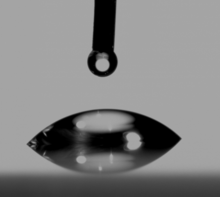
A water drop on a glass surface

The first water drop will look somewhat like the photograph (on the left) of a water droplet placed on a glass surface using a bulb dropper. In this photograph, the water droplet is not adhering in any way to the surface of the glass.


This photograph is, however, representative of a phenomenon that exists in both Chemistry and Biology called Adsorption.


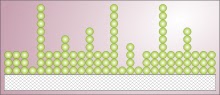
Adsorption is the physical adherence of a material (the adsorbate, in either gas or liquid or solid form) onto a surface of another material (the adsorbent)usually by "bonding"  of ions, atoms, molecules or biomolecules between the two materials. 


Adsorbate Molecules on Adsorbent Surface 
Adsorption results in increasing the total volume. Atoms on the surface of the adsorbent attract the adsorbate atoms and, thus, a layer of the adsorbate is created on the surface of the adsorbent. In reality the picture is more like the illustration on the right. Water, as adsorbate behaves exactly in a similar manner but its structure is not so well ordered


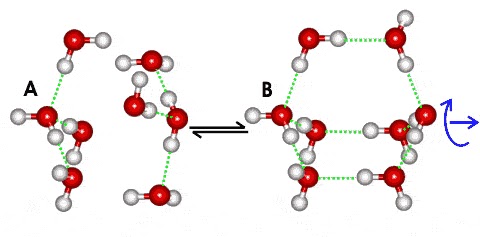
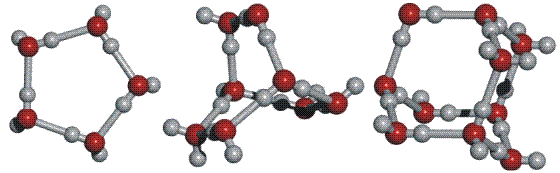
Water Clustering
A unique property of water, due its unique physical molecules, is that water molecules cluster in nearly an infinite number of shapes, two of which are shown in the following illustration:


This ability to cluster and form new chemical forms gives water many of its unique properties. Desiccants (like silica gel) use adsorption to remove water from air.


Adsorption in Biology
In the Science of Virology, the adhesion of a substance to an organic particle, e.g. the adhesion of a virus to a cell, is also known as Adsorption. 


In Chemistry the adhesion is fueled by chemical bonds (e.g. by water's hydrogen bonds) while in Virology, viruses adsorb to their host cell surface via specific anti-receptor molecules, often glycoproteins. One example of glycoproteins found in the human body is mucins, which are secreted in the mucus of the respiratory and digestive tracts, where sugars attach to the mucins and give then considerable water-holding capacity.


It still remains to be seen if glycoproteins, and its brethren,can be used to extract water from the air in considerable volume!


Photo Sources:
http://en.wikipedia.org/wiki/Surface_energy
http://en.wikipedia.org/wiki/Adsorption
http://www.lsbu.ac.uk/water/abstrct.html#min

Saturday, December 4, 2010

What do Jesus Lizard, Life and Micro-Habitats have in common?


Basilisk, the lizard in the video is also called the Jesus Lizard because it can walk on water for about 15 feet when it's weight is about 250 grams. The lizard is able to accomplish this feat by trapping air and water bubbles in a web formation under its feet that assist it to stay above the water surface as long as it keeps moving.

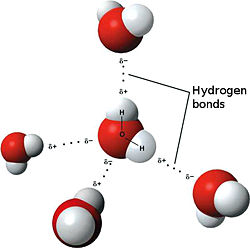
This ability of the Jesus Lizard is a result of the hydrogen bonds that connect water molecules. As shown in the diagram below, the positively charged hydrogen atoms are attracted to the negatively charged oxygen atoms. This  


attraction creates a very strong bond, that at the water's surface is responsible for the strong surface tension of water that also assists the Jesus Lizard to walk on the water's surface.


Life Requires Liquid Water
Imagine what would happen if water did not exist as a liquid over the range of temperatures that humans and other life forms can endure. If water at 98.6 degrees Fahrenheit (37 degrees Celsius) was a gas, imagine what would happen to the blood in our veins, the sweat we release, the tears we shed and the rest of the 68% of us that is water. Likewise, imagine if water at 96.6 degrees Fahrenheit (37 degrees Celsius) was a solid. Our saviour, and that of all water-based life, is the Hydrogen Bond.

Hydrogen bonds make water molecules stick together strongly enough to make water freeze at temperatures much lower than it would without them and make water boil at temperatures much higher than that if these bonds did not exist. Scientists tell us that water that boils at 100 degrees Celsius would, without the stickiness of hydrogen bonds, boil at temperatures well below -90 degrees Fahrenheit (-70 degrees Celsius). Life as we know it would not exist without the hydrogen bond.

Water Micro-habitats in the Atmosphere
Hydrogen bonds create the surface tension which, in turn, presents a barrier keeping air and water apart. This separation creates micro-habitats - small regions that contain some special features that suit one (or more) organisms better than it suits other organisms - in the atmosphere. The impact on air-borne organisms when water is extracted from air using biological means needs much further research and study.