Cloud seeding is done to increase precipitation in areas where extreme drought or long-term scarcity conditions exist.
Typical inorganic seeding nuclei
Most seeding procedures use inorganic particles or artificially produced organic particles.
Silver Iodide (AgI) is a commonly used inorganic condensation nuclei.
Dry Ice (solid Carbon dioxide) is another inorganic nuclei commonly used.
Artificial Precipitation Process
For rain to fall upon demand i.e. for artificial cloud seeding to work, the air needs to contain super-cooled water. Super-cooled water is liquid water colder than zero degrees Celsius.
Silver Iodide has a crystalline structure very similar to that of ice and it is assumed that existence of this structure induces freezing temperatures that convert water vapor into super-cooled liquid water.
Dry ice achieves the super-cooling effect by its expansion that in turn super-cools water vapor.
Rainmaking using silver iodide or solid carbon dioxide both require existence of liquid droplets in super-cooled air.
These initially miniscule liquid droplets serve as the base for liquid and ice droplets to grow to a size large enough that they end up falling to the ground.
Cloud Seeding Goal
Lots and lots of rain is the goal of cloud seeding. Humanity cannot, however, capture much, if any, of this rain and, typically must wait for hydrological processes that add this artificially produced rainwater to existing reservoirs of liquid water that are water is being drawn water from.
Obviously, cloud seeding is an option for supplying multiple acre-feet of water rather than the few liters each individual requires.
Typical inorganic seeding nuclei
 |
| Cloud Seeding Source - en.wikipedia.org |
 |
| AgI Molecule Source- axcessbio.com |
Dry Ice (solid Carbon dioxide) is another inorganic nuclei commonly used.
Artificial Precipitation Process
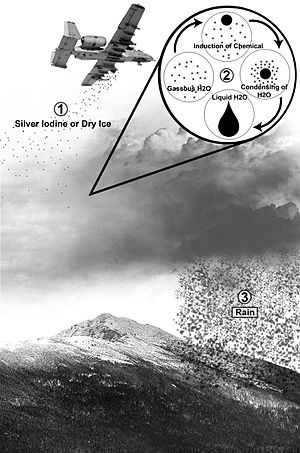 |
| Precipitation Process Source - en.wikipedia.org |
Silver Iodide has a crystalline structure very similar to that of ice and it is assumed that existence of this structure induces freezing temperatures that convert water vapor into super-cooled liquid water.
Dry ice achieves the super-cooling effect by its expansion that in turn super-cools water vapor.
Rainmaking using silver iodide or solid carbon dioxide both require existence of liquid droplets in super-cooled air.
These initially miniscule liquid droplets serve as the base for liquid and ice droplets to grow to a size large enough that they end up falling to the ground.
Cloud Seeding Goal
Lots and lots of rain is the goal of cloud seeding. Humanity cannot, however, capture much, if any, of this rain and, typically must wait for hydrological processes that add this artificially produced rainwater to existing reservoirs of liquid water that are water is being drawn water from.
Obviously, cloud seeding is an option for supplying multiple acre-feet of water rather than the few liters each individual requires.


