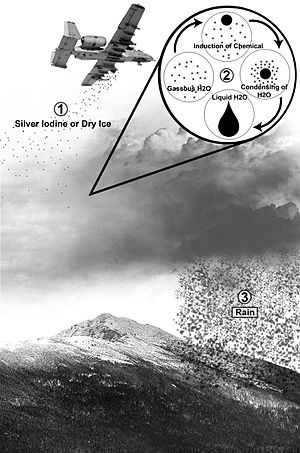
We all know from experience that the darker a cloud the stronger the rainstorm it will produce.
Cloud Color and Rain Amount
From experience we know that there is a very strong correlation between the color of a cloud and the amount of rain it produces:
- the darker a cloud, the more rain we expect to get
or,
- the lighter (with the lightest being the whitest) a cloud the less rain likely.
Particulate Density
All clouds contain particles.
When sunlight passes through a cloud it gets scattered by these particles.
The more light scattered the less light emerges from the bottom of the cloud - the bottom is what we see and use to describe the cloud as a dark one or a light one.
Water Droplets and/or Ice Crystals
In addition to particles, clouds contain water droplets and/or ice crystals. These droplets and crystals also disperse the sunlight that falls on the cloud from above. As the density of these droplets and crystals increases, less and less sunlight is able to penetrate the cloud. This lack of penetrations darkens the color of the cloud.
So what we know from experience is true: The darker a cloud, the stronger the rain falling from it because it contains more water droplets and ice crystals
Cloud Color and Rain Amount
 |
| Dark Clouds Source - wallpapersget.com |
- the darker a cloud, the more rain we expect to get
or,
- the lighter (with the lightest being the whitest) a cloud the less rain likely.
Particulate Density
All clouds contain particles.
 |
| Light Scattered by Particles Source - http://www.cas.manchester.ac.uk |
The more light scattered the less light emerges from the bottom of the cloud - the bottom is what we see and use to describe the cloud as a dark one or a light one.
 |
| Light scattered by a cloud Source - tutorvista.com |
In addition to particles, clouds contain water droplets and/or ice crystals. These droplets and crystals also disperse the sunlight that falls on the cloud from above. As the density of these droplets and crystals increases, less and less sunlight is able to penetrate the cloud. This lack of penetrations darkens the color of the cloud.
So what we know from experience is true: The darker a cloud, the stronger the rain falling from it because it contains more water droplets and ice crystals