Saturday, September 29, 2012

Sound & Music Generated by Freshwater

We all are very familiar with freshwater's role in generating electricity, changing weather, growing food and improving health. But few of us are aware of how our ancestors used water to make sounds and music.
Playing a glass partially full of water
Source - invigorate.royalsociety.org
We have all tried this in our home one time or another. Fill a glass partially full of water and wet its rim and rub one finger along the rim.
Source - exploresound.org
The speed with which we move changes the sound that is produced. The sound produced also changes depending upon the amount of empty volume in the glass.
Lining up a few glasses with varying amount of water in them, creates a musical organ.
Water Driven Pipe Instrument - The Hydraulis
hydraulis circa 1,000 BC
Source - en.wikipedia.org
Water Organ
Source - en.wikipedia.org
With water supplied from some higher point above the instrument, air is introduced in the water stream that is turning a musical cylinder quite like in today's music boxes. 
As the air produces pulses in the water stream, the stream changes the rotation of the musical cylinder to produce changes in sounds - changes that together produced music as early as 3rd century BC.
The Hydraulophone
A Hydraulophone
Source - en.wikipedia.org
Blocking the flow of water can also be done with the fingers somewhat like the plucking of guitar strings. When a stream of water is stopped by a finger it changes the sound the instrument makes.
In the hydraulophone, water is also sometimes used to make the sound

Water, a most abundant substance on the planet, also has a vast abundance of uses.

Saturday, September 22, 2012

Water + Gravity = Tools to Tell Time

The sundial and water clocks are probably the oldest instruments whose function was to tell time. As long-ago as 4,000 BC, we were using gravity and water to measure time.
Inflow Timekeepers - The ghati
A Coconut Shell with a hole
Source - sciencephoto.com
These timekeepers measure time by how long it takes for water to fill a container.
In India, the standard water clock was a 'ghati' that measured time in 24 minute intervals - 60 of which together made up a 21st century 24-hour day.
The ghati was half a coconut shell with a hole drilled to just the right size in it. When floated in a tank of water, the shell would slowly take on water till it sank.
The size of the hole and the coconut half-shell were such that it took 24 minutes for the shell to sink.
The ghati was in use for over 5,000 years all over the ancient world.
Outflow Timekeepers - The Klepsydra
A Klepsydra
Source - depthome.brooklyn.cuny.edu
These time keepers measure time by long it takes for water to empty a container of fixed volume.
The jar at the higher elevation is filled to a fixed height. Water flows out of the hole at the bottom into another jar.
The klepsydra was made in the conical shape (a wide top and a narrow bottom) so that it would also be used to measure the passage of time. The conical shape ensured that the pressure at the bottom of the jar (that pushed out the water) remained constant as the water level dropped - A greater amount of water would flow out when the jar was filled, so that the surface level of the water in the jar would drop at a steady rate.

Water, a most abundant substance on the planet, also has a vast abundance of uses.

Saturday, September 15, 2012

Freshwater and Radio Waves = A Security Tool!

We depend on adequate supplies of freshwater for our food, energy, health and every other artificial creation of ours. Now, with advances in science and technology, freshwater is also key to our security needs.
Full Body scanners at Airports
Image from Full Body Scanners
Source - en.wikipedia.org
Full Body Scanner Equipment
Source - au.ibtimes.com
Transportation authouroties around the world have adopted a tool, the full body scanner, to ensure that no travelers take board prohibited items on board aircraft, trains and other mass transportation vehicles.
There are many technologies used to create images that can reveal prohibited items.
Terahertz Radiation
Terahertz radiation band
Source - teranova-ist.org
Light with wavelength between 300GHz and 10THz is known as Terahertz Radiation.
This radiation exists naturally and falls between infrared and microwave radiation.
A characteristic quality of Terahertz radiation is its ability to penetrate clothing and the human body but only to a very limited extend - freshwater just below the human skin stops and absorbs particular terahertz radiation
Absorption by Freshwater 
Terahertz Radiation absorbed by water vapor
Source - en.wikipedia.org
One form of body scanner works by firing radio waves of Terahertz length onto the human body and capturing the pattern of reflected and absorbed waves.
This pattern creates a body image of the kind full body scanners create to identify the existence of banned items.
As most metals do not absorb terahertz radiation, their existence can be confirmed in the pattern and the image. As most banned items are made of metals, the pattern can identify items hidden in clothing that could be one of the items banned from being transported on planes and trains.
Commercial Use of Terahertz Radiation
A Custom Clothing Machine
Source - digitalstyledigest.com
The first commercial application of freshwater-based body scanners is a set of machines that have been deployed in some specialty clothing stores.
These machines create an exact outline, in 3-D of the human body so that fitting clothes, for each of our individual body contours, can be found or manufactured.
These machines fire radio waves in the Terahertz range and catch the returning waves to build a true 3-D outline of a body.

Can terahertz radiation be used to locate new sources of freshwater?

Saturday, September 8, 2012

Perspective & Predictability Define Scarcity!

Source - cartoonstock.com
"One person's junk is another person's fortune" goes the old adage.
The difference between "junk" and "antique" is predominantly one of perspective.
Perspective is, of course, itself influenced by many factors that vary widely because these factors are very individual and extremely personal in nature.
It's much the same condition with safe drinking water:
- Those that have enough cannot see how they could ever do with less 
- Those that don't have enough seem to find a way to survive with what they can get
Of course those that can only get less than the necessary minimum suffer ill heath and other debilitating impacts.
Is piped water available 365/24/7 the definition of no scarcity?
Bathroom plumbing
Source - avivimprovements.wordpress.com
In the middle of the twentieth century, piped water was the norm not the exception for most of humanity.
Now, at the beginning of the twenty-first century, a large part of humanity does not get piped water 365/24/7 although all permanent houses have the necessary plumbing in place - for these house dwellers, supply of water may be intermittent or only available for a few hours a week on a unpredictable schedule.
Using the definition of 365/24/7 piped water supply, a large part of humanity already is experiencing scarcity with more people joining this group daily.
Perspective is ruled by Existing Circumstances
Esher's Waterfall
Source - en.wikipedia.org
Esher's depiction of a waterfall is a great example of perspective. Only people who happen to be in the left tower and in the big house on the left, are the ones who experience the waterfall.
The former see water dropping from where they are, while the latter see water falling to where they are.
For everyone else, water is simply moving at the same level as, of course, water cannot rise against gravity.
When asked if receiving freshwater 365/24/7 is necessary, most people who don't have 365/24/7 water supply do not label regular continuous unavailability a problem. From their perspective, they can live with much less than 365/24/7 piped water supply. 
The opposite is true for those that are used to having water run out of a tap when they turn the tap on. For them scarcity has arrived, if there is no water, even for a few seconds, running out of any tap.
Unpredictability creates scarcity
Women fetching water
Source - artwolfe.photoshelter.com
Those with and without continuously piped water agree on one thing: water availability must be predictable.
Once predictability is assured, scarcity disappears for most every individual wherever they may live and under whatever circumstances.
Take the case of people, mostly all of whom are women and girls, who make daily long difficult treks for drinking water.
In their minds, fetching necessary drinking water is just a necessary chore they must perform daily. That's just part of their life.
They don't even consider fetching water a burdensome chore. It is those with piped water that call fetching water an unnecessary and unfortunate chore.
What is the Absolute Minimum amount of freshwater for Humans?
Water Meter
Source - caes.uga.edu
Humans loose water when they breathe and when they perform virtually any movement. Even the process of being alive (not counting breathing, uses up water.
At a United Nations conference in 1977, it was decided that an average human being requires 3 liters (3.2 quarts) of water under average conditions i.e. an person living in an average climate and doing the things that people do on an average.
But, of course, there is no average human being or average climate or average life condition. And, the 3 liters do not include water needed for cooking and sanitation and human hygiene.
Adding up these numbers in a practical way, the minimum required freshwater per capita is 50 liters (13.2 gallons) per day, it was agreed, for maintaining a person's body water balance and ensuring acceptable healthiness.
Is 50 liters/day/person truly enough?
Yes, if we ask those 2+ billion who live on less than 50 liters per day!
No, if we ask those that live on more than ten times the 50 liters per day!

So what's should be the freshwater supply target per head per day?

Saturday, September 1, 2012

Freshwater's Supply Chain is Unlike that of Any Other Resource!

Freshwater is a resource like no other. While differences between freshwater and other renewable and non-renewable resources are many, freshwater's supply chain makes freshwater a most unique natural and renewable resource. Nature delivers freshwater in ways it doesn't do for any other resource. 
Freshwater's Current 3-Source Supply Chain
Source - willoughby.nsw.gov.au
3 sources of freshwater exist for most human settlements. These are:
1. Rainwater that naturally falls on the settlement
2. Freshwater transported from near and far locations  to the settlement, and
3. Locally obtained water, usually from a combination of sources located at ground level (e.g. rivers and lakes) and below ground (e.g. wells that tap the local water table).
Some locations do not, of course, have all 3 sources available to them -  but most do, because this 3-source approach was seen as the most prudent and dependable one.
Threat's to the 3-Source Supply
All three sources can be threatened today in a variety of ways for human settlements in different locations:
1. Climate change has impacted the frequency, amount and location of rainfall.
2. The ability to bring water from remote locations is threatened by both dwindling resources at the remote location and the assertion of communities along the transportation route to the freshwater being transported.
3. Continued extraction of groundwater has lowered water table levels, in some cases to depths that are difficult to access.
Rainfall - Resource delivery on a near-regular schedule
Source - diswaterdrams.com
Other than freshwater, nature delivers no other natural resource on a fairly regular schedule to locations where the resource may also be ingeniously available in bulk. 
Delivery of freshwater as rain was probably of little value while humans were migrating all over the globe. Rainfall's value only became evident about 10,000 years ago, when humans chose to settle down in one place (and grow the food they needed) instead of moving around in search of food. Humans, in a sense, became dependent on rainfall at the start of the agricultural age.
Rainfall Dependency
Once reliant on rain to grow their food, humans became subject to the impacts of any change in rainfall delivery frequency, amount or location. And it is, in large part, this dependency that is shaping a crisis in freshwater supply - supply of rain is simply too undependable.
The one unique feature that defines freshwater delivery is today the one unique force behind freshwater scarcity and water security.


Saturday, August 25, 2012

Freshwater Innovations Fuel Population Growth!

While we may never know with absolute certainty the answer to the question: "Which came first, the chicken or the egg?" we can be reasonably sure that human population grew and thrived because required amounts of freshwater became available necessary to sustain growing numbers of people.
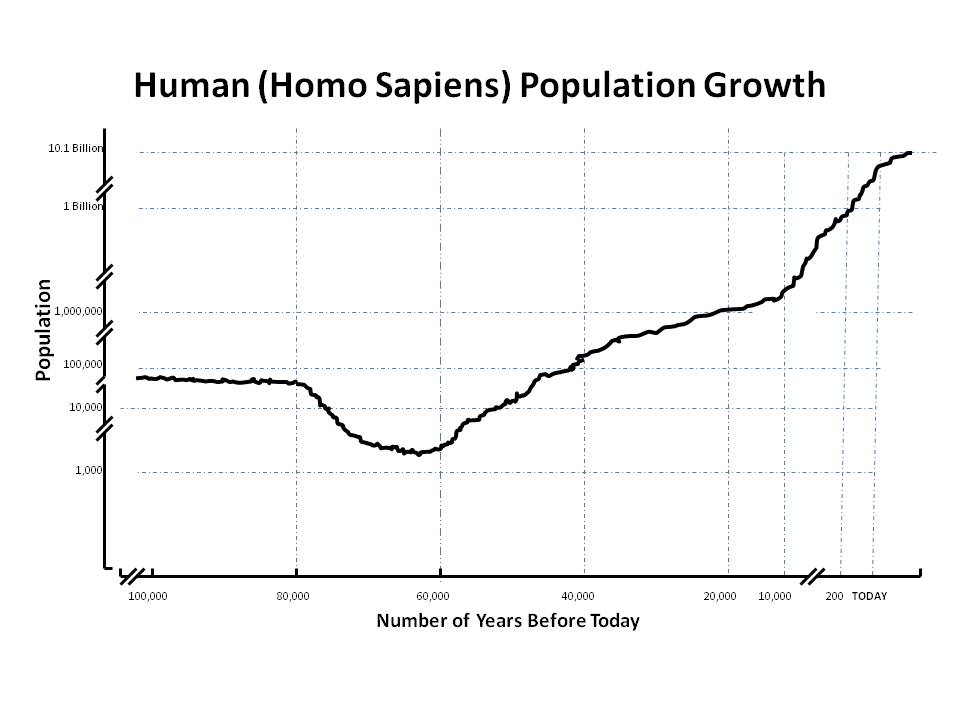
Human Population Growth
Source - Adapted from Page 15, of book titled
"Pandora's Seed" authored by Spencer Wells
Approximately 200,000 years ago, our breed of human (aka Homo Sapiens) originated in Africa. Only 60,000 years ago Homo Sapiens started to grow in number.
Some 10,000 years ago, however, this rate of growth accelerated dramatically - Human population grew thousand-fold, from 1 million people to 1 billion people, in less than 10,000 years. 
Role of Freshwater
Source - Ommato LLC
When key water-related innovations are superimposed on to the population graph, it becomes clear how these innovations influenced growth in numbers of people. Key water-related innovations included:
- About 10,000 years ago, humans dug a well to capture water they saw disappearing into the ground
- Some 7,000 years ago, irrigation was born when humans figured out that water would, on its own accord, move from higher levels to lower levels
- About 5,000 years ago humans made the artificial lake when they built a dam to stop a river from flowing
- Approx 4,000 years ago humans began to raise water from lower levels to higher levels with the invention of a Shaduf. This was quickly followed with the Archimedes Screw and the Waterwheel all increasing the height to which water could be raised.
- Around 300 AD, 1900 years ago, the Romans built their gigantic aqueducts to bring water from many miles away to their cities.
Impact of Innovations
Each innovation had its incremental impact. But as is evident from the chart, the greatest impact on human population numbers came from the inventions that raised water to very high levels and that transported water over long distances.

What innovations lie in the wings or are possible today, that will bring abundance to safe drinking water in the 21st century?

Saturday, August 11, 2012

Small Numbers and Water Sufficiency!

Small numbers, like everything else, when looked at without a framing context have no meaning at all and usually lead to the wrong conclusion. The oft-repeated statement "Only 2.5% of the water on Earth is freshwater" is factually correct considering the measurements and assumptions behind its quantification. But is it correct in implying that because 2.5% is a small number, it only represents a problem?
Lumps of Sugar
Source - blog.cytalk.com
If the question is: Are 2 lumps of sugar more than enough to feed all the ants in the world or would 600 lumps of sugar be adequate?
Source - twobitbard.weebly.com
The likely answer usually is: 600 lumps.
The primary reasoning behind this answer is the assumption that as 600 is more than 2, then 600 is likely to NOT be the wrong answer. And, as the convoluted logic goes, if it is less likely to be the wrong answer, then, of course, it is more likely to be right answer.
Source - clker.com
The other bits of assumption are what we know about how much sugar an ant requires and the actual size of each lump of sugar! And as we do not precisely know these bits of information, we go with the larger number i.e. 600 lumps while assuming the size of each sugar lump based on how large we think the spoon is. This spoon size is based on the spoons we usually use.
But what if each lump was 1kilometer long on each edge? And there were 150 Trillion ants in the world? Then too the larger number would be the answer, because the number is simply larger. Going with the larger number of 600 lumps is just safer because it is less likely to be wrong.
This logic applies also to freshwater supplies
Only 2.5% of the Earth's Water is Freshwater
Source - go.water.usgs.gov
What is the conclusion when we see the world's water (larger blue sphere) and freshwater in liquid form (smaller blue sphere), displayed relative to the size of the Earth? 
The 1st conclusion: We have very little water and even less liquid freshwater! (relative to the size of the Earth, of course)
The 2nd conclusion: We could quickly run out of freshwater! ... because see how little of it exists in comparison with the size of the Earth.
But what's our conclusion when we know the following:
The total amount of water on Earth is: 
- About 332,500,000 cubic miles (mi3) = 1,386,000,000 cubic kilometers (km3)
- The larger sphere is about 860 miles (about 1,385 kilometers) in diameter
The amount of Freshwater
If 2.5% of the total water is Freshwater, then the amount of freshwater is: 8,312,500 cubic miles (mi3) = 3,465,000 cubic kilometers (km3)
The size of these numbers makes it very difficult to reach a conclusion one way or another! Even conceptualizing how large (or small) a cubic mile is, is difficult for most of us.
The Takeaway
Small percentages do not necessarily imply insufficiency or sufficiency.
Much more analysis is required before we can judge if we are facing freshwater insufficiency or insecurity anytime in the near or far future.

Saturday, August 4, 2012

The Energy-Freshwater Nexus

Humanity has created an inter-dependency between water and energy that would be impossible to take apart. The most recent example of this inter-dependency are the recent blackouts in India.
600+ million people without electricity
Auto traffic at a standstill
Source - geekosystem.com
Candle light for a haircut
Source - theaustralian.com.au
While the causes of the blackouts of July 2012 are still being determined, a root cause has been suggested: "... northern states may have been drawing more than their allocated power quota to help stricken farmers pump groundwater from bore wells ..." (The Financial Times dated 30 July 2012).  This large and unprecedented demand for ground water was fueled by a large monsoon deficit.
Hydropower
Tehri Hydroelectric Power station - India's largest
Source - wikipedia.org
Freshwater is also the fuel for 19% of India's electric power supply.
As in most parts of the world, the first electric power generating station in India was also a hydroelectric station commissioned in 1897.
This nearly one-fifth of India's electricity generating capacity requires reservoirs of freshwater which, in July 2012, dropped to just 24% of their capacity.


Water Consumption for Different Energy Fuels
Source - World Economic Forum
  • Minimal water is consumed in production of traditional oil and gas resources - 3 to 7 liters/GJ   (GJ=gigajoule)
  • Enhanced oil recovery require 50-9000 liters/GJ
  • Oil sands require 70-1,800 liters/GJ
  • Petroleum refining requires 25-65 liters/GJ
  • Unconventional gas resources require 36-56 liters/GJ
  • Corn grown for bio-fuels require 9,000-100,000 liters/GJ
  • Soy grown for bio-fuels require 50,000 - 270,000 liters/GJ
  • Coal mining requires 5-75 liters/GJ
  • etc
Energy production is water-intensive just like water production is now energy-intensive

Saturday, July 21, 2012

Why can't we see Water in the Air?

What we know reflects the questions we formulate which, in turn, limit the scope of the answers we get. These answers then tell us what we can do and, maybe, why.
Asking the right question about air we breathe!
Glass half full of water
Source - en.wikipwedia.org
Puddle
Source - roywater.com
When we look at freshwater we see it as something that exists in bulk, like a glass half full of water, a huge lake that we can jump into, a puddle that can wet our shoes.
From these experiences we jump to the conclusion, and remember it as knowledge, that when we cannot "see" any water it's because there is no water there.
This knowledge, based solely on experience, also makes us typically unaware of the air that surrounds us. Only when we have difficulty breathing, or breathe in something that we choke on, do we realize that the air exists and is bad.
Water we cannot see because it's bulk is so small
Water on a leaf
Source - savethepark.org
Water exists in the air as groups of molecules in gaseous or vapor form.
Liquid water molecules can combine into large enough bodies visible to the human eye, for example, in fog.
 These sets of molecules have body when compared to the molecules of air's other ingredients (Nitrogen, carbon-dioxide and other gases).
But these water molecule groups are so tiny when compared with drops of water that we can clearly see, for example, on plant leaves.
primarily dependent on temperature.

Just because we cannot see the water in the air around us , in the same air we breathe, it does not imply that air is devoid of moisture of any kind!

Saturday, July 14, 2012

Where On Earth Is the Water?

Ocean-water dependent species and ecosystems have two luxuries that freshwater-dependent species and ecosystems lack:
- Ocean-water exists in one BIG connected mass distributed all over the world. Freshwater exists in multiple locations all over the world
- Ocean-water exists mostly in just one form: as a liquid; Freshwater, however, exists in vapor (e.g. as a gas), liquid and solid (e.g. as ice) form
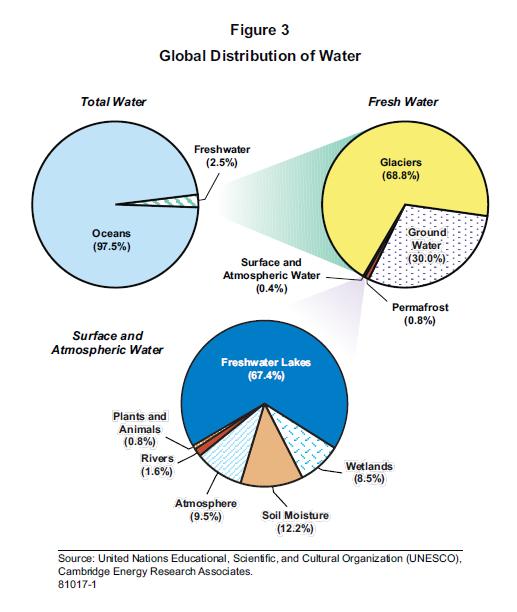
Global Distribution of Water
Water covers much of the Earth's surface:
- Ocean-water is the predominant (97.5% of the total) variety.
- Just 2.5% of the total water on Earth is freshwater. 
Freshwater Locations
Ignoring movement of freshwater between various deposits of freshwater on Earth, Freshwater exists in 8 locations:
- In glaciers as ice and in liquid form
- As groundwater in underground aquifers
- In Freshwater lakes
- In wetlands
- Dissolved in soil
- Suspended in the atmosphere
- In flowing rivers, and
- In plants and animals
Historical Sources of Freshwater
There are two types of sources that humankind has tapped for its freshwater needs:
A. Freshwater Bodies
Freshwater lakes, wetlands and rivers were humankind's earliest sources of water. These sources are still major sources of freshwater because they are continuously replenished. We may choose to extract freshwater at rates greater than the replenishment rate, but that is another subject.
Plants were probably a major source of freshwater for humanity, because all food contains freshwater. With the harnessing of agriculture (about 10,000 years ago) and the resulting improvement in diet, humans get a lot of their required freshwater from the food they eat and digest.
B. Water moving between bodies of freshwater
While all water is always in continuous motion, Evaporation and condensation are the primary ways freshwater moves between different freshwater bodies. 
Tapping New Sources of Freshwater
Of the 8 freshwater bodies, the single ocean-water body and the ways water moves between these bodies, there are only 6 possible new sources of freshwater:
1. The freshwater in the atmosphere is nearly 5 times MORE than the freshwater in all the rivers on Earth.
2. The freshwater in soil is nearly 6.6 times MORE than the freshwater in all the rivers
3. The freshwater in plants and animals
4. Artificially converting seawater into freshwater i.e. desalination.
5. Making freshwater from scratch - our bodies make between 300 and 400 ml of freshwater per day through the biological process of metabolism - hence our name for this water is "metabolic water"
6. Catching freshwater as it moves from one source to another - Rainfall is the predominant such source.
Increasing Freshwater Supplies
In addition to the above 6 choices, there exists, of course, the option to use less water by recycling used water, increasing water use efficiency and reducing the amount of water that is wasted.
The Task Before Us
Which of the above 6 "new sources" of freshwater and using less water should we focus on and why?

Saturday, July 7, 2012

How Long is the Future? - When Water Is the Topic!

We each have a different idea of the time period we are looking at when we talk about the future! So how do we get the global community of people and nations to work together on freshwater scarcity from which only a few are immune?
How Long is the Future?
Source - blog.enerdynamics.com
An interesting description of the question comes from Eric Schmidt, Executive Chairman of Google: "Based on their professions, people have different answers to the question “How long is the future?” If you are a political leader it is 2 years, 4 tears or 6 years. If you are a government worker it is 2 weeks or even 1 week because the budget has not even been approved. If you are in a company where your bonus is paid out at the end of the year and that is a majority of your compensation, then that's your future. If you are a long term owner who is largely prevented from selling any of your shares, the owner has a very different definition of the future? Politicians, for example, see the future in increments of a few years, while those who have long-term equity in a company see the future differently."
Freshwater's Role
Source - en.wikipedia.org
Freshwater is at the HEART of everything artificial and many many natural creations on Earth.
Included in the artificial creations are not only physical things and what we call 'stuff' but also political, economic and social stability, each of which also depends upon how long a freshwater-secure future we seek or envision.
The "Future" in Development: NGOs, GOs and others
Unfortunately, each organization's definition of "Future" differs in the development community. Some may be looking till the end of their latest funded project; others may be working within the funding cycles of their benefactors; still others may simply be waiting for their funding to run out; other's still may be run out of a location by factors they simply cannot influence. The "future" is different for each entity. So how do we reconcile these different definitions of the future when we talk about safe drinking water?
Is how we define Innovation, the key?
Source - fotolia.com
Any discussion of innovation is also never independent of time. Are we innovating to get through this winter? Are we innovating till the benefiting community moves to a new physical location? Are we seeking a better future for our children? 
All the questions include a presumption of a set time period in them.
The huge objects we have created (like dams, aqueducts, levees etc) were supposed to last for a very very long time and they have done so, sometimes to our regret because of unforeseen negative impacts on nature's creations and balance.
Our Freshwater Future: 10 years or less?
Source - vimeo.com
The earliest forecast date when we encounter dire water scarcity for many is the one that says: By 2025, as many as one-third of the human population (2.8 billion people) could be experiencing severe water shortages! And the vast majority of these people will be in the underdeveloped and developing world!
The period from the start of 2013 till the end of of 2024 consists of just 12 years. So, 
1. We have 12 years to make a lasting difference for 2.8 billion people.
2. The difference we make should last at least their lifetime i.e. our innovation should prevail over water shortages through a lifetime of 65 years (a fair global measure of life expectancy) at a minimum.
How many of our current efforts are good for at least 65 years?
But we have a decade to get it done!
Are we in the water development community working the plan to prevail throughout the 21st century and everywhere in the world , rather than enduring safe drinking water scarcity or severe water stress ?

Saturday, June 30, 2012

Freshwater - One Reason to Nix Solar?

Solar power, like every other fossil and renewable source of electric power (other than wind-generated power) is dependent upon adequate supplies of fresh water. The amount of water required varies with the type of process used to convert sunlight into electricity.
2 Major Types of Solar Generators
PV-based Solar Panel Power Generation
Source - europlas.co.uk
Solar Thermal Power Generation
Source - treehugger.com
Photo-voltaic (PV) and Solar Thermal are the two predominant technologies for converting sunlight into electric power.
Solar Thermal requires orders of magnitude more fresh water supplies than does photo-voltaic power generation. For example,a proposed Solar Thermal Power Plant to be located in Amargosa Valley, Nevada, required 1.3 billion gallons of water per year. This volume represents 20 percent of the Valley's available ground water supply - water that the desert Valley badly needs for other uses. This water usage level is of the order of use required by a coal-fired plant.
Photovoltaic power generation, on the other hand has a very minimal water requirement once it is installed and running. But its power generation capability is also limited to that of a single home or two. 
Sustainability
Shale gas extraction
Source - news.consumerreports.org
Depending upon definition, when water use is a criteria, some renewable energy sources begin to look unsustainable.
Even shale gas, will be deemed unsustainable when its water use is a criteria
Sustainable Electric Power Generation
Wind Power
Source - treehugger.com
Wind power is the only electricity generating option that has virtually no dependency on freshwater.

Saturday, June 23, 2012

Bottled Safe Water - Good or Bad?

Like the saying "Beauty is in the eyes of the beholder," local conditions and people's circumstances determine the acceptability of every action taken to quench thirst.
Water in Bottles
A sheepskin water container
Source - aliexpress.com
Carrying and transporting drinking water for personal and community use in containers fashioned from animal skins has been an accepted practice forever.
Source - rusmilitary.com

Early canteens for water carried by soldiers were fashioned to resemble historical containers created from animal skins.
Soda and Mineral Water Bottles
Source - sha.org/bottle/soda.htm
The first glass bottles were produced around 1500 B.C. but it was only after 1903, when the automatic bottle blowing machine was invented, that people started carrying their individual water supply in glass bottles.
For a long time, soda drinks and drinking water (containing minerals of many many kinds) was sold in glass bottles in stores where the bottle was recycled.
The Plastic Bottle
Source - plasticsareforever.org
It was only in the 1960s that plastic bottles (the PET bottle) became cheap enough to be used for dispensing water and other drinks.
The popularity of water in plastic bottles is so great that each year about 38 billion plastic water bottles end up in US landfills.
The water in these bottles can cost $1.50  or more - water that is available for free from public water foundation or for less than a penny at home.
Are Plastic Bottles Good or Bad?
The correct answer is: It depends!
As safe drinking water is easily and commonly available everywhere in the developed world, buying water in a bottle at 10,000 times what it would cost to get from a tap, may be seen as foolhardy and wasteful by some.
But what if bottled water was the only safe water available for miles around i.e. what if there was an implicit guarantee that tap water would be unsafe? Would the purchase of a bottle of water be then seen as foolhardy or wasteful?
Unfortunately, the former case is the typical case in the developed countries of the world, while the latter situation is the typical situation in developing and underdeveloped nations.
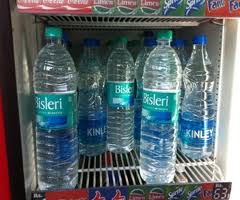
Safe drinking water in plastic bottles, at a cost that the lower class can easily afford, may be just the solution for people in the developing and underdeveloped world, when their tap water is unsafe!
Nigeria - Bottled Water Brand
Source - deparkbottling.com


India - Bottled Water Brand
Source - waterreview.in
Also, if the switch to water bottles engineered with cornstarch. instead of the PET process, can be quickly deployed worldwide, we will also be reducing the plastic decomposition time from 700 years to about 80 days!


Saturday, June 16, 2012

Commerce - A Water Scarcity Elimination Tool

Scarcity of safe drinking water is a problem as old as civilization. One solution in common use till the end of the twentieth century was commerce
Commerce
Source - housemedicalclinic.com
The most common definition of commerce is 'the exchange of goods and commodities' 
i.e. a transaction between two parties (individuals or societies or countries or geographical areas) that involves an exchange of one good or commodity from one party in exchange for another good or commodity from the other party.
Commerce is, of course, the backbone of economics and applies to everything that exists both natural and artificial.
Commerce is also behind many of the deals we have today that involve transporting freshwater over extremely long distances.
Los Angeles, California
Commerce between water-scarce regions and regions with surplus water was a common solution in earlier times.
Source - usc.edu
Source - circleofblue.org
In 1905, this city. with few local freshwater lakes or streams, acquired groundwater rights under 300,000 acres of land in the Owens Valley, to secure safe drinking water for its residents. The city built an aqueduct system to transport this water from Owens Valley to Los Angeles, a distance of over 220 miles.
In late 2011, Los Angeles' Municipal Water Authority has sued a local Ovens Valley Water District (Mammoth Community Water District) to ensure that the water in a creek, on land Los Angeles owns is exclusively available for use by Los Angeles only.
With safe drinking water security once again a looming concern, Los Angeles City is taking steps to reinstate its ownership on Owens Valley water.
in anticipation of water scarce times.
Globally, the aqueducts that exist on every continent and virtually every country are examples of commerce being a tool to eradicate water scarcity both within nations and between nations.

Saturday, June 9, 2012

Is SAFE DRINKING WATER the New OIL?

Analysts everywhere are eyeing the problems that humanity is having with safe drinking water supply, both in terms of quantity and quality, as possible new sources of large profits. "Water is the new oil" is the mantra of analysts seeking to publicize investment opportunities

The Global Water Industry
Source - snetglobalwaterindexes.com
The global water industry, about $360 billion in size, is the third largest industry in the world - behind petroleum and electricity. 
Globally, over 90% of water utilities are owned by governments. In Europe, 45% of utilities are privately owned with many owned and operated by publicly traded firms. In the US, only 10% of water utility companies are privately owned.
The opportunity to invest, of the kind that exists in the oil industry simply does not exist in the water industry.
Oil is NOT Water
Oil and water don't mix but they weigh about the same. Depending upon the type of oil and its density, 1 gallon of oil weighs 6-8 lbs, while 1 gallon of water weighs about 8 lbs. So, they are very similar in weight, but water is a resource that thrives on motion - water must always be moving. If held in a stagnant mode, water deteriorates quickly or simply evaporates or disappears into the ground. 
A Million Thirsts
Source - renalfellow.blogspot.com
Source - narrativeandotology.blogspot.com
Thirst is location specific. Each thirst reflects the unique cultural, human, industrial, agricultural, ecological and environmental issues of a location. The kind of pollution that may need cleanup is different in each location. 
The big similar solutions (like digging wells, building Dams, constructing aqueducts, etc) that supply the needs of a region have all seen their best days.
So how does an industry evolve such that it meets all the urgent needs? In three possible ways:
- Tap an existing global industry with a robust infrastructure available to support a variety of needs. Oil has just such an infrastructure today, but water does not.
- Create a global industry. It took over 75 years to go from individual oil wells serving a local need, to any oil well being able to serve a need anywhere in the world. Do we have 75 years and the billions to invest in building a global water industry?
-  Ignore "use, waste and demand" to focus only on supply. Desalination could fit this bill. Unfortunately, however, nearly all of the 15,000 desalination plants are privately owned but not publicly traded. Also, revenues from individual plants are so low that they are not viable candidates for stand-alone investment as water plants.


Thus, Water Cannot Be The New Oil - Those of us who envision participating in a 'market' in water, a market akin to the markets that exist for trading other natural resources, have a long wait ahead of us.

Saturday, June 2, 2012

A Common Remedy for Differing Freshwater Consumption?

The most commonly quoted global statistic is that 70% of the world's freshwater is used in agriculture, 22% to make the industrial (i.e. non-agricultural) goods we cannot do without, and 8% for residential and personal use by people. What this statistic is missing is that this global breakdown is not the situation in any country
How Freshwater is Actually Used
Source - Scientific American.com
From the accompanying chart it does indeed appear that the global segmentation of 70%-22%-8% for agriculture-industry-residential is quite correct but the segmentation of individual countries is quite different. 
The only point of agreement might be that, generally speaking, the major users of freshwater do consume the most in the agricultural industry and the least in peoples' home.
Some conclusions:
- China and India, the countries with the largest numbers of people, do use the most water as could be expected. The US is the third larger user of freshwater in the world
- Nigeria, the last country in the top 10 list, seems to consume nearly all its freshwater to grow food, with tiny amounts spent on personal and industrial needs.
"Virtual Water" Exporters and Importers
Virtual water is defined as the amount of water consumed to create a product that is exported or imported. The exporter if the product is labelled an exported of virtual water while the importer of the product is known as an importer of virtual water. Some interesting conclusions:
- The US, an extremely large consumer of freshwater measured in terms of "per capita consumption" is also a large exporter of virtual water through all the food stuff it exports
- Japan, a consumer of small amounts of freshwater, is the largest importer of virtual water.
Resolving the Freshwater Crisis
Recognizing the different ways individual countries consume their water, implies that a different remedy may be required for each countries' specific situation. This conclusion must, however, be balanced against the "time" it will take to develop and deploy all the many necessary solutions.
Would it not be ideal if we could all pool our resources to develop a solution applicable to everyone?
Making this point again using different words:
- What is the equivalent of the "cell phone" for the freshwater industry?
or,
- What, in the freshwater industry can lead to the same result as the cell phone did in the personal communications industry, namely, hook the 60%+ people who had no hope of getting a land-line connection in their lifetime, but got connected using wireless technology embedded in the mobile handset!