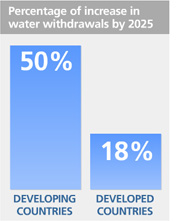
Like the saying "Beauty is in the eyes of the beholder," local conditions and people's circumstances determine the acceptability of every action taken to quench thirst.
Water in Bottles
Carrying and transporting drinking water for personal and community use in containers fashioned from animal skins has been an accepted practice forever.
Early canteens for water carried by soldiers were fashioned to resemble historical containers created from animal skins.
The first glass bottles were produced around 1500 B.C. but it was only after 1903, when the automatic bottle blowing machine was invented, that people started carrying their individual water supply in glass bottles.
For a long time, soda drinks and drinking water (containing minerals of many many kinds) was sold in glass bottles in stores where the bottle was recycled.
The Plastic Bottle
It was only in the 1960s that plastic bottles (the PET bottle) became cheap enough to be used for dispensing water and other drinks.
The popularity of water in plastic bottles is so great that each year about 38 billion plastic water bottles end up in US landfills.
The water in these bottles can cost $1.50 or more - water that is available for free from public water foundation or for less than a penny at home.
Are Plastic Bottles Good or Bad?
The correct answer is: It depends!
As safe drinking water is easily and commonly available everywhere in the developed world, buying water in a bottle at 10,000 times what it would cost to get from a tap, may be seen as foolhardy and wasteful by some.
But what if bottled water was the only safe water available for miles around i.e. what if there was an implicit guarantee that tap water would be unsafe? Would the purchase of a bottle of water be then seen as foolhardy or wasteful?
Unfortunately, the former case is the typical case in the developed countries of the world, while the latter situation is the typical situation in developing and underdeveloped nations.
Safe drinking water in plastic bottles, at a cost that the lower class can easily afford, may be just the solution for people in the developing and underdeveloped world, when their tap water is unsafe!
Also, if the switch to water bottles engineered with cornstarch. instead of the PET process, can be quickly deployed worldwide, we will also be reducing the plastic decomposition time from 700 years to about 80 days!
Water in Bottles
 |
| A sheepskin water container Source - aliexpress.com |
 |
| Source - rusmilitary.com |
Early canteens for water carried by soldiers were fashioned to resemble historical containers created from animal skins.
 |
| Soda and Mineral Water Bottles Source - sha.org/bottle/soda.htm |
For a long time, soda drinks and drinking water (containing minerals of many many kinds) was sold in glass bottles in stores where the bottle was recycled.
The Plastic Bottle
 |
| Source - plasticsareforever.org |
The popularity of water in plastic bottles is so great that each year about 38 billion plastic water bottles end up in US landfills.
The water in these bottles can cost $1.50 or more - water that is available for free from public water foundation or for less than a penny at home.
Are Plastic Bottles Good or Bad?
The correct answer is: It depends!
As safe drinking water is easily and commonly available everywhere in the developed world, buying water in a bottle at 10,000 times what it would cost to get from a tap, may be seen as foolhardy and wasteful by some.
But what if bottled water was the only safe water available for miles around i.e. what if there was an implicit guarantee that tap water would be unsafe? Would the purchase of a bottle of water be then seen as foolhardy or wasteful?
Unfortunately, the former case is the typical case in the developed countries of the world, while the latter situation is the typical situation in developing and underdeveloped nations.
Safe drinking water in plastic bottles, at a cost that the lower class can easily afford, may be just the solution for people in the developing and underdeveloped world, when their tap water is unsafe!
 |
| Nigeria - Bottled Water Brand Source - deparkbottling.com |
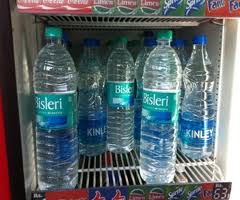 |
| India - Bottled Water Brand Source - waterreview.in |