Saturday, March 30, 2013

Water - A Flavor Enhancement Tool!

Whisky gets consumed most often after water has been added in either liquid or solid (i.e. ice) form. In fact, whiskey drinkers most always have a rigid preference of how water is added to their drink.
Water 'opens up' the Aroma
Source - toonvectors.com
For aroma to be present, particles (containing the aroma) have to dislodge from the whiskey surface and reach our nose.
Some particles are naturally released, but both too much aroma and too little aroma are undesirable. When aroma is naturally intense it can anaesthetise the nose and sear the tongue. This natural intensity grows with increase in alcohol concentration.
When aroma is insignificant, it inhibits our natural curiosity to figure out the aroma generally resulting in an unsatisfactory feeling.
Water inhibits or increases different flavors of aroma. Dilution releases additional aroma
Water promotes a Chemical Reaction
Ice and water added to Whiskey
Source - go-rio.co.uk
Addition of water dilutes the whiskey.
Addition of ice dilutes and cools the whiskey.
Esters and long-chained hydrocarbons exist dissolved in whiskey. When water is added, the solubility of these compounds decreases and increased aroma results.
Ice promotes a different chemical reaction
Ethanol molecules aggregate in large bunches (called micelles) and this bunching traps aroma particles.
As temperature drops, these micelles breakup and with the breakup aroma particles get released.
Thus, cooling enhances flavors that define each whiskey.

Saturday, March 23, 2013

2013 - Year of New Sourcing through Imagination, Ingenuity and Invention? Why Not?

Source - un.int
On March 21st the world celebrated World Water Day 2013.
The day's theme reflected the theme already proclaimed at the beginning of 2013: Year of Water Cooperation.
World Water Day - Over the years
World Water Day has been observed since 1993.The themes for World Water Day have been:
2013: Year of Water Cooperation
2012: Water and Food Security: The World is Thirsty Because We are Hungry
2011: Water for cities: responding to the urban challenge
2010: Clean Water for a Healthy World
2009: Trans Waters
2008: Sanitation
2007: Coping With Water Scarcity
2006: Water and Culture
2005: Water for Life 2005–2015
2004: Water and Disasters
2003: Water for Future
2002: Water for Development
2001: Water for Health
2000: Water for the 21st century
1999: Everyone Lives Downstream
1998: Groundwater – The Invisible Resource
1997: The World's Water: Is there enough?
1996: Water for Thirsty Cities
1995: Women and Water
1994: Caring for our Water Resources is Everybody's Business

Source - epa.gov

World Water Day has never emphasized New Water Sources:
- How to find them
- How to tap them
- How to deliver water from them to where it is needed by humanity or by nature
This missing empasis is especially tough to accept when we know that
(a) water exists everywhere
(b) everything contains water
in either solid, liquid or vapor form
What History tells us
Source - blog author

* Over 10,000 years ago, humans dug a well to obtain freshwater from an under-ground aquifer.
* Over 7,000 years ago, humans invented irrigation to deliver freshwater to their crops.
* About 5000 years ago, humans built a 15-foot high barrier to stop a river and create a lake from which they could extract freshwater at will.
* Nearly 2,000 years ago, humans created waterwheels to raise freshwater to elevations higher than that of lakes and flowing rivers.
* Some 150 years ago, humans invented indoor piping which was soon followed by the in-home boiler to supply domestic hot freshwater.
These inventions, of course, comprise only the very top tip of the iceberg of human ingenuity applied to obtain, transport and use freshwater from known bodies of water.
None of the above actions were accidental or done without intention or taken to satisfy intellectual curiosity. All of these actions were taken in the face of adversity. The people, they are always individuals never organizations, who made these inventions had their backs to the wall of water scarcity. They had to eradicate the real possibility of everyone they knew dying from lack of fresh water.
Searching for Water is NOT a new Task
As the dates clearly indicate, our search for freshwater is not a search new for us. Throughout our history, we have repeatedly reached the uppermost limits of the amount of freshwater readily available from water sources we know, either because our numbers grew too large or drought arrived. We have on a regular basis covered the distance, literally speaking, to find new sources of adequate freshwater supplies. There is now a large body of evidence that supports the notion that freshwater scarcity was behind human migration out of Africa 135,000 years ago. Other major human migrations, like the one 9,500 years ago in Chile were also in search of freshwater.


When freshwater supplies diminish and we must find new sources of supply, the promise of human ingenuity is a historic proven success story.

2013 - The Year of Water Exploration?

Thursday, March 21, 2013

March 21, 2013 - World Water Day

Source - UN.org


    "The fulfillment of basic human needs, our environment, socio-economic development and poverty reduction are all heavily dependent on water.
    Good management of water is especially challenging due to some of its unique characteristics: it is unevenly distributed in time and space, the hydrological cycle is highly complex and perturbations have multiple effects. Rapid urbanization, pollution and climate change threaten the resource while demands for water are increasing in order to satisfy the needs of a growing world population, now at over seven billion people, for food production, energy, industrial and domestic uses. Water is a shared resource and its management needs to take into account a wide variety of conflicting interests. This provides opportunities for cooperation among users.
    In designating 2013 as the UN International Year of Water Cooperation, the UNGA recognizes that cooperation is essential to strike a balance between the different needs and priorities and share this precious resource equitably, using water as an instrument of peace. Promoting water cooperation implies an interdisciplinary approach bringing in cultural, educational and scientific factors, as well as religious, ethical, social, political, legal, institutional and economic dimensions."
- http://www.unwater.org/water-cooperation-2013/water-cooperation/en/

Saturday, March 2, 2013

Lots and Lots of Water in the Atmosphere!


Total moisture in the atmosphere
In total there exists, at any one moment, 12,900 cubic kilometers of water in the atmosphere. 
Liquid water in air
98% of this moisture exists as vapor while 2% exists as liquid i.e. there are:
~ 258 cubic kilometers of water in liquid form in the atmosphere, and
~ 12,642 cubic kilometers of water in vapor form in the atmosphere
Using 1 cubic kilometer = 2.64172052 × 10¹¹ US gallons, there are:
~ 681.56 x 1011 US gallons of water in liquid form in the atmosphere, and
~ 33,396.63 x 1011 US gallons of water in vapor form in the atmosphere
Moisture in air replenishment rate
All the moisture in the atmosphere is, however, replaced every 9 days i.e. 12,900 cubic kilometers of water is delivered to the surface of the Earth from the atmosphere every 9 days i.e.
~ 681.56 x 1011 US gallons of liquid water falls on Earth every 9 days, and
~ 33,396.63 x 1011 US gallons of vapor water falls on Earth every 9 days
Water deposited on Earth from the atmosphere every day
~ 3,787 x 1011 US gallons every day
For a 10 billion human population, this is ~ 37,870 US gallons/person/day
What's behind global water scarcity?
Recognizing that ~ 37,870 US gallons/person/day is just NEW water and does not include water from rivers, lakes, underground aquifers and other sources, the question arises:
Why do we have a water scarcity issue in most places around the globe, today?
Granted, we cannot capture every, or even most, drops for humanity's use, water scarcity remains a challenge for human ingenuity in two ways: How do we capture precipitation in locations that nature chooses and how do we transport the collected water to where we want or desperately needs to have it?

Saturday, February 16, 2013

Rainfall Predictions Possible With Cell Phone Technology

Knowing how much rain falls on a location is key to determining if any unfilled thirst remains unfilled at that particular location. Unfortunately, however, knowing actual rainfall amounts has always been a very difficult task.
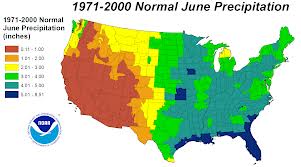
Typical Precipitation Map
Source - climatecentral.org
Resolution of data that makeup such a map is, at best, around 50 miles and is possibly as high as 100-200 miles. This data is gathered from rain gauges installed every 50, 100 or larger distances apart.
We are, however, very well aware that rainfall amounts are not usually similar or identical over a 50 mile or a 100 mile or a 200 mile square of area.
Using rainfall data from this map can lead to incorrect conclusions: thirst experienced by some farms can be overlooked, or, some farms that don't experience thirst can be targeted for additional water supply. In either case, resources expended to deliver water (safe for irrigation) will end up being misspent.
Radar Maps
Source - weathercentral.com
Doppler radar have better resolution that do rainfall data maps.
However, the installed base of Doppler radar sites are predominantly around major cities and population centers. Doppler radar, thus, provides us with high resolution rainfall maps in and around cities.
Farms or other remote agricultural locations have few of these radars and thus assessing their thirst is a problematic task
Towers (for mobile phones) may hold the answer!
For cell phones to work, microwave transmissions are relayed between individual towers. 
These microwave signals, between towers, are transmitted at a known constant strength that allows for signal decay over distance and for known weather conditions that might reasonably be anticipated. For a particular weather condition, the rate at which this signal falls off (or deteriorates) can be predicted for any set of towers.
When liquid water is in the air (i.e. it is raining), however, the signal between towers drops (is weaker) because a part of the signal is reflected off raindrops and does not make it to the next tower.
Depending upon terrain, towers can be just 1-2 miles apart.
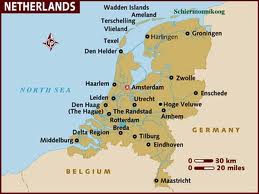
The Netherlands Experiment
Source - lonelyplanet.com
Netherlands, the country, has just 32 rain gauges, but about 8,000 mobile phone towers.
An algorithm has been developed that measures differences between normal (no rain) signal strength and signal strength when it rains.
An experiment was run, in September 2011, to see how well signal monitoring could measure actual rainfall amounts.
This test, conducted with data from just 2400 cell towers, mapped rainfall amounts very close to the measurements from a combination of radar and rain gauges.
Thirst in the Developing and Underdeveloped worlds As cell phones, and the towers that enable them, have become commonplace all over the developing and underdeveloped world, its a simpler step to use cell phone signals to measure and predict rainfall amounts in real time. The traditional alternative, involving radar and rain gauges, may not be necessary any more.

This post was inspired by an article in The New Scientist magazine

Saturday, February 2, 2013

Lightening Requires Liquid Water!

Without water in the atmosphere, there would be no lightening
Positive and Negative Electrical Charges
A Positive Charge
(A lack of Electrons)
Source - Wikipedia.org
A Negative Charge
(An excess of Electrons)
Source - Wikipedia.org
Excess or shortage in electrons determine the charge of an object.
An excess of electrons makes an object a negatively charged object.
A shortage of electrons makes an object a positively charged object.
Location of charged Water in air
Water droplets (liquid) with positive charges stay higher up in the atmosphere. Water droplets with negative charge stays lower in the atmosphere.
Separation of Charges Causes Charge Movement
Lightning is a transfer of electrostatic charges between oppositely charged regions of the sky in an attempt to equalize charges in these regions or the transfer of electrostatic charges between a cloud and the surface of the Earth.
Lightening locations
Lightning frequency map
Source - wikipedia.org
Lightening does not occur everywhere on Earth.
Most lightning occurs over land and in areas where convention currents in the air are the greatest as these currents promote separation of areas that contain oppositely charged droplets of liquid water.
The caution to stay away from water when there is atmospheric movement in charges, thus, makes excellent sense!

Saturday, January 19, 2013

Refraction Makes Water a Daylight Transmitter!

Water's refraction properties can bend sunlight, concentrate it and deliver the concentrated sunlight to areas where sunlight cannot naturally reach.
Refraction
Source
- chemicalparadigms.wikispaces.com
Refraction is the change in direction of a light wave that occurs when materials with different refraction properties transmit the light wave.
The refraction - change in direction - occurs at the point where one material meets another.
Refraction occurs when the light hits the surface of a new medium at an angle other than at 90 degrees i.e. the light does not hit the surface of the medium perpendicularly.
By putting different mediums in the path of a light ray, the ray can be bent to arrive at a location that the original ray cannot reach.
Lighting up a room in Brazil
Source - doorknob.com
Shacks with corrugated metal roofing and no electric connection are usually very dark places.
Source - doorknob.com
A solar bottle installed in a hole in the roof can help.
This is a sealed bottle half full of water and installed so that the water surface in the bottle is in line with the roof's outside surface.
Source - doorknob.com
When sunlight shines on the bottle, water in the bottle captures and concentrates the light and, in effect, acts as an electricity bulb installed in the roof of the shack.
To keep the water clean, a few spoonfuls of chlorine is added to the water. This water-chlorine mixture can provide light for a number of years.

Saturday, January 5, 2013

Water Vapor - The dominant Greenhouse Gas

The Earth's atmosphere is a blanket held in place by gravity and Earth's motion. The location of the Earth relative to the sun and the greenhouse effect of the atmosphere makes Earth a hospitable place for our kind of life
The Greenhouse Effect
Source - Wikipedia.org
The average temperature on the Earth's surface is warmed to 14 Degrees C, due to the Greenhouse effect.
The Greenhouse effect is caused by the gases that make up the atmosphere.
These gases increase the temp on the surface by reflecting back to the surface a portion of the radiation energy emitted by the surface. 
The emitted energy is a part of the solar energy received by the Earth's surface.
Contributions to the Greenhouse Effect
Source - eesc.columbia.edu
Different gases in the atmosphere influence the greenhouse effect in different amounts.
Under a clear sky:
 Water vapor:    ~60%

   (can range between 36% and 72%)
 Carbon Dioxide:~25%
   (can range between 9% and 26%)
 Ozone:            ~8%
   (can range between 3 and 8%)
 Trace gases      ~7%
   (methane between 4% to 9%
    Nitrous oxide between 3% and 9%)

Clouds add to the greenhouse effect.


Tuesday, January 1, 2013

2013 - International Year of Water Cooperation

The United Nations General Assembly has declared 2013 as the Year of Water Cooperation

"The objective of this declaration is to raise awareness of:
a. The potential for increased co-operation, and
b. The challenges facing water management in light of the increase in demand for water access, allocation and services" - Irina Bokova, Director-General, UNESCO


To open chart in a new window, click on: http://www.unece.org/fileadmin/DAM/env/water/mop_6_Rome/Background_docs/Timeline_A3_R3.pdf
Source - unwater.org


Monday, December 31, 2012

May All Thirsts Be Quenched Everywhere


Season’s Greetings
+
 The Very Best of Wishes
For Extreme Delight and Joy
To Become Routine
For You and Yours
In Twenty-Thirteen!

Saturday, December 8, 2012

263 Rivers on Land and 1 River in the Air!

Rivers are the oldest source of freshwater for humans, most ecosystems and most living species.
River Basins
A river basin is the land area from where water drains to feed rivers. The 263 river basins of significant rivers are fed by 45.3% of the land surface area of Earth. The 26 major river basins are shown in the graphic.
26 Largest river basins on Earth
Cartographer - Delphine Digout, UNEP/GRID-Arendal
Arid Areas
The most arid areas are those that do not have enough water i.e. are areas that are not in river basins: Southern California in The US, Western and Central Australia, The Mediterranean sections of Europe, North Africa and others are the  most arid areas on Earth.
The Missing but Largest River of all
Rainfed Agricuture
Source - fao.org
When land areas that serve as river basins are compared with those where rainfed agriculture is predominant, it becomes apparent that much of the water fed into rivers is water delivered by rain.
In a manner of visualization, rain too can be seen as a river in the air or atmosphere.
As is to be expected, the river in the air differs from the rivers that are on the surface of land:
- The river in the air is mobile and is subject to the movements of air streams (that carry the water in this river) in the atmosphere. Land based rivers are, over short periods of time, fixed in space.
- The river in the air is the original river of fresh water that feeds a land-based rivers.
100% of the water in rivers on land is in liquid for, while only 2% of the water in the river in the air is in liquid form. 98% of the water in the air exists as water vapor.

It is this river in the air, that we must find a way to tap when we seek to extract water in the air we breathe.

Saturday, December 1, 2012

The Most Water Loving Molecule in Nature: Hyaluronan

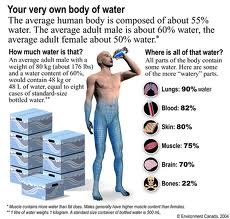
In some organisms 90% of their weight comes from the water that is in the organism. Human babies and kids have the most water (about 78%) which drops to 60-65% when they become adults. Adult women generally have less water than men do.
Human bodies and water
Source - ec.gc.ca
Every part of the human body is predominantly made up of freshwater.
Our physical body simply would not exist if freshwater did not exist.
We also would not exist for very long if we could not replenish the water lost by the human body. Continued availability of freshwater is absolutely necessary for humans and other life-forms to continue to exist.
But what keeps all this water together in the human body?

Hyaluronan
Source - vitanetonline.com
The "glue" keeping all this water in our bodies is a carbohydrate called Hyaluronan.
The average 154 lb. person has roughly 15 grams of hyaluronan occurring naturally and distributed over all parts of the human body.
Its consistent function in the human body is to bind with water and hold the water for use in individual cells of the human body.
Hyaluronan has a half-life of about 3-days in all organs of the body except in the skin where it's half-life is just about a day. As Hyaluronan decays more supplies are biologically synthesized in specialized areas of the human body,
Commercial Applications
Source - bueatyinthebag.com
Hyaluronan can be synthetically created and is the predominant ingredient in skin care products. As human skin ages, it looses its ability to hold large amounts of hyaluronan i.e. the skin is no longer as hydrated as young skin and shows wrinkles and feels drier when touched.

Now that we can commercially produce hyaluronan, can we use its water-loving (hydrophilic) properties to extract water vapor from the air we breathe?

Friday, November 30, 2012

Let Global Public Play With Science!

Source - Financial Times Newspaper
dated 16 Nov 2012
A note I wrote was published in the Financial Times Newspaper on 16 November 2012. 

The contents of this note essentially describe the approach that is applicable to producing the progress we desire on every one of our most intransigent challenges in the twenty-first century.

This is also a key element of the approach being used to create the means to extract water vapor from the air we breathe.


The note can be accessed online at http://www.ft.com/intl/cms/s/0/750f8a06-2e8d-11e2-9b98-00144feabdc0.html#axzz2CPXvG8qL

Saturday, November 24, 2012

Urbanization = Use Clean Water to Remove Dirty Water!

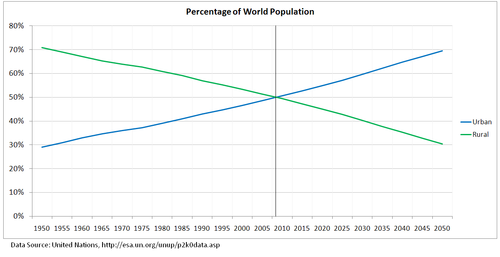
In 1950, with world population around 2.5 billion, there were just two cities (London and New York) classified as mega-cities because their population was more than 8 million each. In 2008, with the world population at over 6 billion, over 3 billion people lived in mega-cities distributed around the globe.
Migration to cities - Urbanization
Source - wikipedia.org
More than half the world's people live in cities today.
Meeting the concentrated water needs of these large numbers of people has led to the rise of urban institutions whose sole focus has been the supply and delivery of fresh water and of urban institutions responsible for removal of dirty water.
Clean water removes dirty water
Dirty and Clean Water
Source - trashwater.org
City dwellers use water differently than people living in rural areas.
In rural settings dirty water is left alone to either seep into the ground or evaporate into the air. Sometimes. to avoid it being a health hazard, dirt is added to the dirty water to absorb the dirty water and cover up its location.
In urban settings, however, the usual practice is to not allow dirty water to seep into the ground or evaporate into the air.
In urban areas, clean water is used to get rid of dirty water.
This increases the per-capita water requirements of city dwellers over people living in rural areas.
The most pronounced use of this practice is in the bathroom where water contaminated with human waste is flushed away by clean water.
Importance of Residential Water Consumption
Source - westbasin.org
Urban water is typically used for residential, industrial, commercial, and public purposes. In addition, minor amounts of water are used in urban settings for other purposes like fire-fighting, line-cleaning, and to make up system losses.
The largest amount of water is used in residences. For example, 66% of the total water, supplied by the Metropolitan Water District of Southern California, is used in residences of the approximately 15 million people living along the Southern California coast from Oxnard to San Diego.
This is 66% of an estimated 195 gallons per-capita per day. (source - paper titled "Determinants of Urban Water use" by W. Michael Hanemann).
It is estimated that over two-thirds of the residential supply (66% of 195 gallons per-capita per day) is clean water being piped in solely for the purpose of getting rid of dirty water!
Is there an innovation in clean water supply (like extracting water available in the local air) or in flushing away dirty water (like using composting toilets) - innovations that do not require the capital-expensive and costly-to-maintain water supply and waste extraction piping systems (both susceptible to leaks) of today?

Saturday, November 17, 2012

How does Water exist in Air?

Water molecules in the air exist like sand, salt and sugar molecules exist in a salt-sand-sugar mixture. The compound H2O is free and stands alone like a component in a physical mixture not as a component in a chemical mixture
A mechanical Mixture
Each component stands apart
Source - tojojoling.blogspot.com
Each piece stands apart
Source - cookteen.com
In a mechanical mixture, each component exists separately from every other component.
In a mechanical mixture, each component can be separated from all other components through a process akin to separating all the pasta or the red candy.
Air is a mechanical mixture of elements and compounds
Elements in the air include:
Gas
Ratio compared to Dry Air (%)
Chemical Symbol
By volume
By weight
Oxygen
20.95
23.20
O2
Nitrogen
78.09
75.47
N2
Hydrogen
0.00005
~ 0
H2
Argon
0.933
1.28
Ar
Neon
0.0018
0.0012
Ne
Helium
0.0005
0.00007
He
Krypton
0.0001
0.0003
Kr
Xenon
9 10-6
0.00004
Xe
Source - http://www.engineeringtoolbox.com/air-composition-d_212.html
Compounds in the air include:
Water, Carbon Dioxide, Sulfur dioxide, Methane, Nitrous oxide, Ozone, Nitrogen dioxide, Iodine, Carbon monoxide and Ammonia
Water exists in the air in 2 forms
The water in air exists in two states: about 2% exists in liquid form while the remaining approx 98% exists in liquid form.
The task of extracting water from the air is mostly a task of extracting the vapor form of water from the air.

Saturday, November 10, 2012

Wish Freshwater Scarcity was as Simple as the Fiscal Cliff !

The US Fiscal cliff and Global Freshwater Scarcity are quite similar but it is the differences that matter and push for a very similar remedy for both.
The US Fiscal Cliff
The US Fiscal Cliff
Source - healthreformexplained.com
The US faces a Fiscal Cliff on January 1, 2013 when a mix of spending cuts and tax increases go into effect unless a deal is reached between politicians in Washington DC by end of day December 31, 2012 - a little over 8 weeks from today.
The Freshwater Cliff, of course has two possible outcomes once the end of the 'ramp' is reached:
- Either gravity will take over and the US will drop down into whatever is at the bottom of the cliff and a number of unpleasant results will be felt
- or, the target on the other side will be hit and nothing with too extreme negative impacts will result.
The Global Freshwater Cliff
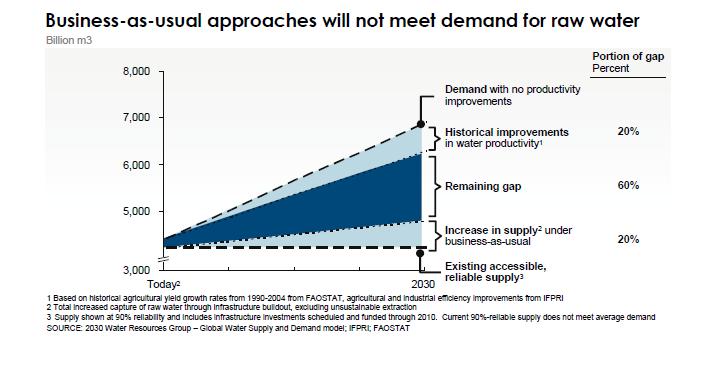
The Freshwater "Gap"
Source - World Economic Forum
While the fiscal cliff has either an acceptable or an unacceptable 'end', the Freshwater Cliff has NO END - the Freshwater Cliff only gets worse with time i.e. it has only a worsening prognosis. 
In the graph, the Freshwater Cliff is the dark area that continues to grow with time i.e. unlike the Fiscal Cliff, there is no target that can be defined like it can in the case of the fiscal cliff.
This essentially means that the "drop" from the freshwater cliff will continue forever till an effective remedy is found.
Representative impacts of the continuing increase in the "freshwater gap" include a combination of:
- more geographical areas experiencing shortages (droughts) and/or overwhelming supplies (floods)
- droughts and floods of greater severity measured in terms of their negative impacts
- greater uncertainty in freshwater supplies in more areas

The challenge, thus, from both the Fiscal Cliff and the Freshwater Cliff is the same: Find a remedy that ends the "fall off the cliff" quickly and with the least negative impact on life and livelihoods

Saturday, November 3, 2012

Freshwater Security: A Community or a Global Issue?

The only way I got my mother to stop using the phrase "Finish your food. There are starving children in .....(you can fill in the blank with the name of your favorite nation)" was by gathering the courage to say "Why don't we send the food to them?" Of course, such a delivery never took place but this conversation clearly showed me that human communities are in some ways totally independent from other human settlements.
Super-storm Sandy's early legacy
Super storm Sandy turns lights off
Source - news.yahoo.com
When the storm hit, power and services were lost in many areas of New York. Today, nearly a week later, Lower Manhattan and Staten Island are like world's apart even though they are just 10 miles, as a crow flies, from each other.
Electric power and many other services are fully operational in Lower Manhattan but not yet available for many Staten Island communities.
To residents of Staten Island without electricity, Lower Manhattan is today a world away.
Rich and poor nations share borders
Asuper wealthy country inext to a not-so welthy nation
Source - churchworldservice.org
This feeling of being a world apart, when you are really only next door, also separates countries e.g. The wealthy US shares a border with the developing nation of Mexico.
As we are well aware, rivers cross country boundaries and a truckload of case law and agreements specify how much water each country can draw from these rivers.
This inter-dependency with freshwater is one ordained by nature
Freshwater is both a Global and a Local Issue
If New York figures out a way to be freshwater secure, it does not imply that Miami cannot also be freshwater secure. However, if New York industries starts spewing excessive amounts of carbon in the atmosphere, it can impact the climate in Miami, which in turn could alter rainfall patterns for Miami. Freshwater inter-dependency, if any, for New York and Miami is the result of them being interconnected by the Earth's atmosphere. What one does to its atmosphere can and is felt by the other. Thus, freshwater security is typically a local issue if the atmosphere cooperates. When it does not, freshwater can become a regional and even a global issue.

Saturday, October 27, 2012

Why Sea Water Needs Cleaning!

Seawater is 97.5% of the total water on Earth. In times of drought and other thirst, humans have tried to cleanup seawater to turn it into freshwater. But so far we do not know how to transform seawater into freshwater economically and without severely impacting the environment.
Seawater has a composition much like the human body
Seawater composition
Source - earth.usc.edu
Recognizing that our ancestors originally lived in the sea, it is not surprising to find that the proportion of minerals and salts in human tissue is very similar to that in seawater.
Of course, the exact proportion varies around a similar mean proportion for individual seawater and human tissues.
Human bodies require the salt they contain.
Human bodies loose salt easily
Sweating, crying and urinating are some of the ways in which the human body looses salts. We must replace this lost salt but we cannot intake an excessive amount of extra salt. The excessive salt is bad for the cells that make up our bodies and organs like our kidneys.
What happens when we ingest more salt than we need?
Water moves out of cells to dilute the salt content to a normal acceptable level. This movement dehydrates cells and impairs their normal functioning. Seizures, unconsciousness and brain damage are some of the results of extreme dehydration or prolonged dehydration. Excessive intake of seawater is, thus, a life threatening issue for the human body.
Salt content of Freshwater
USGS has categorized different waters, based on their salt content in parts-per-million (ppm), as follows:
  • Fresh water - Less than 1,000 ppm
  • Slightly saline water - From 1,000 ppm to 3,000 ppm
  • Moderately saline water - From 3,000 ppm to 10,000 ppm
  • Highly saline water - From 10,000 ppm to 35,000 ppm
  • Ocean water - about 35,000 ppm
To avoid intake of excessive amount of salts, we must, therefore, clean up seawater (i.e. lower the salts it contains) before it is safe for human consumption. The process of lowering salinity or amount of salts in seawater is known as desalinization.