Saturday, July 16, 2011

100 gallons of Water Added into Air Daily by 1 Big Tree

Trees, and all plants do to some extent, recycle some of the rainwater that falls on them rather than let it all flow away


The "Smoke" in Great Smokey Mountains National Park
Smokey Mountains National Park
Source - art.com
The Great Smokey Mountains contain over 187,000 acres of old growth forest - the largest such forest east of the Mississippi. It got its name because, from a distance, this forest-covered range appears to be exhaling plumes of smoke into the sky above it.
But this is not smoke. This forest is usually covered in a mist that is the result of water vapor transpired by the trees and the natural fog created by water-laden air from the Gulf of Mexico that cools rapidly as it moves onto the higher elevations of the Appalachian mountain range.
Scientists estimate that a quarter of the rain that falls on these trees is transpired back into the atmosphere by the forest.


The Amazon Rain Forest
Source - travelblog.com
Trees in the 55 million year-old Amazon Rain Forest cover over 1.4 billion acres.
The forest gets about 9 feet of rain every year.
Scientists estimate that fully half the rainfall is transpired back into the atmosphere by trees of the rain forest. 
Estimates vary widely, but every canopy tree in the rain forest is estimated to transpires more than 00 gallons of water every day, during the growing season - this translates into adding over 10,000 gallons of water transpired into the atmosphere over the course of a summer from ONE tree.

Saturday, July 9, 2011

Global Warming Increases the Ocean in the Atmosphere

Increased water-holding capacity of the atmosphere and increased evaporation are together expected to increase the amount of water in the atmosphere.


Source - SuperStock.com
(1598R‑241586)
Water-Holding Capacity of the Atmosphere
On average, 2-3% of the molecules in the air are water molecules, with a maximum possible of 4% in warm and humid tropical locations.
However, as temperatures increase water vapor volume can exceed 4%, like in the inside of a boiling tea kettle.
Climate models, Earth-system science and satellite observations all conclude that as carbon dioxide levels increase, the air will heat up and water vapor volume in the air will increase beyond the maximum of 4%. 


Surface Evaporation
Evaporation is a continuous surface phenomenon that maintains an equilibrium between molecules leaving a water surface as vapor and vapor molecules being added to a water surface as liquid. As higher temperature implies more kinetic energy, there is more evaporation at higher temperatures


7% vs. 1-3% increase in water fluxes
Atmospheric studies and Earth System Science predict that for every degree Kelvin increase in surface water temperature, the ocean of water in the atmosphere will increase by 7%, while precipitation will increase between 1% and 3% - Source: Science, Vol 317, pages 233-235

Saturday, July 2, 2011

Planes may increase Precipitation

Motion through clouds can expand air and, through this expansion, the air is cooled to such a low temperature that vapor condenses to liquid and even forms ice crystals.


Water Droplets seen in Clouds That Planes Penetrated

Source - http://www.youtube.com/watch?v=pYWAR2OiiNg&feature=mfu_in_order&list=UL


As reported in the LA Times (2 July 2009 issue), a study has been completed by the National Center for Atmospheric Research in Boulder, Colorado, that links planes to precipitation.
The study focused on satellite images taken over a four-hour period of a cloud layer over Texas. The images revealed a series of holes and canals in the cloud layer, that upon analysis, were shown to be made up primarily of liquid water droplets.
Scientists measured the holes and canals, and through a review of FAA records, identified a full array of aircraft that were involved.


Expanding Air Enables Flight and Condensation
Computer models built as part of the study showed that the very same mechanisms that keep airplane aloft had cooled the air to the extent necessary to condense water vapor. Cooling of air was the result of ambient air being forced to expand around propeller tips and over a jet wing.


Condensation Nuclei NOT Needed
Typically, an increase in collisions between water vapor molecules and condensation nuclei is required to convert vapor molecules to liquid molecules. But, as this research shows, rapid air expansion by motion of airplanes can produce precipitation without requiring condensation nuclei.

Saturday, June 25, 2011

Our Atmosphere is the Most Active Water Reservoir

Freshwater stays in the Atmosphere's Ocean, on average, only 9 days.


Water Storage Reservoirs
Source - www.physicalgeography.net
A water molecule, either as a saltwater molecule or as a freshwater molecule, is stored in one of 8 reservoirs at any point in time - the atmosphere, oceans, lakes, soils, glaciers, snowfields and in the ground. Water molecules stay in different reservoirs for different periods of time.


Water in the Atmosphere has the smallest residence time

Average Reservoir Residence Times
ReservoirAverage residence time
Antarctica20,000 years
Oceans3,200 years
Glaciers20 to 100 years
Seasonal snow cover2 to 6 months
Soil moisture1 to 2 months
Groundwater: shallow100 to 200 years
Groundwater: deep10,000 years
Lakes50 to 100 years
Rivers2 to 6 months
Atmosphere9 days
Residence Time is the time, on average that a water molecule spends in a particular reservoir while moving through the hydrologic cycle.
As shown in the chart, water (in freshwater form) stays the shortest period (just 9 days, on average) in the atmosphere. 
Water in the deep ground, on the other hand has the longest residence time of 10,000 years.


The hydraulic Cycle is a Continuous Cycle
The hydraulic cycle never stops. Any efforts to extract water from the atmosphere will only speed-up the hydraulic cycle and reduce water's residence time, in the atmosphere to less than 9 days, on average.
The impact of human efforts to extract water from the atmosphere on Residence times is unknown as no significant extraction is currently possible or done. The efforts at seeding rain have so far been very localized efforts

Saturday, June 18, 2011

Water Makes a Leaf Stand Upright

Leaves wilt, most commonly, when water volume in its cells drop.


Turgidity
A Deflated Balloon
Source - simplystatedbusiness.com
A wilted cell is like a balloon that has lost its air. The pressure of the air inside the balloon, against the balloon wall, provides the rigidity required to maintain the shape of a balloon. 
Healthy Parsley Leaves
Source - faithforeverliving.org
The water inside a cell is like the air in balloons.
As the amount of water drops in a cell, the cell looses its ability to maintain its shape - the cell wilts like a deflated balloon because the pressure (known as Turgor Pressure) from the water in the cell against the cell wall drops.


Many Many cells
Cellular Structure of a Leaf
Source - exploratorium.edu
A leaf is made up of many, many cells. As individual cells loose the water contained in each cell, each cell wilts. Eventually this wilting is clearly visible as a wilted leaf.

Saturday, June 11, 2011

Our Regular, Renewable Freshwater Supply comes from the Air

Net daily precipitation of water vapor from the atmosphere is like a "river" from the world's Oceans to land. This 'river' delivers between 40,000 - 47,000 cubic km of freshwater, on average, every year forever.


Rivers seed and sustain life
Rivers are known by two attributes, their length and the amount of water they carry. 
Although the terrain for every river is vastly different, a river performs a function critical to life i. e. it continues to supply freshwater for humans and other living creatures, including, plants and nature's ecosystems.
This is one reason why all early human populations, everywhere in the world, began and multiplied on banks of a river.


Our Renewable Water Supply = 40,000-47,000 cubic km per year
Rain Cloud
Source - ed101.bu.edu
The vast ocean of water that exists in the Earth's atmosphere regularly delivers a river of water to land masses on Earth.
Discounting evaporation from land, net precipitation of water vapor in the form of dew, rain, snow, floods, hail, etc. delivers 40,000-47,000 cubic km of freshwater, on average, every year.
As long as the Sun continues to power the Earth's Hydrologic Cycle, this supply will continue.


Supply distribution is Uneven
Like rivers, however, this supply is not uniformally distributed on all the land mass on Earth or where people and living things congregate.
Also, it does not arrive on a schedule we can bank on. Should this be a problem in the Age of Humans?


The Age of Humans
It is now widely recognized that we humans have shaped the Earth to our preferences with so wide and deep an impact that we now play a very significant (some say predominant) role in 90% of the ecosystems that exist on Earth. The climate crisis is just one BIG example of our impact.
In this Age, is it not possible for humans to intensify and speed-up nature's evaporation-precipitation cycle to the advantage of all ecosystems and life on Earth, including our own?

Saturday, June 4, 2011

There's a Freshwater Ocean in the Air!

The global elemental water cycle (aka The Hydrologic Cycle) stores about 3.43 million billion US gallons of freshwater in the atmosphere at any point in time and precipitates the equivalent of 13 million billion US gallons of water on land every year


Our Sun is the Primary Driver of the Water Cycle
The Sun
Source - science.nationalgeographic.com
Freshwater in the atmosphere is water evaporated from land and oceans by the energy contained in sunlight.
Sunlight heats water on land and oceans causing some of it to evaporate into the atmosphere. 
Sunlight also creates air currents that raise the evaporated water vapor higher in the atmosphere and moves the water vapor using wind all over the globe.


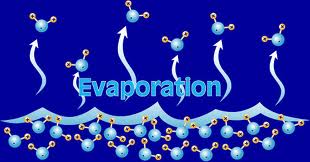
Water Evaporation into the Air
Evaporation
Source - aboutcivil.com
Between 496,000 and 460,000 cubic kilometers of water evaporates every year into the atmosphere. 
Of this amount 70,000 -73,000 evaporates from land while 390,000-423,000 evaporates from the oceans every year.
Evaporation adds between 1,359 and 1,260 cubic km daily into the air = the addition of 358,800 - 332,700 billion US gallons of water a day
References:
Principles and Applications of Aquatic Chemistry,By François Morel, Janet G. Hering
Industry, Fresh Water and Sustainable Development, WBCSD & UNEP, 1998Water - Facts & Trends - Ver 2, World Business Council for Sustainable Development

Saturday, May 28, 2011

Source of Water on Planet Earth

The Deuterium/Hydrogen ratio of water on Earth suggests that all the water came to Earth on meteorites,

The Deuterium/Hydrogen Ratio
Source - nasa.gov
Much of the Earth's hydrogen exists in two isotopes, namely, the commonly available Hydrogen and as "heavy" hydrogen (Deuterium). 0.015% of ocean water is heavy water i.e. made up of deuterium and oxygen.
Our bodies also contain about 5 grams of deuterium which is thought to be harmless to us in that quantity. At higher levels heavy-water inhibits cell function and is, thus, harmful to the human body.

Meteors and Comets
Comet Lulin
Source - Guardian.com.uk
Both meteors and comets contain water. Vaporization of the water, as a comet comes close to the sun gives comets their distinctive 'tail.
Meteors, on the other hand, contain only small quantities of water that land on Earth, if the meteor is not vaporised in the atmosphere. 
Meteors are named for their originating star and the pieces that land on Earth are called meteorites.
Meteorite showers occur almost annually.

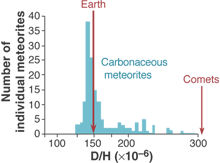
Differences in Water carried by Comets and Meteors
Source - Science Magazine 10 Aug 2001
The Origin of Water by Francois Robert
Analysis of the water contained on meteorites and comets clearly shows that meteorites contain water in the same deuterium/hydrogen ratio as exists on Earth. 
The water on Earth, thus, originated in meteorites.


Saturday, May 21, 2011

Water Helps Us "see" Air

Just like fish are unaware of the water they live in, we humans take our atmosphere for granted. However, water in the atmosphere periodically reminds us of air's existence especially when there is no wind that we can feel


Water droplets in the atmosphere
Source - nationalgeographic.com
Clouds are water droplets and ice crystals suspended in the air. 
Water vapor condenses to liquid form when the air becomes saturated and condensation nuclei are available to catalyze condensation.
The two common ways for saturation to produce clouds are:
  • Add moisture to the air through evaporation
  • Cool the air to its dew point

Artificial Clouds
Source - Wikipedia.org
Source - skystef.be
Carbon-dioxide and water vapor are the primary products of hydrocarbon combustion. 
Contrails, visible condensation trails, are formed behind aircraft when water vapor in the air and/or in engine exhaust condense. 
Contrails are more visible at higher altitudes where the temperature is low (-40 degrees) and where the reduction in pressure behind an airplane cools water vapor that can condense onto particulates in the exhaust.

Seeing our Breath
Source - sixmartinis.blogspot.com
On a cold day, we can "see our breath" because we exhale water vapor that becomes chilled to the point where the vapor condenses into a fog before our eyes.

Saturday, May 14, 2011

Song and Dance for Raindrops - Superstition or Science?

Many human communities have a long-standing belief that song and dance can deliver raindrops from the gods.


Nucleation of vapor into liquid droplets
Air may be under-saturated, saturated or super-saturated with water vapor. As 2% of the moisture in the air is always in the liquid state, the 98% of water in vapor form comes into occasional contact with water droplets in the air.
Thermodynamically speaking, both the under-saturated and the saturated conditions are stable, in the sense that the vapor and liquid states continue to coexist indefinitely unless a physical disturbance occurs. 
The super-saturated condition, however, is thermodynamically unstable i.e. the excess vapor in the air is actively wanting to exit from the air and is prone to doing so in liquid water form. In fact, if the super-saturated vapor comes into contact with liquid water droplets and continues to stay in contact for less than a second, this vapor condenses immediately to grow the liquid droplet.


Song and Dance create motion in air
Loud continuous sounds cause air to move (as sound waves cause tiny movements in the air) as does dancing that moves air in chunks the size of our human bodies. The net amount of physical movement of air is, of course, dependent upon the pitch and duration of the sounds we make and the intensity and continuity of our physical movement.
It is thermodynamically proven that on a cool still night, when air is saturated or super-saturated with water vapor, when this air contains water droplets of a critical size, the right intensity and continuity of sound and human body movement can condense water vapor into fog that eventually turns into liquid rain.


This use of sounds to produce rain is also documented in the rain dances in Africa and the use of yelling in the Yunan mountains of China.

Saturday, May 7, 2011

Our Atmosphere is the ONLY source of Freshwater

The ONLY source of 99% of ALL freshwater is water contained in the atmosphere. As 98% of this water is in vapor form, precipitation is the key to delivery of freshwater as rain, snow, dew and mist.

Freshwater - Definition
All water contains dissolved solids.
  • Water with dissolved solids that constitute <0.5 parts per thousand, is classified as freshwater
  • Water in the oceans contains 30-50 parts per thousand of dissolved solids 

Water and Life on Earth
Life on Earth, of every kind, depends entirely on a complex set of interrelated conditions - the most significant condition is that all cells have to continue to be 'wet' to function. Some cells can survive periods of dehydration but during periods of dehydration, they cannot perform their function.  
All cells reflect the different salt (saline) water environments that exist on Earth. Some exist only in the salt-waters of the oceans while others (including humans) cannot survive without freshwater.

Limited but plentiful resource
There is enough freshwater for all living things that require it. However, the total amount of freshwater available is limited by nature and this amount is more than adequate for all living things that require it. 
The limited supply of freshwater is continuously replenished by the Earth's hydrological cycle.
On an average, only 11 days elapse between the time water evaporates into the atmosphere (mainly from the oceans) and the time it drops at rain after being moved around by wind.

One estimate of global fresh-water distribution
Water sourceWater volume, in cubic milesWater volume, in cubic kilometersPercent of
freshwater
Percent of
total water
Lakes, swamps24,600102,5000.29%0.008%
Rivers5092,1200.006%0.0002%
Total global fresh water8,404,00035,030,000100%2.5%
Total global water332,500,0001,386,000,000--100%
Source: Gleick, P. H., 1996: Water resources. In Encyclopedia of Climate and Weather, ed. by S. H. Schneider, Oxford University Press, New York, vol. 2, pp.817-823.


Amount of Freshwater in the Atmosphere
The atmosphere contains 10.5 billion acre-feet of water at any instant in time. This water is more than 6 times all the water in all the rivers in the world.

The vast majority of freshwater is locked up in glaciers that constitute ice packs at the poles and on mountain tops, in the pores of rocks and underground.


Saturday, April 30, 2011

Extracting freshwater from the air is the only way to meet all our freshwater needs

The Earth has a finite amount freshwater and nature has made sure that we do not run out of it. We can waste freshwater, contaminate it and misuse it but we cannot destroy even a drop of it. All we can do and have done is tap its supply to the extent that our demand exceeds nature's freshwater supply.  


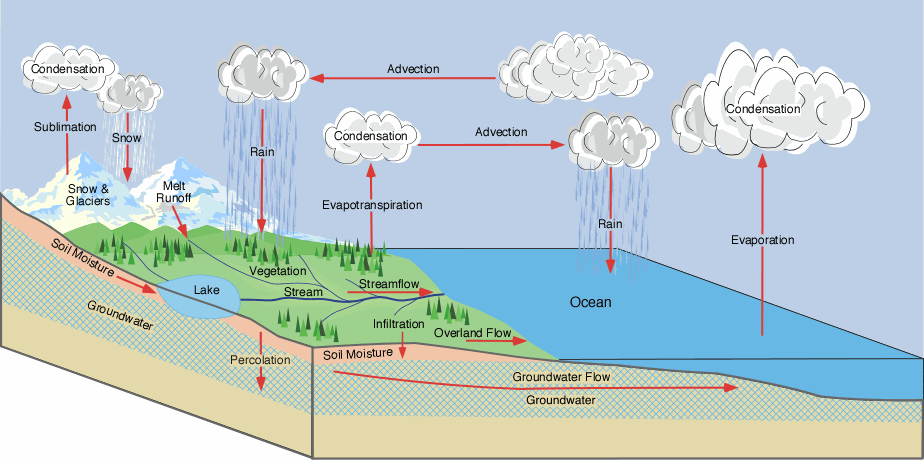
The Water Cycle
The Hydrological Cycle
Source - Britannica.com
Known in scientific circles as the Hydrological Cycle, this cycle continuously delivers freshwater into the atmosphere, rivers, streams, lakes and underground aquifers. This renewing supply is a continuous one and mankind has developed ways to extract freshwater from every source except the atmosphere. 


Freshwater in the atmosphere
There are approximately 10.5 billion acre-feet of freshwater in the atmosphere.
2% of this freshwater exists as liquid droplets while 98% exists as water vapor. 
The freshwater in the air is more than 6 times the freshwater in all the rivers in the world.


Mankind is appropriating 54% of all Freshwater from traditional sources
Source - unwater.org
At the global level, 70% of the freshwater is used for agriculture, 22% by industry and 8% by people for drinking, cooking, sanitation etc.
At a population of 6 billion, mankind is appropriating 54% of all the freshwater in rivers, lakes and underground aquifers.
Our freshwater use has grown at a rate that is twice the rate of population growth. Thus, if these rates of increase continue, when the human population hits 9 billion in 2050, we will be appropriating more than 81% of all the freshwater in all the rivers, lakes and underground aquifers.


Difficult Choices
Thus, we have, simply speaking, just two options:
- Dramatically reduce the amount of freshwater we use, or
- Create or open up a new supply source for freshwater


This blog's efforts are focussed on tapping Nature's hydrological cycle at its freshwater source - the atmosphere.

Saturday, April 23, 2011

Tears of Wine

Wine, a mixture of water and ethanol (a type of alcohol), exhibits a phenomenon that could be a part of the process to extract water vapor from air.


What is Air?
Air, is the name we have given to the atmosphere that is closest to the ground that contains a mixture (not chemical compound) of gases and water (in vapor, liquid and ice crystal form) that sustain and promote life, as we know it, on planet Earth.

Drops & Rivulets in a glass of wine
Source- www.monashscientific.com
Tears of Wine
Mixtures, that are physical and not chemical in nature, contain interfaces between the mixed materials. An example can be found by looking up in the air (an exaggerated one, I admit) - an interface exists between a cloud and the air around it. 
When an interface exists between materials that have very different surface tension forces, mass transfer occurs along their interface. 
The amount of mass transfer is impacted by a number of factors that include, amongst others,  the differing surface tension forces, temperature, pressure and evaporation rates.
This effect can be clearly seen in a glass of wine, in the formation of drops and rivulets on the insides of the glass surface above the wine surface.
Drops and rivulets in a wine glass
Source - newzstuff.blogspot.com
These drops and rivulets are the result of the different surface tensions of water and ethanol that constitute wine, and the fact that ethanol evaporates much faster than water does.
The scientific name for this phenomenon is: The Marangoni Effect.
In wine, as water and alcohol are not mixed completely homogeneously, different regions exist with different concentrations of water and of alcohol. 
In regions, where concentration of alcohol is greater, this alcohol pulls on the regions around it (where water concentration is greater) because the surface tension of alcohol is greater than the surface tension of water. The primary result is a movement of water away from alcohol and an increase in the separation between alcohol and water.
Moving a glass or
holding it at an angle
Source - 123rf.com
While this phenomenon was discovered and explained in the 1850s and 1860s, wine drinkers just know that they need to continuously move the wine glass in a circular pattern of motion to make the wine taste consistent and the one they had when the wine was pored from a freshly uncorked bottle.
This circular motion is really only focused on creating a more homogeneous mixture of alcohol and water. 
This motion does encourage increase in alcohol evaporation, and increased aeration (detrimental to taste and aroma?) but, hopefully, the wine is consumed before too much alcohol evaporates or too much air gets added to the mixture of water and alcohol.
Surface Tension Values Between Water and Air

Surface Tension 
InterfaceTemperaturemilliNewtons per meter
γ in (mN·m–1)
Water - air20 °C72.86±0.05[1]
Water - air21.5 °C72.75
Water - air25 °C71.99±0.05[1]

Saturday, April 16, 2011

A Water Drop is Usually a Sphere but Never Shaped like a Tear-Drop

The shape of a "free" drop (or droplet) of water varies with the volume contained in the drop but is never shaped like a "tear-drop" that we are all familiar with and use to represent water.

Possible Source of the Tear-drop Shape
Common Representation of a water drop
Source - free.clipartof.com
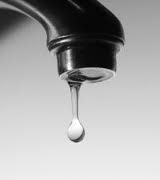
The widely recognized representation of a water drop, in the shape of a tear-drop (shown on the right) simply does not exist except in our mind's eye. This shape probably originated from our observation of the appearance of water clinging to a surface or immediately before dropping from a surface (like a dripping tap). 
Water dripping from a Tap
Source - head-first.co.u
k
Tiny drops of water
Source- Photography-on-the-ne
t
The Primary Shape of a Water Drop is a Sphere
Water drops, smaller than 2 mm in size, take the shape of a perfect sphere. 
The drop takes this shape as a sphere is the geometric shape that has the smallest surface area for a given volume (see April 9, 2011 post). 
Also, the mass of water contained in a drop of this small size does not experience enough gravitational force for the shape to be impacted significantly. Simply speaking, the gravitational force is much less than the force of the Hydrogen Bonds in a drop of water.


The Shape of Raindrops depends on the size of the drop
Shapes of Raindrops of fifferent size
Source - http://en.wikipedia.org/wiki/Drop_(liquid)
As raindrops fall through the air they experience resistance from the air. This resistance is larger for larger drops and is insignificant, like the force of gravity, on drops less than 2mm in size.
As raindrop size grows,however, from the  combination of individual raindrops, the air resistance and gravity increase till they force the breakup of the large raindrops into smaller raindrops. These smaller raindrops again start exhibiting the spherical shape and combine into larger drops once again. This process of starting with tiny drops that combine to form larger drops which then break up into smaller drops, only stops when  raindrops reach the ground or some structure on the ground.

Saturday, April 9, 2011

Why Does Water Form Drops?

Water forms drops whenever water molecules are attracted to each other by a force that is stronger than the attraction between water molecules and other molecules.

Water Beads into Drops in Air
2 water molecules conned by a "Hydrogen Bond"
Source-sweetwordsfromasourpatch.wordpress.com
Water molecules are made up of 2 hydrogen atoms and 1 atom of oxygen. These atoms are  arranged in a particular configuration that is unique to water molecules.
This arrangement of atoms produces a net charge (positive and negative) in different parts of the water molecule. This attribute of a water molecule is known as "polarity".
The existence of the negative and positive charges creates attraction (known as "hydrogen bonds") between water molecules.
In environments, like air, this bond is much stronger between water molecules than between a water molecule and any other negatively or positively charged molecule in air.
Water molecules forming 3-D structure of a drop
Source - ifm.liu.se
The result is the clustering of  a large number of water molecules together in a wide variety of configurations to form a 3-D structure, that we see and call a "water drop"

The shape is influenced by surface tension. More in my next post.