Showing posts with label deuterium. Show all posts

Saturday, August 13, 2011

Body Water Cycle Linked to Global Water Cycle?

How come the residence time that nature has established for water molecules on Earth and through the human body are so close and supportive of life? Are they interdependent in ways that we do not understand?


Water Residence Time in Human Body
Source - archive.stsci.edu.
Soon after the discovery of deuterium in 1931 , a Hungarian scientist, Gyorgy Hevesy and his colleagues used dilute volumes of heavy water to study the uptake of water by fish, other animals and humans.  
Gyorgy Hevesy
Source - nndb.com
Employing non-radioactive isotopes, like deuterium, Hevesy determined that "heavy" water, taken through the mouth, appeared in human urine (his own) after about 26 minutes. Also by monitoring urine levels, they were able to ascertain the average lifetime of a water molecule in the human body as 11-13 days.
Hevesy and his colleagues also used the same process to estimate the total water content of the average human body as 10 to the power of 27 molecules or 1,000,000,000,000,000,000,000,000,000 molecules. I have found no description of what an "average human" was commonly meant in Hevesy's time.
Water Residence Time in the Atmosphere
As described in the post dated June 25, 2011, water residence time is the lowest for water vapor in the atmosphere and equal to 9 days, as reported in Wikipedia. Other sources put this residence time at 11 days.
The residence time of water molecules is larger in all other stages of the global water cycle by orders of magnitude.


It is interesting to note that the residence times of a water molecule (on average) in the human body of 11-13 days, is just slightly larger than the residence time in the atmosphere of 9-11 days. Is nature taking care of living beings' water replacement need by making sure that rain and other forms of precipitation continuously provide new water in time to nourish life on Earth?

Saturday, May 28, 2011

Source of Water on Planet Earth

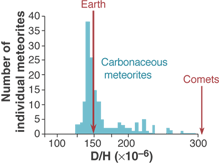
The Deuterium/Hydrogen ratio of water on Earth suggests that all the water came to Earth on meteorites,

The Deuterium/Hydrogen Ratio
Source - nasa.gov
Much of the Earth's hydrogen exists in two isotopes, namely, the commonly available Hydrogen and as "heavy" hydrogen (Deuterium). 0.015% of ocean water is heavy water i.e. made up of deuterium and oxygen.
Our bodies also contain about 5 grams of deuterium which is thought to be harmless to us in that quantity. At higher levels heavy-water inhibits cell function and is, thus, harmful to the human body.

Meteors and Comets
Comet Lulin
Source - Guardian.com.uk
Both meteors and comets contain water. Vaporization of the water, as a comet comes close to the sun gives comets their distinctive 'tail.
Meteors, on the other hand, contain only small quantities of water that land on Earth, if the meteor is not vaporised in the atmosphere. 
Meteors are named for their originating star and the pieces that land on Earth are called meteorites.
Meteorite showers occur almost annually.

Differences in Water carried by Comets and Meteors
Source - Science Magazine 10 Aug 2001
The Origin of Water by Francois Robert
Analysis of the water contained on meteorites and comets clearly shows that meteorites contain water in the same deuterium/hydrogen ratio as exists on Earth. 
The water on Earth, thus, originated in meteorites.