Showing posts with label residence time. Show all posts

Saturday, August 13, 2011

Body Water Cycle Linked to Global Water Cycle?

How come the residence time that nature has established for water molecules on Earth and through the human body are so close and supportive of life? Are they interdependent in ways that we do not understand?


Water Residence Time in Human Body
Source - archive.stsci.edu.
Soon after the discovery of deuterium in 1931 , a Hungarian scientist, Gyorgy Hevesy and his colleagues used dilute volumes of heavy water to study the uptake of water by fish, other animals and humans.  
Gyorgy Hevesy
Source - nndb.com
Employing non-radioactive isotopes, like deuterium, Hevesy determined that "heavy" water, taken through the mouth, appeared in human urine (his own) after about 26 minutes. Also by monitoring urine levels, they were able to ascertain the average lifetime of a water molecule in the human body as 11-13 days.
Hevesy and his colleagues also used the same process to estimate the total water content of the average human body as 10 to the power of 27 molecules or 1,000,000,000,000,000,000,000,000,000 molecules. I have found no description of what an "average human" was commonly meant in Hevesy's time.
Water Residence Time in the Atmosphere
As described in the post dated June 25, 2011, water residence time is the lowest for water vapor in the atmosphere and equal to 9 days, as reported in Wikipedia. Other sources put this residence time at 11 days.
The residence time of water molecules is larger in all other stages of the global water cycle by orders of magnitude.


It is interesting to note that the residence times of a water molecule (on average) in the human body of 11-13 days, is just slightly larger than the residence time in the atmosphere of 9-11 days. Is nature taking care of living beings' water replacement need by making sure that rain and other forms of precipitation continuously provide new water in time to nourish life on Earth?

Saturday, June 25, 2011

Our Atmosphere is the Most Active Water Reservoir

Freshwater stays in the Atmosphere's Ocean, on average, only 9 days.


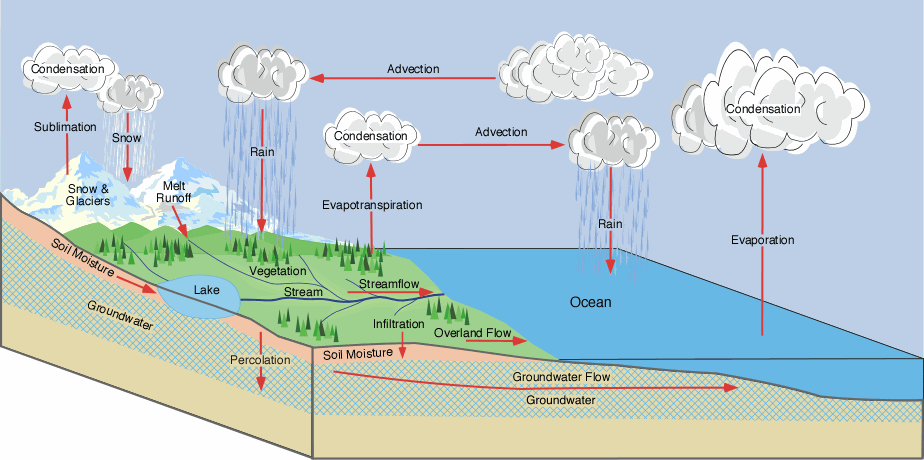
Water Storage Reservoirs
Source - www.physicalgeography.net
A water molecule, either as a saltwater molecule or as a freshwater molecule, is stored in one of 8 reservoirs at any point in time - the atmosphere, oceans, lakes, soils, glaciers, snowfields and in the ground. Water molecules stay in different reservoirs for different periods of time.


Water in the Atmosphere has the smallest residence time

Average Reservoir Residence Times
ReservoirAverage residence time
Antarctica20,000 years
Oceans3,200 years
Glaciers20 to 100 years
Seasonal snow cover2 to 6 months
Soil moisture1 to 2 months
Groundwater: shallow100 to 200 years
Groundwater: deep10,000 years
Lakes50 to 100 years
Rivers2 to 6 months
Atmosphere9 days
Residence Time is the time, on average that a water molecule spends in a particular reservoir while moving through the hydrologic cycle.
As shown in the chart, water (in freshwater form) stays the shortest period (just 9 days, on average) in the atmosphere. 
Water in the deep ground, on the other hand has the longest residence time of 10,000 years.


The hydraulic Cycle is a Continuous Cycle
The hydraulic cycle never stops. Any efforts to extract water from the atmosphere will only speed-up the hydraulic cycle and reduce water's residence time, in the atmosphere to less than 9 days, on average.
The impact of human efforts to extract water from the atmosphere on Residence times is unknown as no significant extraction is currently possible or done. The efforts at seeding rain have so far been very localized efforts