Precipitation of moisture in the air is the primary way that new safe water is delivered everywhere. Nearly all of this precipitation happens naturally as part of what we call the Water Cycle. If we could raise air artificially or manually, we could deliver safe water anywhere!
Air Circulation
Large-scale rising and dropping air is a characteristic of the atmosphere.
The location of both rising and descending air vary by location (by latitude and longitude) and by season (as the axis of the earth changes relatively to the sun as the Earth rotates around the sun.
The wettest areas are seen in the areas where air is 'naturally' rising i.e. at the equator and the mid-latitudes 40-60 degrees North and South.
The driest areas are seen where air is naturally descending: 20-30 degree North and South latitudes and around the poles.
Drivers of Rising and Falling air
The primary causes of air circulation are surface heating, terrain changes, convergence of air masses. There is more rainfall on higher elevations of mountains and as weather patterns create turbulence in the atmosphere.
The rising and falling air moves northwards or southwards by season i.e. how the earth is oriented relative to the sun.
Like mountains, the presence of large bodies of water also influences incidence and rates of precipitation.
Adiabatic Cooling
As air mass rise, pressure on the air mass drops and the air mass cools.
Air Circulation
 |
| Rising and descending air Source - adapaonline.org |
The location of both rising and descending air vary by location (by latitude and longitude) and by season (as the axis of the earth changes relatively to the sun as the Earth rotates around the sun.
The wettest areas are seen in the areas where air is 'naturally' rising i.e. at the equator and the mid-latitudes 40-60 degrees North and South.
The driest areas are seen where air is naturally descending: 20-30 degree North and South latitudes and around the poles.
Drivers of Rising and Falling air
 |
| Causes of Rising and Falling air Source - cmmap.org |
The rising and falling air moves northwards or southwards by season i.e. how the earth is oriented relative to the sun.
Like mountains, the presence of large bodies of water also influences incidence and rates of precipitation.
Adiabatic Cooling
 |
| Source - cmmap.org |
 |
| Source - |
 |
| Source - |
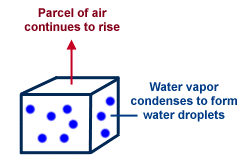
As rising continues, so does the cooling, till water vapor molecules condense and coalesce to form water droplets.
Intensity of precipitation increases as the depth of the rising air mass increases.
Is there any way for us to artificially raise large bodies of air that we know are full of water vapor?


