Saturday, January 22, 2011

Can Living Things Make Water?

Making water by combining its components, oxygen and hydrogen, requires a process we know very well from Chemistry textbooks, However, we do not know how to control this process in a way to safely manage the large amount of energy that the process releases. (see post dated November 9, 2010).Aerobic RespirationAll living things (Animals, humans, fungi, algae, bacteria and plants) breathe i.e. take in oxygen from the environment. Their body's biological process breaks down glucose in tissues to release energy.
This process can be over-simplistically described by the following equation:

  Glucose + Oxygen = Carbon Dioxide + Water + Energy

and chemically represented as follows:

   C6H12O6 + 6 O2     →     6 CO2 + 6 H2O  +  Energy

As shown in the above equation, this process creates water as a by-product while releasing energy in the form of ATP (Adenosine Triphosphate)

ATP is the main energy source for cell functions. About 30 molecules of ATP are produced from oxidation of 1 molecule of glucose. Some of the water released hydrolyzes ATP to ADP but the rest remains as water in a cell.

If we could synthetically perform the above, we will be creating water using a biological process that Nature perfected a long long time ago.Of course, the biological process of aerobic Respiration is not as simple as shown above and is better represented as follows:


This is the challenge faced by the emerging science of Synthetic Biology when the task is to replicate, scale up and commercially extract water from the atmosphere.

Image Sources: Solarnavigator.net; library.thinkquest.org, Wikipedia

Saturday, January 15, 2011

Nature's Water Purification Cycle

Water, the source of all life of the kind we know on Earth, is always in movement naturally – it is perpetually moving to a different location and changing its form. The energy source for this continuous never-ending transformation is sunlight.

The Water Cycle

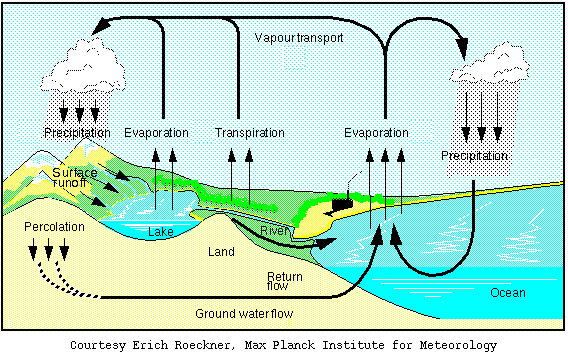
The figure on the right displays Nature's 4-process Water Cycle (also known as the Hydrological cycle).

The four processes are: 
  • Evaporation & Transpiration - this process removes salts and other ingredients from seawater and delivers pure fresh drinking water (as water vapor) into the atmosphere
  • Vapor Transport - this process ensures that the pure fresh drinking water is available everywhere
  • Precipitation (Condensation) - this process deposits the pure drinking water on the ground and facilitates a process called Chemical Weathering that scrubs carbon dioxide from the atmosphere and is part of Nature's Carbon Cycle
  • Surface and ground runoff - this process adds the results of the precipitation process into the Ocean

All of these processes are in various stages of progression at any one time time everywhere around the world.

Drinking Water

Water, fit for consumption by humans, animal, insect and plant life, is available in the atmosphere.

The appropriate name of the Water Cycle is Water Purification Cycle.

Saturday, January 8, 2011

Water From Air using ADSORPTION

The old adage “drops of water make an ocean” also applies to making AIR a universal source of fresh water – all that needs done is extract the first drop of water from air and then just keep adding new drops after they are extracted, onto the first drop.


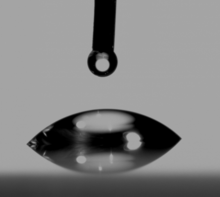
A water drop on a glass surface

The first water drop will look somewhat like the photograph (on the left) of a water droplet placed on a glass surface using a bulb dropper. In this photograph, the water droplet is not adhering in any way to the surface of the glass.


This photograph is, however, representative of a phenomenon that exists in both Chemistry and Biology called Adsorption.


Adsorption is the physical adherence of a material (the adsorbate, in either gas or liquid or solid form) onto a surface of another material (the adsorbent)usually by "bonding"  of ions, atoms, molecules or biomolecules between the two materials. 


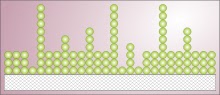
Adsorbate Molecules on Adsorbent Surface 
Adsorption results in increasing the total volume. Atoms on the surface of the adsorbent attract the adsorbate atoms and, thus, a layer of the adsorbate is created on the surface of the adsorbent. In reality the picture is more like the illustration on the right. Water, as adsorbate behaves exactly in a similar manner but its structure is not so well ordered


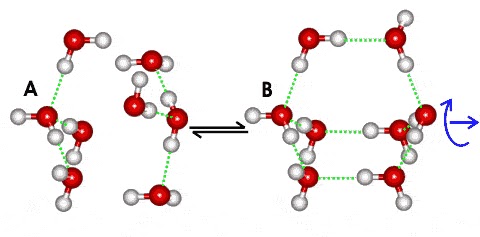
Water Clustering
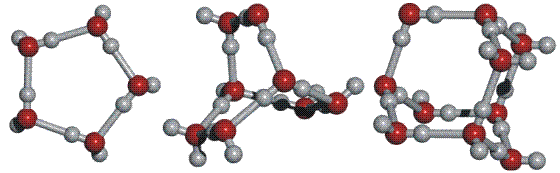
A unique property of water, due its unique physical molecules, is that water molecules cluster in nearly an infinite number of shapes, two of which are shown in the following illustration:


This ability to cluster and form new chemical forms gives water many of its unique properties. Desiccants (like silica gel) use adsorption to remove water from air.


Adsorption in Biology
In the Science of Virology, the adhesion of a substance to an organic particle, e.g. the adhesion of a virus to a cell, is also known as Adsorption. 


In Chemistry the adhesion is fueled by chemical bonds (e.g. by water's hydrogen bonds) while in Virology, viruses adsorb to their host cell surface via specific anti-receptor molecules, often glycoproteins. One example of glycoproteins found in the human body is mucins, which are secreted in the mucus of the respiratory and digestive tracts, where sugars attach to the mucins and give then considerable water-holding capacity.


It still remains to be seen if glycoproteins, and its brethren,can be used to extract water from the air in considerable volume!


Photo Sources:
http://en.wikipedia.org/wiki/Surface_energy
http://en.wikipedia.org/wiki/Adsorption
http://www.lsbu.ac.uk/water/abstrct.html#min

Saturday, January 1, 2011

Water and Happy New Year

The Best of Wishes,
for Manna from Heaven,
for one and all,
in Twenty-Eleven!

I send these wishes out at the New Year of the Georgian Calendar, but the significance of water to all life on Earth is well known and celebrated, albeit at different dates, by different cultures and peoples. 
Thales (~650 B.C.)

Water's purification and cleansing properties are celebrated by all religions in their own individual ways. 

Water also figures prominently in each of our myths of creation. Many traditions begin with the Earth being retrieved from an ocean or all living creatures surviving a flood . 

One philosopher (Thales, around 650 BC) even believed that all matter could be traced back to a single substance that, he opined, was water.

Making sense of the unknown through something intimately familiar is an art we even practice today. In years past, the most familiar entity to everyone was WATER!

Sunday, December 19, 2010

The Dance of Liquid Water

     Water is the only substance that naturally exists in 3 forms, as a solid (ice), as a liquid (the water we drink) and as a gas (water vapor). Water in the atmosphere exists in all three forms with the vast majority of water being in the vapor form.

Visible water in the air
     Clouds are the visible form of liquid water in the air. Clouds are formed when water vapor in the air condenses into liquid droplets that are so small that they are light enough to float in the air. For this change (condensation) in form to occur, water needs a non-gaseous surface. Physical particles that serve this purpose are known as cloud condensation nuclei (CCN).
     For clouds to be seen, water droplets need to coalesce (combine) into larger droplets. This coalescence typically happens when individual droplets collide as they move through the air. Water droplets combine with some difficulty (a direct result of the hydrogen bonds discussed in my post dated December 4, 2010) as illustrated by the gravity-fueled "dance" of a drop of liquid water that is falling onto a larger liquid water body, in the video below:


For clouds to produce rain drops, the CCN-created water droplets need to grow about a million times larger through numerous collisions.

Invisible (to the human eye) liquid water in the Air
     Liquid water droplets that are smaller than 0.02 mm in size that find a physical particle suitable for formation (from water vapor), can also be trapped between particles and stay in that 'normal' state for extended periods of time. Aerosol particles, by holding water droplets captive, contribute a continued and longer-term worsening impact on global warming.
     Initiatives that are efficient and effective at extracting this "trapped" water from the atmosphere and inhibiting continuing entrapment would produce both fresh drinking water and reduce Global Warming.    


References:
http://www.atmosphere.mpg.de/enid/850ac2615b35b9f50abbc96fa4273dbb,0/1__Clouds/-_Water_in_the_atmosphere_25n.html
http://www.youtube.com/watch?v=6KKNnjFpGto&feature=BF&playnext=1&list=QL

Saturday, December 11, 2010

Amount of Water in the Atmosphere

We know, all too well from personal experience, that the amount of water in air varies quite a bit over a day, over a month and over a year. We can sense humidity levels and have experienced how we sweat more and the sweat does not evaporate when air humidity is high. 


3413 Trillion US Gallons
     The US Geological Survey estimates the total amount of water in the atmosphere as 3,100 cubic miles or (at 1 cubic mile = 1.10111715 × 10¹² US gallons) 3413.463165 × 1012 US gallons.

     This is only about 0.001% of the total water on Earth .

Temperature & Humidity control amount
     The specific amount of water in the air varies with temperature and humidity.
     At 30 degrees Celsius, the amount of water varies from 0 grams per cubic meter in dry air to 30 grams per cubic meter (0.03 ounce per cubic foot) when the air is saturated.

        At a temperature of 50 degrees Celsius, there are 83 grams per cubic meter (0.08 ounces per cubic foot) when the humidity is 100% 

Relative
humidity
20
%
40
%
60
%
80
%
100
%
+50
°C
16.6
33.2
49.8
66.4
83.0
+40
°C
10.2
20.5
30.7
40.9
51.1
+30
°C
6.1
12.1
18.2
24.3
30.4
+20
°C
3.5
6.9
10.4
13.8
17.3
+10
°C
1.9
3.8
5.6
7.5
9.4
0
1.0
1.9
2.9
3.9
4.8
-10
°C
0.5
0.9
1.4
1.9
2.3
-20
°C
0.2
0.4
0.5
0.7
0.9


3 ways water ends up in the air 
     Evaporation - the process by which water is converted from liquid to vapor state and added into the air. Nearly 90% of the water in the atmosphere is due to evaporation from oceans, lakes and other large bodies of water
     Transpiration - The process  by which plants release water vapor directly into the air. This process accounts for nearly 10% of the water vapor in the atmosphere
     Sublimation -  The process by which ice changes directly (without entering the liquid state) into water vapor that ends up in the air. This is why ice, that has been in your freezer or the ice chest for a long time, looks 'different', tastes hollow, feels 'less cold' and crushes easily.

Mean Annual Precipitation = 1 Meter
    The mean annual precipitation every year is about 1 meter (about 3 feet and 3 inches). As this is water vapor condensed from regions close to the surface, it gives us a measure of the amount of water that circulates in and out of the atmosphere on an annual basis.
     Attempts to extract this volume of water through human endeavour would keep the hydrological cycle in harmony with its natural performance

99% of water is close to ground level
     75% of the air in the atmosphere and 99% of all the water in the atmosphere lie in the first 9 miles (15 kilometers) above the ground. This part of the atmosphere is called the Troposphere.

     The composition of the troposphere is uniform throughout its height (i.e. does not vary with elevation above the Earth) except in one way, namely, the proportion of water vapor is greatest closest to the ground and decreases as elevation increases.


References:


Saturday, December 4, 2010

What do Jesus Lizard, Life and Micro-Habitats have in common?


Basilisk, the lizard in the video is also called the Jesus Lizard because it can walk on water for about 15 feet when it's weight is about 250 grams. The lizard is able to accomplish this feat by trapping air and water bubbles in a web formation under its feet that assist it to stay above the water surface as long as it keeps moving.

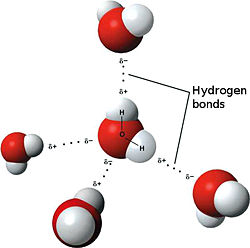
This ability of the Jesus Lizard is a result of the hydrogen bonds that connect water molecules. As shown in the diagram below, the positively charged hydrogen atoms are attracted to the negatively charged oxygen atoms. This  


attraction creates a very strong bond, that at the water's surface is responsible for the strong surface tension of water that also assists the Jesus Lizard to walk on the water's surface.


Life Requires Liquid Water
Imagine what would happen if water did not exist as a liquid over the range of temperatures that humans and other life forms can endure. If water at 98.6 degrees Fahrenheit (37 degrees Celsius) was a gas, imagine what would happen to the blood in our veins, the sweat we release, the tears we shed and the rest of the 68% of us that is water. Likewise, imagine if water at 96.6 degrees Fahrenheit (37 degrees Celsius) was a solid. Our saviour, and that of all water-based life, is the Hydrogen Bond.

Hydrogen bonds make water molecules stick together strongly enough to make water freeze at temperatures much lower than it would without them and make water boil at temperatures much higher than that if these bonds did not exist. Scientists tell us that water that boils at 100 degrees Celsius would, without the stickiness of hydrogen bonds, boil at temperatures well below -90 degrees Fahrenheit (-70 degrees Celsius). Life as we know it would not exist without the hydrogen bond.

Water Micro-habitats in the Atmosphere
Hydrogen bonds create the surface tension which, in turn, presents a barrier keeping air and water apart. This separation creates micro-habitats - small regions that contain some special features that suit one (or more) organisms better than it suits other organisms - in the atmosphere. The impact on air-borne organisms when water is extracted from air using biological means needs much further research and study.

Saturday, November 27, 2010

Water Vapor, Climate Change, 3+ Atom Molecules

Solving the world’s water crisis by extracting water from the air around us could also notably alleviate current trends in Climate Change, as water vapor is responsible for the predominant impact on global warming.

Water vapor is the most significant greenhouse gas
Different gasses in the atmosphere have different abilities to absorb, radiate and transmit heat (http://en.wikipedia.org/wiki/Greenhouse_gas):

Gas
 
Formula
 
      Contribution
(%)
Water Vapor
H2O
     36 – 72 %  
Carbon Dioxide
CO2
     9 – 26 %
Methane
CH4
     4 – 9 %  
Ozone
O3
     3 – 7 %  


Water vapor’s contribution varies due to environmental and atmospheric conditions:
-          Under a clear sky, this contribution ranges between 36% and 66%
-          Under a cloudy sky, this contribution ranges between 66% and 85%

Don’t create 3+ Atom molecules!
Nitrogen and oxygen, two gases that account for 80% of the atmosphere are not greenhouse gases because each molecule of nitrogen and oxygen in made up of two atoms. Water vapor, carbon dioxide, methane, ozone have 3 or more atoms and this makes them excellent absorbers of heat energy radiated by the Earth. Thus, any approach to extract water vapor from air that produces molecules with 3 (or more) atoms will not alleviate current trends in climate change and could further worsen them

Sunday, November 21, 2010

Harvesting Dew using Biomimicry!

The Groasis Waterboxx (www.groasis.com) has won Popular Science’s Best of What’s New Innovation of the Year Award (http://www.popsci.com/bown/2010/product/aquapro-holland-groasis-waterboxx) by harnessing some nifty nature-inspired (biologically-inspired) engineering.

Quoting Groasis’ website, “The Groasis waterboxx is an 'intelligent water incubator' that produces and captures water from the air through condensation and rain. The condensation is caused by artificial stimulation and the water is captured because of the design of the device, without using energy.” For a very instructive and entertaining animation visit www.groasis.com.

The design of the Groasis Waterboxx is a recent successful innovation based on the emerging science of biomimicry (the word is a combination of “bios”, meaning life, and “mimesis”, meaning ‘to imitate”) that looks at nature’s creations for mankind’s inspiration for building sustainable ecologically supportive solutions.

The most famous innovation using Biomimicry principles is, of course, Velcro. As described in Wikipedia (http://en.wikipedia.org/wiki/Velcro ) - This hook-and-loop fastener was invented in 1941 by a Swiss engineer, George de Mestral who lived in Commugny, Switzerland. The idea came to him one day after returning from a hunting trip with his dog in the Alps. He took a close look at the burrs (seeds) of burdock that kept sticking to his clothes and his dog's fur. He examined them under a microscope, and noted their hundreds of "hooks" that caught on anything with a loop, such as clothing, animal fur, or hair. He saw the possibility of binding two materials reversibly in a simple fashion, if he could figure out how to duplicate the hooks and loops. Other examples at http://brainz.org/15-coolest-cases-biomimicry/

Monday, November 15, 2010

US Precipitation - A potential new source of drinking water?

"...... the United States withdraws 339 Billion gallons of ground and surface water a day. Although 4 TRILLION gallons of water falls on us daily in the form of precipitation, much of that disappears in evaporation and runoff ......" (National Geographic Special Edition - Water: The Chaos of Supply).

Tuesday, November 9, 2010

Can we make water?

We know that a water molecule is made up of one Oxygen atom and two Hydrogen atoms and that hydrogen fires (hydrogen combustion) produce water and heat. What we don’t know is how to control hydrogen combustion. If necessity is indeed the mother of invention, we could learn how to control Hydrogen fires when the necessity for fresh water becomes highly acute.

The water molecule
Water is both a chemical compound and a charged dipolar molecule. One oxygen atom (the red one in the illustration) and two hydrogen atoms (the white ones) link together to form a water molecule”

To create water, both Hydrogen and Oxygen molecules must be present. Combining them is, however, a major hurdle as the mixture of Hydrogen and Oxygen is highly explosive because hydrogen is flammable, oxygen promotes combustion and the reaction to produce water releases large amounts of energy.
2H2 + O2 = 2H2O + ENERGY 572 KJ

The Hindenburg disaster
Water is the main by-product of any hydrogen fire. The Hindenburg, which carried over seven million cubic feet of hydrogen could, theoretically speaking, have created as much as half a million liters of water. While there is no practical way to confirm that the Hydrogen fire did indeed produce this much water, there are unconfirmed reports from people present on the ground of a ‘light rain’. It has also not been conclusively proven that the ‘light rain’ was not water vapor (present in the air) condensation.