Saturday, April 30, 2011

Extracting freshwater from the air is the only way to meet all our freshwater needs

The Earth has a finite amount freshwater and nature has made sure that we do not run out of it. We can waste freshwater, contaminate it and misuse it but we cannot destroy even a drop of it. All we can do and have done is tap its supply to the extent that our demand exceeds nature's freshwater supply.  


The Water Cycle
The Hydrological Cycle
Source - Britannica.com
Known in scientific circles as the Hydrological Cycle, this cycle continuously delivers freshwater into the atmosphere, rivers, streams, lakes and underground aquifers. This renewing supply is a continuous one and mankind has developed ways to extract freshwater from every source except the atmosphere. 


Freshwater in the atmosphere
There are approximately 10.5 billion acre-feet of freshwater in the atmosphere.
2% of this freshwater exists as liquid droplets while 98% exists as water vapor. 
The freshwater in the air is more than 6 times the freshwater in all the rivers in the world.


Mankind is appropriating 54% of all Freshwater from traditional sources
Source - unwater.org
At the global level, 70% of the freshwater is used for agriculture, 22% by industry and 8% by people for drinking, cooking, sanitation etc.
At a population of 6 billion, mankind is appropriating 54% of all the freshwater in rivers, lakes and underground aquifers.
Our freshwater use has grown at a rate that is twice the rate of population growth. Thus, if these rates of increase continue, when the human population hits 9 billion in 2050, we will be appropriating more than 81% of all the freshwater in all the rivers, lakes and underground aquifers.


Difficult Choices
Thus, we have, simply speaking, just two options:
- Dramatically reduce the amount of freshwater we use, or
- Create or open up a new supply source for freshwater


This blog's efforts are focussed on tapping Nature's hydrological cycle at its freshwater source - the atmosphere.

Saturday, April 23, 2011

Tears of Wine

Wine, a mixture of water and ethanol (a type of alcohol), exhibits a phenomenon that could be a part of the process to extract water vapor from air.


What is Air?
Air, is the name we have given to the atmosphere that is closest to the ground that contains a mixture (not chemical compound) of gases and water (in vapor, liquid and ice crystal form) that sustain and promote life, as we know it, on planet Earth.

Drops & Rivulets in a glass of wine
Source- www.monashscientific.com
Tears of Wine
Mixtures, that are physical and not chemical in nature, contain interfaces between the mixed materials. An example can be found by looking up in the air (an exaggerated one, I admit) - an interface exists between a cloud and the air around it. 
When an interface exists between materials that have very different surface tension forces, mass transfer occurs along their interface. 
The amount of mass transfer is impacted by a number of factors that include, amongst others,  the differing surface tension forces, temperature, pressure and evaporation rates.
This effect can be clearly seen in a glass of wine, in the formation of drops and rivulets on the insides of the glass surface above the wine surface.
Drops and rivulets in a wine glass
Source - newzstuff.blogspot.com
These drops and rivulets are the result of the different surface tensions of water and ethanol that constitute wine, and the fact that ethanol evaporates much faster than water does.
The scientific name for this phenomenon is: The Marangoni Effect.
In wine, as water and alcohol are not mixed completely homogeneously, different regions exist with different concentrations of water and of alcohol. 
In regions, where concentration of alcohol is greater, this alcohol pulls on the regions around it (where water concentration is greater) because the surface tension of alcohol is greater than the surface tension of water. The primary result is a movement of water away from alcohol and an increase in the separation between alcohol and water.
Moving a glass or
holding it at an angle
Source - 123rf.com
While this phenomenon was discovered and explained in the 1850s and 1860s, wine drinkers just know that they need to continuously move the wine glass in a circular pattern of motion to make the wine taste consistent and the one they had when the wine was pored from a freshly uncorked bottle.
This circular motion is really only focused on creating a more homogeneous mixture of alcohol and water. 
This motion does encourage increase in alcohol evaporation, and increased aeration (detrimental to taste and aroma?) but, hopefully, the wine is consumed before too much alcohol evaporates or too much air gets added to the mixture of water and alcohol.
Surface Tension Values Between Water and Air

Surface Tension 
InterfaceTemperaturemilliNewtons per meter
γ in (mN·m–1)
Water - air20 °C72.86±0.05[1]
Water - air21.5 °C72.75
Water - air25 °C71.99±0.05[1]

Saturday, April 16, 2011

A Water Drop is Usually a Sphere but Never Shaped like a Tear-Drop

The shape of a "free" drop (or droplet) of water varies with the volume contained in the drop but is never shaped like a "tear-drop" that we are all familiar with and use to represent water.

Possible Source of the Tear-drop Shape
Common Representation of a water drop
Source - free.clipartof.com
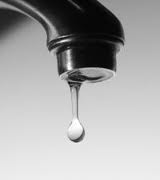
The widely recognized representation of a water drop, in the shape of a tear-drop (shown on the right) simply does not exist except in our mind's eye. This shape probably originated from our observation of the appearance of water clinging to a surface or immediately before dropping from a surface (like a dripping tap). 
Water dripping from a Tap
Source - head-first.co.u
k
Tiny drops of water
Source- Photography-on-the-ne
t
The Primary Shape of a Water Drop is a Sphere
Water drops, smaller than 2 mm in size, take the shape of a perfect sphere. 
The drop takes this shape as a sphere is the geometric shape that has the smallest surface area for a given volume (see April 9, 2011 post). 
Also, the mass of water contained in a drop of this small size does not experience enough gravitational force for the shape to be impacted significantly. Simply speaking, the gravitational force is much less than the force of the Hydrogen Bonds in a drop of water.


The Shape of Raindrops depends on the size of the drop
Shapes of Raindrops of fifferent size
Source - http://en.wikipedia.org/wiki/Drop_(liquid)
As raindrops fall through the air they experience resistance from the air. This resistance is larger for larger drops and is insignificant, like the force of gravity, on drops less than 2mm in size.
As raindrop size grows,however, from the  combination of individual raindrops, the air resistance and gravity increase till they force the breakup of the large raindrops into smaller raindrops. These smaller raindrops again start exhibiting the spherical shape and combine into larger drops once again. This process of starting with tiny drops that combine to form larger drops which then break up into smaller drops, only stops when  raindrops reach the ground or some structure on the ground.

Saturday, April 9, 2011

Why Does Water Form Drops?

Water forms drops whenever water molecules are attracted to each other by a force that is stronger than the attraction between water molecules and other molecules.

Water Beads into Drops in Air
2 water molecules conned by a "Hydrogen Bond"
Source-sweetwordsfromasourpatch.wordpress.com
Water molecules are made up of 2 hydrogen atoms and 1 atom of oxygen. These atoms are  arranged in a particular configuration that is unique to water molecules.
This arrangement of atoms produces a net charge (positive and negative) in different parts of the water molecule. This attribute of a water molecule is known as "polarity".
The existence of the negative and positive charges creates attraction (known as "hydrogen bonds") between water molecules.
In environments, like air, this bond is much stronger between water molecules than between a water molecule and any other negatively or positively charged molecule in air.
Water molecules forming 3-D structure of a drop
Source - ifm.liu.se
The result is the clustering of  a large number of water molecules together in a wide variety of configurations to form a 3-D structure, that we see and call a "water drop"

The shape is influenced by surface tension. More in my next post.


Saturday, April 2, 2011

Surfaces Tailored to Extract Specific Dissolved Material

The human lung is an example of a 'surface' that has been designed to extract oxygen dissolved in air. A by-product of this process is the loss of water that occurs when we breathe.


The Human Lung
Resembling a sponge, the human lung contains over 70 square feet of surface area for 
A microscopic view inside the human lung
Source-www.environmentalgraffiti.com-image 8292
absorption of oxygen from the air we breathe. 

In an unstressed but not totally relaxed state, an adult typically takes 16 breaths a minute that process nearly 2000 gallons of air in a day.

During such 'normal' breathing, the inhaled air travels at a rate of about 50 mph to the lungs and over the inner surfaces in the lung.

Composition of Inhaled and Exhaled breath
Only a fraction of the oxygen inhaled is extracted by the lungs (Source-Users.ren.com)
Component
Inhaled Atmospheric Air (% volume)
Exhaled
Air
(% volume)
N2 (plus inert gases)
78.62
74.9
O2
20.85
15.3
CO2
0.03
3.6
H2O
0.5
6.2

100.0%
100.0%
Exhaled air contains 120 times the moisture in the inhaled air. The typical human, thus, looses about half a liter of water through the act of breathing every day. This exhaled breath has a relative humidity of over a 100% and contains moisture picked up by the air from the moist surfaces of the lungs breathing passages.

Fish Gills
Just like human lungs are designed to extract oxygen from the air, fish gills are designed to extract oxygen dissolved in water.
When compared to water, air has over 20 times as much oxygen. Fish gills do their job in the oxygen-sparse water successfully, because the amount of oxygen required by a cold-blooded fish is very very small compared to that required by warm-blooded humans. 
It is for this reason, that whales who are warm-blooded need to surface periodically and 'breathe' the air.
And, it is for this same reason, that human lungs cannot breathe in water because human lungs do not have adequate surface area to extract necessary volumes of dissolved oxygen from water. Of course, evolution also is to blame as the linings of our lungs are probably not designed to function under water as they do in air.

Liquivent 
One way to help humans breathe under water would be to increase the amount of dissolved 
oxygen in water. Liquivent is just such a product in clinical testing - it is made up of per-fluorocarbons that can dissolve very large amounts of oxygen. It is expected that human lungs will be able to extract greater volumes of Oxygen without undue difficulty from per-fluorocarbons leading to smaller shoulder-tanks to breathe underwater.

Extracting water from air and wind may simply require the creation of a Liquivent-equivalent for water.

Saturday, March 26, 2011

We Use Water's Unusual Properties To Our Advantage

Dry air is heavier (more dense) than wet air, because water vapor is lighter (less dense) than air. We creatively utilize our knowledge of air density, that is also a function of temperature and pressure, to our advantage.


Baseballs Travel Further in Denver
 
The lower the air pressure, the less dense the air and the less the number of molecules in a unit of air. Thus,  a baseball (or any moving object) experiences less resistance (or drag) to its motion and ends up travelling a longer distance in air of less density.
Source - USAtoday.com
The baseball goes further as the reduced molecules in the air reduce the rate at which its speed slows.
This same effect is seen, but somewhat less obviously when the amount of water vapor increases in the air. Baseballs travel further in moist air where increase in the amount of water vapor reduces the number of molecules subjecting the baseball to resistance.


Indy 500 cars are designed with weather in mind
Source - farcaronline.blogspot.com
Dry dense air also slows a race car. But as high speed is a mandatory requirement, race cars are designed to take advantage of the drag produced by different weather conditions.
Simply speaking, the Indy 500 cars are designed to accept the drag to better hug the track i.e. make the drag push the car onto the track. 
While driving skills are of paramount importance, it is these design modifications that allow a race car to take a turn at 115 mph (without sliding off the track) instead of a slow 70 mph to win the Indianapolis 500.
The driver and pit crew cannot, of course, change the amount of water vapor in the air (humidity) or adjust the atmospheric pressure over the race track. 
All they know is the air temperature and how it is forecast to change while the race is being run. The design allows them to make adjustments to their car that will allow the driver to race with the optimum drag and, hopefully, win the race. 


NASCAR reduces drag with Nitrogen
Source - Nascar.com
Nascar races are run with stock cars - cars we all drive on city streets but strengthened a bit to accommodate more lethal accidents than those we expect during our drives. 
Nascar's solution to reduce air resistance, because they cannot make body design changes, is to use Nitrogen instead of air to inflate the tires of their cars. 
Nitrogen eliminates the small amount of water vapor that exists inside a tire filled with air. As the tire heats up, the water vapor increases the internal pressure in a tire and introduces instabilities that have greater impacts at higher speeds, reduces gas mileage, increases tire wear and reduces tire life. Nitrogen does not display any such negative characteristics.


NASCAR's solution is so appealing that many of us city drivers are starting to fill the tires of our cars with Nitrogen.

Saturday, March 19, 2011

Trees are Tall Because Water Can Move Against Gravity

Source - USDA Forest Service
The Sequoia Sempervirens (commonly known as The California Redwood) tree species has the tallest tree in the world, reaching a height of 379.1 feet. This height, a bit short of the estimated 430 feet maximum possible height for a tree, is the result of the tree's ability to develop an internal structure that water can use to rise from tree roots to the topmost leaves of the tree.


Water Molecule
Source- H2O_molecule_scheme_of_dipole.png
The unique shape of the water molecule, the shape that makes the water molecule a "polar" molecule, is used by the tree to design its internal water supply system that moves water up the tree. Simply speaking, water moves up the tree because it is "attracted" to the sides of the channels that the tree has created in its internal structure.


Capillary Action
Source - davidnelson.md.
Capillary action is the phenomenon that raises water molecules closest to a vertical surface (of the sides of a tube) because the attraction between the water molecules and the surface material molecules is high and the tube is so small that the water in the tube is unable to form a water surface, as shown on the right. 
When there is a very very tiny or no water surface, then the condition exists (called Capillary action) that all the water  molecules on the surface are "pulled up" and water rises against gravity.
Water in a narrow tube continues to rise due to capillary action, till the forces of attraction (between the water molecules and molecules of the wall material) are able to support the column of water that is formed in the tube. Measurement of this attraction force and calculations of water weight have shown that the maximum height that capillary action can transport water, against the force of gravity, is about 430 feet. So no tree can be taller than 430 feet in height. 


Capillary action is also behind the ability of water to move through soil from high humidity locations to low humidity locations.


Tree Leaves & Branches Are Smallest at the top
Source-hollowcreektreefarm.com
In especially tall trees, the number of branches, the length of a branch, the number of leaves and the size of a leaf all reduce as the height increases. 
These differences with height are due to the amount of water that the tree has available at different heights. As less water is available at greater heights, there is less need for longer branches, lots of leaves and leaves of larger sizes, because transpiration needs are less at greater heights
This reducing volume of water with height, produces the typical conical shape of trees.

Saturday, March 12, 2011

Water Vapor Permeability

Source -Diffanimals.com
Just like birds of a feather flock together, water is attracted to some surfaces and very little to others. Extracting water, that exists in both vapor and liquid form, from air can, thus, be facilitated either by choosing a naturally-available surface that attracts water droplets and vapor molecules, or by installing a nano substrate, that promotes moisture adsorption and/or absorption, onto the surface. Once water molecules arrive at the surface, one of two situations exist: Either the surface undergoes a transformation (that may be permanent or temporary) or the surface undergoes no transformation. The energy requirements to collect the water from these different surfaces are different. 


Water Vapor Permeability (WVP)
Source - CopyrightFreeImages.com
WVP is the rate of water vapor transmission per unit area per unit of vapor pressure differential.  If a water drop on a leaf stays as a drop the WVP of the leaf is near zero. Such a situation occurs when the attraction between water molecules is very much greater than the attraction between water molecules and the molecules at the surface of the leaf that come into contact with the water molecules. 
Source - psrc.usm.edu


Many novel membranes have been created that are almost impermeable to air but are permeable to water vapor. 


Nafion, a Dupont product, is one such membrane that is commercially available. Such membranes, which do not permit air to pass through them, but permit passage of water vapor, find important applications in power source, pharmaceutical and biotech industries.


The side of the Nafion membrane that comes in contact with water vapor develops a surface concentration in equilibrium with the vapor. With increase in time, the migration of water vapor occurs along the thickness direction of the membrane. 


Initially, a new dry Nafion membrane is impervious to air and large molecules of water and water vapor. However, once the membrane has been exposed to water vapor, the membrane chemically attracts the vapor and absorbs the vapor. The part of the membrane that absorbs water vapor becomes conducting to the vapor, while the rest of the membrane remains dry and non-conducting. Therefore, vapor transport through the
membrane is zero in the initial stages and gains speed once the moisture concentration on the far side of the membrane becomes greater than zero.

Saturday, March 5, 2011

Water Helps A Gecko Walk On Ceilings With a Small Human Child On Its Back

In the Simpsons Movie, Homer had to hold up his pig upside down, to realize his dream of owning a pig that could imitate a spider and walk on ceilings. He could have realized this dream and  
Source-thesharkguys.com
Gecko climbing the wall.
(Credit: iStockphoto/Luis Carlos Torres)
watched his pig from his favorite couch, if he had only known about nature's ingenious design of the underside of a Gecko's foot.All he really had to do was modify the underside of his pig's feet (to make them similar to the feet nature gave the common household gecko) and add a little moisture to the air in the room. 

Van Der Walls Forces
At the molecular level, all molecules experience some level of attraction. This 
attraction is electrical in nature and arises from the temporary fluctuating dipoles that are created by electron motion. 
A molecule that typically is symmetrical and has no electrical distortion, can exhibit an electrical charge when either a lot of its electrons happen to be in the same area of the molecule or when influenced by another molecule that is exhibiting an electrical charge. This temporary "sloshing around" of electrons creates fluctuating dipoles even in a 'normally' benign molecule.
Source-Labwater.com


And, as one would expect, in the presence of water that exhibits a permanent dipole charge, the molecular attraction is strong, long-lived and nearly permanent.


The Underside of the Gecko's Foot
Different types of geckos have different 'looking feet' but they all share a common characteristic - they can all interact with all kinds of surfaces at the molecular level and use this molecular attraction to scamper up walls and run around on the ceiling.
Different Gecko Foot Designs
Source-geckolab.lclark.edu 
Gecko Foot Hairs & Strands
Source-Sciencephoto.com
Each toe of a gecko's foot contains hundreds of pad like ridges. On each ridge are millions of hairs that each divide, at their ends, into smaller strands. These strands are so tiny that the molecules at their ends interact with the molecules of the surface the gecko is walking on. The presence of even minuscule amounts of water strengthens these attractive bonds between the gecko's strands and the surface. Maybe, this is why, the Gecko population surges after a monsoon rain when the moisture in the air makes the gecko most mobile on nearly every kind of surface.
In a laboratory environment, the Van Der Walls attraction forces between a single strand and a surface have been measured to support a weight of up to 200 microNewtons - enough to support an ant. With half a million strands on each foot a little gecko walking with 2 million strands can carry a back-pack weighing 90 lbs - the weight of a small child.
Capillary Contribution of water
Liquid bridges formed by water monolayers. between a surface and the strands under a gecko's foot, further increase the attraction bond (due to Van Der Walls forces) that enables the gecko to scamper up walls and walk on ceilings. This increase in adhesion force significantly increases with increase in surface hydrophilicity and increasing levels of humidity.


Capillary forces will be the subject of a future blog.
The task at hand is to use learning from a gecko's foot to use Van Der Walls forces to attract water molecules in the atmosphere using water molecules resident on a hydrophilic surface.


Saturday, February 26, 2011

Water Vapor Absorption and The Surface Law

Many of nature's crucial processes occur at surfaces. Nutrients, water vapor and other material are exchanged by cells at the surface of each cell. Liquid water evaporates into the air (as water vapor) from the surface of a body of water. Sunlight is absorbed at the surface of the leaf. 


Water vapor absorption and adsorption also requires surfaces. Thus, ignoring efficiency considerations for the moment, a larger amount of water vapor will be absorbed if a larger a surface area is available that is capable of absorbing water vapor.


The Surface Law

A cube with sides of length 's'
Source: tutornext.com
The ability to increase surface area is controlled by the Surface Law that states: As volume of a physical object increases, the object's relative surface area decreases. For example, consider the cube on the right:
  • A cube 1 unit in size (s=1), has volume equal to1 and surface area equal to 6. Its ratio of surface area/volume is 6
  • A cube 2 units in size (s=2), has volume equal to 8 and a surface area equal to 24. Its ratio of surface area/volume is 3
  • A cube 4 units in size (s=4), has a volume equal to 64 and surface area equal to 96. Its ratio of surface area/volume is 1.5 
In the above example, the relative surface area reduces as the volume increases. From a biological perspective, this implies that it is relatively more difficult to supply nutrients to the cells at the center of each cube as the volume of cube increases. As expected, Nature has come up with interesting structures that increase surface area without increasing mass


Tracheal System
source: users.rcn.com
This is a grouping of tubes, air sacs and various geometries (such as loops or helices) that continuously bring air to tissues so that the tissues can directly exchange nutrients (oxygen, water vapor, carbon dioxide, etc) from the air.


Pores
Nature invented pores to increase surface area. 

source: the poultrysite.com
The typical chicken egg is perforated by about 10,000 pores (approx 1.5 pores per square millimeter of shell surface) that permit passage of respiratory gases and water vapor through the hard shell.


The pore size (17 micro-mm) has been optimized to provide the large amount of oxygen required just prior to hatching.


The Human Respiratory System
Source: Goldiesroom.org


As body size increases, the complexity of providing enough surface area to all the tissues and cells in the body increases.

  • Oxygen is extracted from the air we breathe at the surfaces of miniature air sacs (alveoli) in the lungs
  • This oxygen diffuses from the blood into a cell at the surface of a capillary

The human system to move oxygen into the body and remove carbon dioxide from the human body increases in complexity by creating new surface areas with specialized functionality that feeds nutrients to cells and extracts waste for disposal.


A Gram with Surface Area of 2 Basketball Courts
Source: physorg.com
MOF-74 is a porous crystalline powder developed at the University of California in Los Angeles that resembles a series of tightly packed straws comprised of mostly carbon atoms (white balls) with columns of zinc ions (blue balls) running down the walls.


The green balls are hydrogen molecules that this design is optimized for.


A gram of MOF-74 has the surface area of 2 basketball courts


Many many more examples exist of structures created by nature and mankind for supplying cells with nutrients and removing waste. So what would a structure look like that presents enough surface area to withdraw water vapor from unsaturated air?

Saturday, February 19, 2011

Nature's Creations Absorb Water Vapor From Air

98% of the water in the atmosphere exists in vapor form. While most living creatures must forage for liquid water on a regular basis, Nature has equipped some creatures with specialized structures (unique body creations) that enable them to absorb water vapor directly out of unsaturated air. 


Ixodes Ricinus - Ticks
Source:database.portal.modwest.com
Ticks usually get their allowance of needed water from the blood of the creatures they feed on. However, under drought-like conditions, the Ixodes Ricinus tick absorb water vapor from the atmosphere. Ixodes Ricinus tick is unique in that they can satisfy their water need by drinking liquid water and absorbing water vapor
The Desert Cockroach
Source: bugguide.net


The Desert Cockroach, Arenivaga Investigata
This cockroach absorbs water vapor from the unsaturated atmosphere. It has two bladder-like extensions in its mouth-parts that are assumed to accomplish vapor absorption and vapor condensation to liquid form - a form that the cockroach needs for survival.

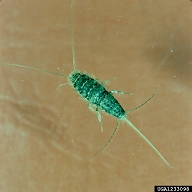
Firebrat, Thermobia Domestica
Firebrat
Source: www.forestryimages.org
The greatest known concentration of mitochondria is found in the cells of what is believed to be the functionally mature water vapour-absorbing epithelium of the posterior rectal (anal) sacs of the firebrat, Thermobia domestica. Water Vapor Absorption from sub-saturated air down to as low as 43% relative humidity (RH) is essential for the growth, development and survival of the Firebrat in hot, dry environments where liquid drinking water is lacking. (source: Journal of Insect Physiology)


The Mealworm Tenebrio molitor 
mealworm Tenebrio molitor
Source: http://www.ozanimals.com/Insect 
Water gain in several xeric insects, like the Mealworm, is accomplished through absorption of water vapor from the atmosphere. This absorption is predominant at the larvae stage of beetle development and is less predominant in the mature beetle.


Soil-Dwelling Anthropods

SnowBug
Source: http://soils.usda.gov 

Arthropods balance their water budget by actively absorbing water from highly unsaturated atmospheres. This animal maintains its body fluids hyperosmotic to its surroundings so that net water uptake occurs by passive diffusion along the gradient of water potential. The animal's basically manges glucose and myoinositol to effect large increases in osmotic pressure. This allows it to stay active in the same ranges of drought intensity like plants are capable of surviving. 


The above creatures are but a handful of nature's creations that live off water vapor in the atmosphere using  a specialized "condensation sac" and/or managing naturally occurring sugars (glucose) and materials synthesized from sugar e.g. myoinositol.


Do the above creations of nature hold the keys that we can use to guide our development of artificial machines that extract water vapor from the atmosphere?